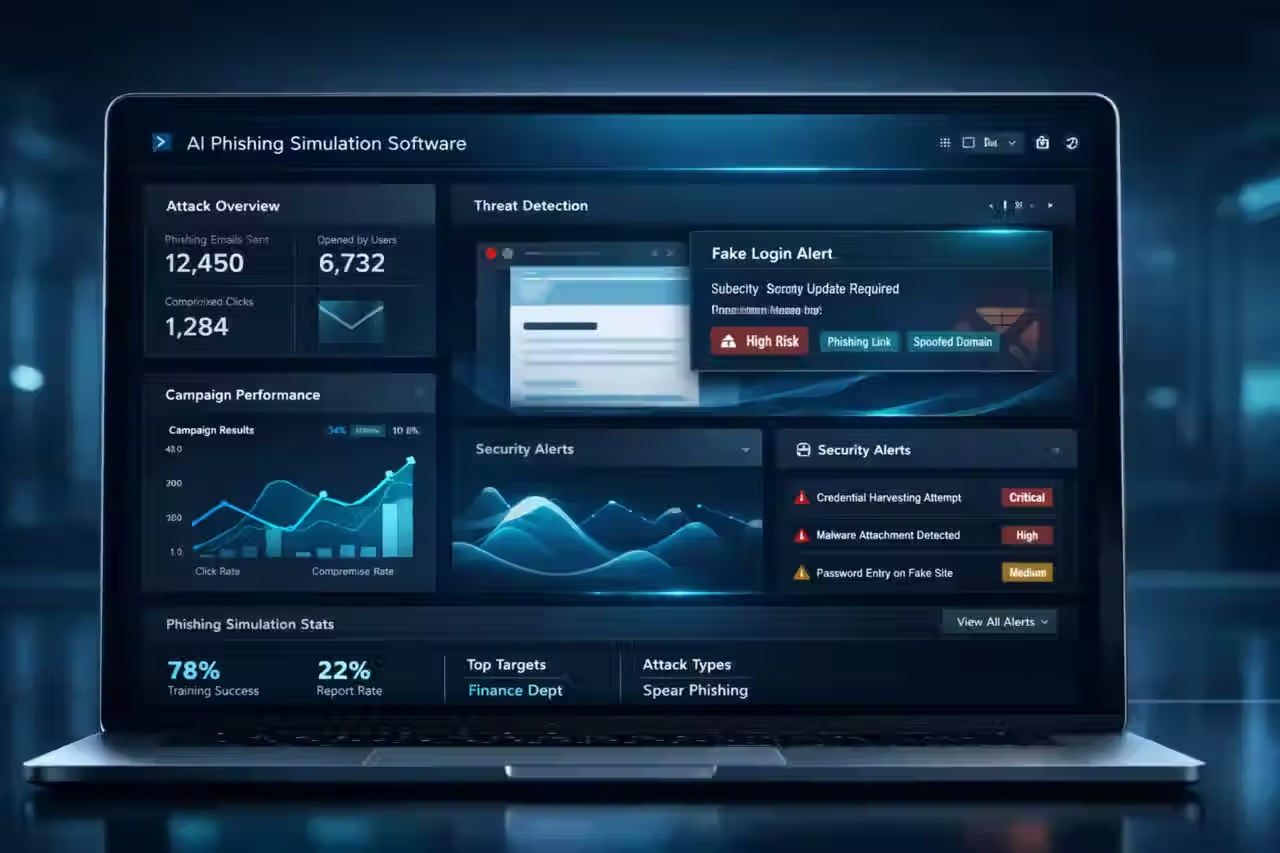
AI Phishing Simulation is full-stack, production-ready software for running AI-driven phishing simulations and security awareness training programmes. The backend is built with Python FastAPI, the frontend with React 18 and TypeScript, and the full stack runs on PostgreSQL 16 and Redis 7 behind an Nginx reverse proxy. A complete Docker Compose configuration covers all six services and a one-command setup gets the environment running. It is designed for developers and security teams who need a working codebase for corporate phishing simulation without building the infrastructure from scratch.
The AI layer uses Claude Opus via the Anthropic API across two core modules: a phishing email generator that produces personalized, per-target emails tailored to the recipient's name, department, job title, and company, with category selection (IT helpdesk, executive impersonation, SaaS credential harvesting, and more), configurable difficulty scoring, and explicit social engineering technique labeling; and a training advisor that analyzes each target's behavioral risk profile and recommends specific training modules for auto-enrollment. A RAG pipeline using all-MiniLM-L6-v2 embeddings retrieves similar template examples to provide retrieval-augmented context for generation. Behavioral risk scoring uses a weighted multi-factor model covering click rate, submission rate, report rate, and recency decay, supplemented by an IsolationForest anomaly detector for outlier identification.
The platform covers the full simulation workflow: a campaign wizard, a built-in email template library seeded with realistic templates across multiple attack categories, a landing page builder with credential-capture simulation, and four tracking event types — email open (tracking pixel), link click, credential submission, and user-reported phishing. All events stream to the dashboard in real time over WebSocket. Targets can be imported in bulk via CSV with up to 50,000 rows per upload using upsert logic. Employees who click are automatically enrolled in targeted training modules. Campaign and executive-level PDF reports are generated on demand using ReportLab. Three RBAC roles are included: super_admin, campaign_manager, and viewer. Async email dispatch and scheduled cleanup tasks run via Celery and Celery Beat with Redis as the queue backend. An Anthropic API key and a configured SMTP server are both required for full functionality.
Seed data included with the software — email templates, training modules, landing pages, and demo organizations — is synthetically generated. Synthetic data is used deliberately to ensure no real employee or organizational information is embedded in or distributed with the codebase, while providing realistic coverage across attack categories and difficulty levels from day one.
AI Phishing Simulation Software
Ownership. Seller retains all right, title, and interest in and to the software application, including all copyrights and other intellectual property rights. No ownership is transferred to Buyer.
License Grant. Upon payment, Seller grants Buyer a non-exclusive, non-transferable, perpetual license to use, modify, and internally reproduce the software application solely to build, operate, and maintain Buyer’s own closed-source product or service for Buyer’s internal business purposes or for services Buyer provides to Buyer’s customers.
Permitted Commercial Use. Buyer may use the software application as a component in a materially distinct end product or service, including a hosted SaaS or paid service, provided that:
(a) the end product is offered under Buyer’s own brand;
(b) the software application is not exposed, sold, licensed, or distributed on a standalone basis;
(c) Buyer’s customers receive only the functionality of Buyer’s end product or service, not the source code or reusable software itself; and
(d) the end product or service is not advertised, marketed, positioned, or offered as a substitute for, clone of, competing alternative to, or lower-priced or free version of Seller’s software application or any commercial version of Seller’s software application.
Restrictions. Buyer may not, and may not permit any third party to:
(a) sell, resell, license, sublicense, redistribute, publish, transfer, or otherwise make available the software application, in whole or in part, on a standalone basis;
(b) open-source, disclose, or provide access to the source code of the software application except to Buyer’s employees and contractors who are bound by written confidentiality obligations;
(c) use the software application, or any substantially similar version of it, to create or offer a competing developer tool, template, starter kit, boilerplate, clone, or other product whose primary value is substantially the same as the software application itself; or
(d) remove any proprietary notices contained in the software application.
Buyer IP. As between the parties, Buyer owns Buyer’s branding, content, data, and original code that Buyer independently creates for Buyer’s end product, excluding the software application and any portion derived directly from it. Seller retains all rights in the software application and all modifications to the software application itself.
No Support; No Warranty. THE SOFTWARE APPLICATION IS LICENSED “AS IS” AND “AS AVAILABLE,” WITHOUT WARRANTIES OF ANY KIND, EXPRESS OR IMPLIED, TO THE MAXIMUM EXTENT PERMITTED BY LAW. SELLER HAS NO OBLIGATION TO PROVIDE SUPPORT, MAINTENANCE, UPDATES, OR ENHANCEMENTS.
Termination. This license terminates automatically if Buyer materially breaches these terms. Upon termination, Buyer must stop using the software application itself, except that Buyer may continue operating an already-deployed end product for a reasonable wind-down period of 30 days unless the breach involves unauthorized distribution, disclosure, or competition.
Changes to Terms. Seller may update these license terms prospectively for future sales only. The version in effect on the purchase date governs Buyer’s license, unless Buyer later expressly agrees in writing to a new version.
