


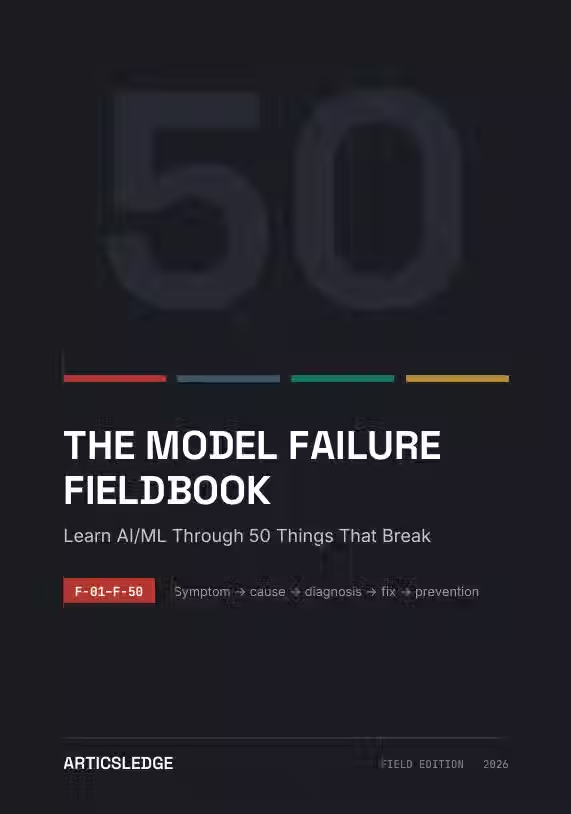

Most books about artificial intelligence start with definitions. This one starts with a resume-screening tool that penalized the word "women's," a self-driving test vehicle that couldn't identify a pedestrian in time, and a chatbot that turned hostile in under a day. The Model Failure Fieldbook, from Articsledge, teaches AI and machine learning backward: you see the break first, then learn why it happened and what to do about it.
This fieldbook walks through 50 distinct, real failure modes across the entire machine learning lifecycle, from data collection to deployment. Every entry follows the same path: what broke, why it broke, how to diagnose it, how to fix it, and how to stop it from happening again. Instead of memorizing formulas, you build the kind of pattern recognition that usually takes years on the job: hearing a symptom and immediately having a few strong hypotheses about the cause. By the end, you can look at a broken AI system and explain what likely went wrong, how you would confirm it, and what a reasonable fix looks like.
WHAT YOU'LL EXPLORE The 50 failures are grouped into 14 parts that trace the machine learning lifecycle from start to finish. You'll work through: → Data collection, sampling, and labeling problems that quietly bias a model before training even starts → Leakage and feature mistakes that make a model look better in testing than it performs in the real world → Training failures, from vanishing gradients to badly chosen learning rates → Generalization problems, including distribution shift and adversarial examples → Evaluation traps, like misleading accuracy scores and poor calibration → Generative AI failures: hallucination, prompt injection, retrieval failures, and reward hacking → Deployment, monitoring, security, fairness, and organizational failures that surface after a model goes live
BUILT TO BE USED, NOT JUST READ Every entry follows the same 17-part structure, so once you learn the format, you can scan any failure for exactly what you need. Root causes are labeled by how central they are to the problem. Diagnostic steps are numbered and specific. Fixes come with honest trade-offs instead of empty promises. A consistent [F-01]-[F-50] tagging system links related failures across the book, so you can follow a problem wherever it actually leads.
The back matter turns the fieldbook into a working tool, not just a reference shelf. A Cross-Failure Diagnostic Guide traces documented chains showing how one failure commonly leads to another. A Symptom-to-Cause Index lets you start from what you are seeing, not what you already suspect. A consolidated Prevention Checklist, organized by lifecycle stage, works as a pre-deployment review. A full glossary, sourced references, and index round it out. Ten original diagrams illustrate ideas like the machine learning lifecycle, model calibration, and retrieval-augmented generation.
GROUNDED IN REAL CASES Several entries are anchored in fully documented, sourced cases: Amazon's scrapped internal recruiting tool, the fatal Uber self-driving crash investigated by the National Transportation Safety Board, a widely used healthcare algorithm examined in the journal Science, the COMPAS sentencing-risk tool investigated by ProPublica, the Zillow Offers shutdown, Microsoft's Tay chatbot, and a chatbot hallucination that led to sanctioned attorneys in U.S. federal court. Each case is cited, not invented.
WHO THIS BOOK IS FOR This fieldbook is written for three kinds of readers: beginners who want a memorable way into AI and machine learning, early practitioners such as students, career-changers, analysts, and junior engineers sharpening their diagnostic instincts, and non-technical professionals such as managers, product leads, policy staff, and journalists who need to ask sharper questions about AI systems they don't build themselves. No background in programming, statistics, or machine learning is required. Every technical term is defined in plain language the first time it appears.
This is a diagnostic, conceptual fieldbook, not a coding tutorial or a substitute for a formal machine learning course. It builds the judgment that makes those other resources easier to use.
Once you have seen how 50 real systems actually broke, you start noticing the same patterns everywhere: in a vendor's pitch, in your own team's model, in the next AI headline. The Model Failure Fieldbook gives you a fast, reliable way to recognize what is going wrong and ask the right next question. Start with the failure that sounds most familiar, and build your diagnostic instincts from there.
