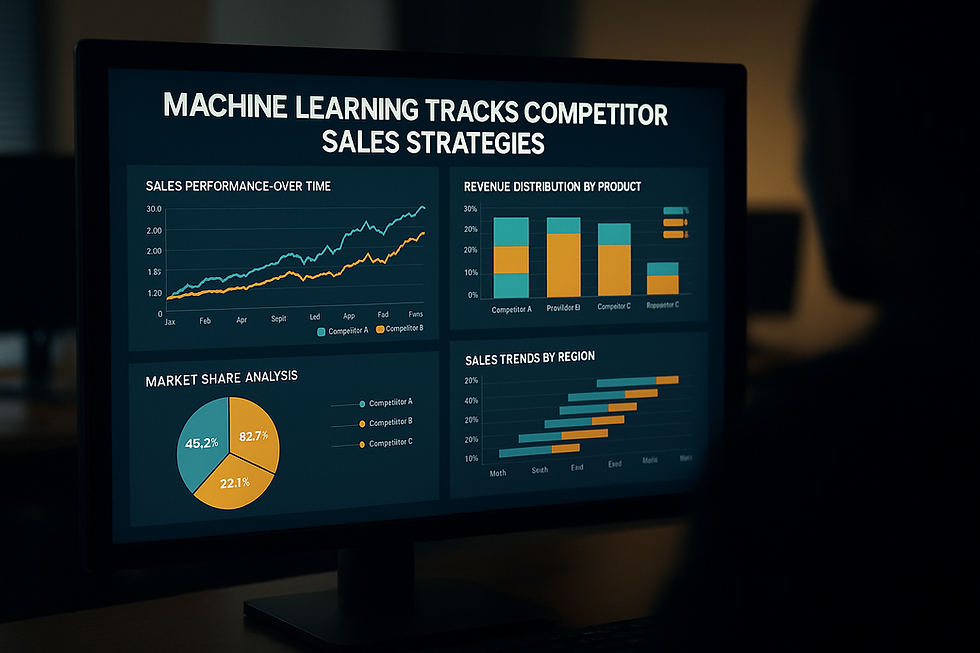
Machine Learning for Sales Data Overload: How to Turn Chaos into Sales Growth

Machine Learning for Sales Data Overload: How to Turn Chaos into Sales Growth
Sales teams today are not drowning in water. They’re drowning in data. And it’s not a graceful swim—it’s a desperate scramble. CRM fields that no one fills properly. Lead lists thousands long, yet cold as the Arctic. Dashboards that promise clarity but deliver confusion. Email open rates. Call logs. Funnel stages. Behavioral signals. Predictive scores. Pipeline stages. Clickstreams. Bounce rates. Retargeting stats.
You’ve got all of it. And yet you’ve got none of it—because it's too much to make sense of.
Salespeople are left overwhelmed. Managers are left frustrated. And growth? It slows down, choked by the very thing that was supposed to fuel it.
But here’s the truth that’s reshaping sales across the globe: Machine Learning isn’t just a luxury for big tech anymore. It’s the lifeboat for every sales team drowning in data.
Let’s break this down—real, raw, researched. No fluff. No fiction. Just how machine learning is finally turning sales data overload into a precision growth engine.
Bonus: Machine Learning in Sales: The Ultimate Guide to Transforming Revenue with Real-Time Intelligence
The Sales Data Explosion: A Blessing That Became a Curse
Let’s start here: the volume of sales data has exploded 70x in just the past decade according to IDC’s “Global Datasphere” report (2021). And by 2025, the global datasphere is expected to reach 181 zettabytes.
For sales, this means:
100s of touchpoints from just one customer journey
CRM fields that multiply every quarter
Activity logs across emails, calls, chats, demos, meetings
Website behavior data, enriched firmographics, purchase intent signals
Social media activity, ad interactions, retargeting footprints
The average enterprise sales team uses over 17 tools, according to the 2023 Gartner Sales Tech Stack Survey. The result? Fragmented data, conflicting signals, decision fatigue.
This isn’t just inefficient—it’s toxic. Sales reps spend over 64% of their time on non-selling tasks, much of it just filtering or organizing data (Salesforce State of Sales, 2023).
The sales profession is crying for clarity.
Machine Learning Isn’t Here to Replace—It’s Here to Rescue
Forget the fearmongering. Machine learning doesn’t replace reps—it rescues them from chaos. It doesn’t kill the art of selling—it gives it superpowers.
Machine learning algorithms, trained on historical patterns, can cut through the noise, spot what matters, and suggest the best action at the right moment.
How?
Let’s walk through the real-world, real-data ways.
1. Signal Overload? ML Finds the Gold in the Noise
Modern buyers leave a messy trail. Opened your email, clicked your link, visited your site, saw your ad, abandoned your cart, came back 3 days later via LinkedIn. Which of these signals really matter?
Machine learning models trained with classification algorithms (like Random Forests or Gradient Boosting Machines) can prioritize the highest converting behaviors—not just the most frequent ones.
Real Case Example:6sense, a B2B sales intelligence platform, uses machine learning to analyze millions of intent signals and assign predictive buying scores. In 2022, Cisco reported a 5x increase in opportunity pipeline accuracy after adopting 6sense’s ML-powered intent analysis engine. Source: Cisco & 6sense 2022 Joint Report.
2. Lead Scoring That Actually Works (Finally)
Traditional lead scoring is built on static rules like “Job title = 5 points.” But buying behaviors aren’t static. They're dynamic, evolving every quarter.
ML-based lead scoring models adjust in real-time—learning from actual closed-won data and identifying invisible patterns in behavior, timing, and sequence.
Real Case Example:HubSpot’s Predictive Lead Scoring model, released in 2017, improved lead-to-MQL conversion by up to 31% across early adopters by learning directly from past deals and contact activity. Source: HubSpot Engineering Blog, 2018.
3. Sales Forecasting That Isn’t Fantasy
Sales forecasting is where data overload kills strategy. With hundreds of reps logging deals, everyone guessing close dates, and pipeline stages getting misused—forecasts become fiction.
But ML-based forecasting models like XGBoost regression can take dozens of variables—deal age, rep performance, buyer behavior, deal size, past cycles—and predict revenue with precision.
Real Case Example:Microsoft Azure’s Sales AI Team reported a 20%+ reduction in forecasting error after deploying ML-based revenue prediction models across their B2B sales teams in 2021. Source: Microsoft Research, 2021.
4. Conversation Intelligence: ML Turns Talk Into Action
Every call a rep makes is a goldmine of intent, objections, competitor mentions, pricing discussions, hesitation. But managers can’t listen to them all.
Enter Natural Language Processing (NLP)—a field of machine learning that analyzes text and voice at scale.
Tools like Gong and Chorus use NLP to identify patterns across millions of calls, flag at-risk deals, and surface winning talk tracks.
Real Case Example:
Lucid Software used Gong’s ML-powered call analysis to refine sales messaging, resulting in a 27% increase in demo-to-close rates. Source: Gong.io Case Study, 2022.
5. Sales Rep Coaching: ML Spots Strengths and Struggles
Imagine knowing which reps talk too much, or miss objections, or handle pricing poorly—automatically.
Machine learning can analyze voice tone, interruption rates, talk-to-listen ratios, and objection handling to generate coaching heatmaps for managers.
Real Case Example:
Clari Copilot reported that customers using their ML-based rep coaching saw win rates improve by 19% and onboarding time reduce by 23% within 6 months. Source: Clari Case Study, 2023.
6. CRM Hygiene Becomes Self-Cleaning
Let’s be honest—CRM data entry is every rep’s nightmare. Incomplete fields, outdated contacts, wrong titles. Over 30% of B2B contact data goes stale annually (ZoomInfo, 2023).
Machine learning can detect anomalies, auto-fill missing fields, validate emails, even predict job changes.
Real Case Example:
People.ai uses machine learning to auto-capture sales activity (emails, meetings, calls) and enrich CRM fields without rep input. RingCentral, after implementation, reported 94% reduction in manual data entry and 100% CRM activity visibility. Source: People.ai Case Study, 2023.
7. From Reports to Real-Time Nudges
Sales dashboards are static. ML-driven sales tools are dynamic. They don’t just show you what happened—they tell you what’s about to happen, and what to do next.
Platforms like Salesforce Einstein, Zoho Zia, and Outreach Kaia use ML to send real-time alerts:
“This deal is slipping—buyer hasn't replied in 6 days”
“This customer just visited pricing page—follow up now”
“Your last 3 calls to this persona failed—try email”
These aren’t just cool features. They’re focus-restorers.
8. Dynamic Pricing and Personalized Offers
Sales reps often rely on gut or playbooks for pricing. But machine learning models can analyze buyer profiles, past deals, discounting trends, deal velocity—and suggest the optimal price or offer with the highest probability of closing.
Real Case Example:
Coca-Cola HBC, using ML from SAP Sales Cloud, increased deal profitability by 5.2% by implementing dynamic pricing recommendations based on historical patterns and competitor moves. Source: SAP Customer Success Story, 2022.
9. Turn Data Chaos Into Growth—with Strategy, Not Just Software
This isn’t about buying a tool and hoping for miracles. It’s about building a strategy around your specific data chaos.
Here’s how real teams do it:
Audit Your Data Universe
Where is your data coming from? What’s redundant, stale, missing?
Identify High-Impact ML Use Cases
Lead scoring? Forecasting? Deal alerts? Start with one and scale.
Partner with Experts (Not Just Vendors)
A good ML vendor doesn’t just sell you a platform—they co-create models with your data.
Prioritize Change Management
Train your reps. Demystify ML. Celebrate early wins. Turn fear into excitement.
Monitor and Retrain Models
Sales patterns evolve. So must your ML models. Use feedback loops.
This Is Already Happening—Across Industries
HP Inc. deployed ML-based lead routing and increased close rates by 6%, reducing sales cycle by 2.5 weeks.Source: Salesforce Blog, 2022
Zendesk used ML-powered enrichment to reduce rep time on lead research by 42%.Source: Zendesk Relate Conference 2023
DocuSign implemented real-time ML sales nudges and increased rep productivity by 22%.Source: DocuSign Investor Report, 2022
Sales Leaders, This Isn’t Optional Anymore
If you’re still relying on static dashboards, gut-feel forecasts, and reps drowning in spreadsheets—it’s not just inefficient. It’s costing you revenue.
The ML revolution in sales is not about replacing humans. It’s about freeing them. Freeing them from chaos. Freeing them to sell. To connect. To close. To grow.
Sales used to be about intuition. Now, it’s about augmented intuition.
Let machine learning do the thinking, so your team can do the selling.
Final Word
You don’t need more dashboards. You need less noise and more clarity. You don’t need more data. You need better decisions. And machine learning—trained on your own history, behavior, and outcomes—is your smartest, fastest, most tireless ally.
This is not a future promise. It’s happening right now, all around you. Teams that embrace ML are outselling, outmaneuvering, and outperforming their competitors.
And the ones that don’t? They’ll get buried under the very data they once celebrated.