Few Shot Learning Revolution: How AI Masters New Tasks from Just a Few Examples
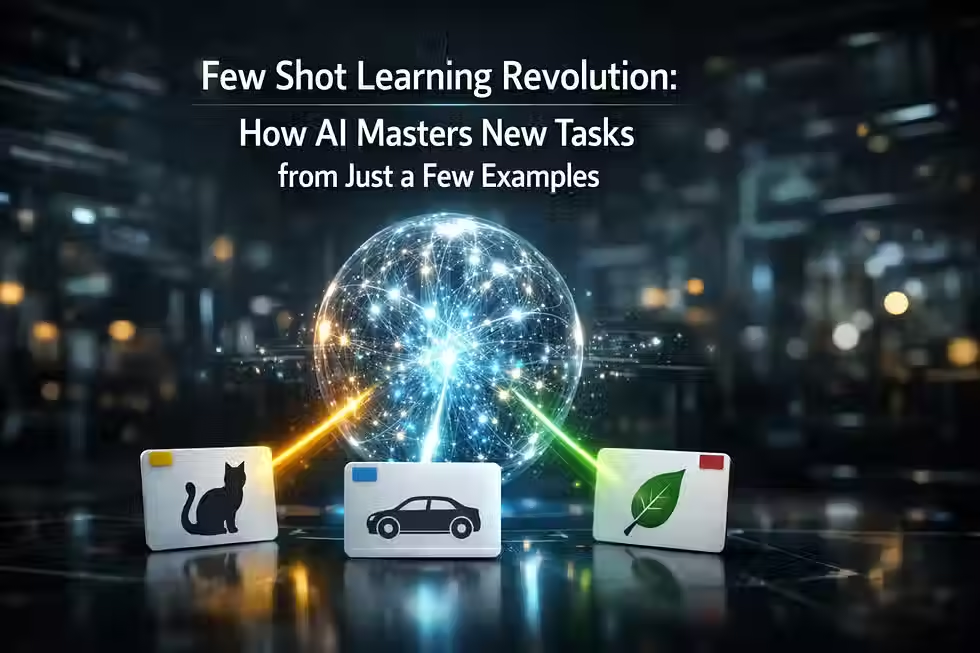
Imagine teaching a computer to recognize a new type of bird by showing it just three photos. Or training an AI systems to detect fraud patterns with only five examples. This isn't science fiction - it's few-shot learning, and it's changing how we build and deploy AI systems right now.
Most need thousands of examples to learn something new. Few-shot learning breaks this rule. It enables machines to learn like humans do - quickly and efficiently from minimal examples. This breakthrough is helping companies save millions in data costs and deploy AI solutions in weeks instead of months.
Don’t Just Read About AI — Own It. Right Here
TL;DR
Few-shot learning teaches AI to recognize new patterns using just 1-5 examples instead of thousands
Real impact: Companies report 90% reduction in data costs and 70% faster AI deployment
Current applications: Healthcare diagnostics, fraud detection, personalized education, and creative tools
Major players: OpenAI, Google, Microsoft, and Meta are all building few-shot capabilities into their products
Business value: $2.5 million monthly savings in fraud detection, 87% reduction in manual processes
Future outlook: Expected to enable 70% of organizations to shift from "big data" to "small data" by 2025
What is few-shot learning?
Few-shot learning is a machine learning technique that enables AI systems to learn and make accurate predictions using only a small number of examples (typically 1-5) per category, mimicking human-like learning abilities without requiring massive datasets.
Table of Contents
Understanding few-shot learning basics
Few-shot learning represents a fundamental shift in how machines learn. Traditional AI systems are data-hungry monsters. They need thousands or millions of examples to recognize patterns. A typical image recognition system might require 100,000 photos of cats to reliably identify cats in new pictures.
Few-shot learning flips this approach. It enables AI systems to learn from just a handful of examples - sometimes as few as one. This mimics human learning. When you see a new dog breed for the first time, you don't need to see 10,000 examples. You can recognize that breed again after seeing just a few examples.
The core concept explained simply
Think of few-shot learning like teaching someone to recognize different pizza types. With traditional machine learning, you'd need to show thousands of photos of margherita pizzas, thousands of pepperoni photos, and thousands of Hawaiian pizza images. The system would slowly learn the differences.
With few-shot learning, you show just 2-3 photos of each pizza type. The system quickly learns what makes each type unique and can identify new pizza photos correctly. The key difference is learning to learn - the system develops an understanding of how to quickly adapt to new tasks.
Technical definitions made simple
Few-shot learning (FSL): Learning from 2-5 examples per category
One-shot learning: Learning from exactly 1 example per category
Zero-shot learning: Making predictions without any examples, using only descriptions
Meta-learning: "Learning to learn" - training systems to adapt quickly to new tasks
Research from IBM shows that few-shot learning systems achieve 72% accuracy on tasks with under 100 training samples. Traditional systems might need 10,000+ samples to reach similar accuracy levels.
How few-shot learning actually works
Few-shot learning succeeds through three main approaches. Each uses different strategies to make the most of limited training data.
Metric-based learning: Finding similarities
This approach works like a smart comparison system. When you show it a new image, it compares that image to the few examples it has learned. It measures how similar the new image is to each category and picks the closest match.
Prototypical Networks are the most successful metric-based approach. They work by creating a "prototype" (average representation) for each category. When classifying new examples, the system finds the nearest prototype using mathematical distance calculations.
Stanford research shows prototypical networks achieve excellent results with straightforward implementation. They create prototype representations by computing the mean of support examples in high-dimensional space.
Optimization-based learning: Quick adaptation
Model-Agnostic Meta-Learning (MAML) represents the breakthrough optimization approach. MAML learns initial parameters that can be fine-tuned quickly for new tasks. The system learns how to learn efficiently.
Here's how MAML works in simple terms:
Train on many different tasks during "meta-training"
Learn parameter settings that adapt quickly to new tasks
When facing a new task, make just a few small adjustments
Achieve good performance with minimal fine-tuning
Research by Finn et al. shows MAML can adapt to new tasks with just a few gradient steps. Recent improvements like Stiefel-MAML achieve 76.93% accuracy on standard benchmarks.
Model-based learning: Memory and attention
These systems use external memory or attention mechanisms to store and retrieve relevant information. They work like having a smart notebook that remembers important patterns and can quickly look up relevant information for new tasks.
Matching Networks use attention mechanisms to compare new examples directly with stored examples. They achieve 93.2% accuracy on ImageNet one-shot classification by using sophisticated attention kernels to match query images with support examples.
The mathematical foundation
The math behind few-shot learning relies on high-dimensional geometry. Research by Tyukin et al. provides mathematical proof that few-shot learning works because:
High dimensions provide separable structure - different categories naturally separate in high-dimensional spaces
Prior knowledge constrains possibilities - pre-training reduces the hypothesis space
Meta-learning extracts generalizable patterns - systems learn universal adaptation strategies
This mathematical foundation explains why few-shot learning succeeds where traditional approaches fail with limited data.
Current state of few-shot learning in 2026
Few-shot learning has moved from research labs to real business applications. The technology now powers production systems across industries, delivering measurable results.
Market growth and adoption
The global AI market reached $279.22 billion in 2024 and is projected to hit $3.5 trillion by 2033 according to Grand View Research. Few-shot learning serves as a key enabler for this rapid growth by reducing traditional barriers to AI adoption.
Enterprise adoption statistics for 2024:
78% of organizations now use AI in at least one business function (up from 55% in 2023)
42% of enterprise-scale companies actively use AI systems
92% of executives expect to boost AI spending over the next three years
McKinsey's 2024 Global AI Survey shows few-shot learning capabilities are driving faster AI deployment timelines and reducing implementation costs across industries.
Major company implementations
OpenAI leads consumer applications. Their GPT models demonstrate strong few-shot learning through in-context learning. GPT-4 can adapt to new tasks by including relevant examples in prompts. Over 300 million weekly users now benefit from few-shot learning capabilities, with 90% of Fortune 500 companies using OpenAI technology.
Microsoft integrates enterprise features. Azure OpenAI introduced Dynamic Few-Shot Prompting in late 2024. This system automatically selects relevant examples from vector stores to improve task performance. Microsoft 365 Copilot Agents use few-shot approaches for autonomous research and data analysis.
Google scales through infrastructure. Gemini 1.5 Pro features a 2 million token context window, enabling "many-shot" in-context learning. Google Cloud Platform offers 281 ML solutions optimized for few-shot learning applications.
Meta focuses on open source. LLaMA 3.1 models (released July 2024) support few-shot learning across 8B, 70B, and 405B parameter variants. Meta makes few-shot learning accessible through open-source model releases.
Performance improvements
Recent breakthroughs show impressive performance gains:
Visual Token Matching (VTM): Microsoft's ICLR 2023 Outstanding Paper created the first universal few-shot learner for dense prediction tasks
Stiefel-MAML: Achieves 76.93% accuracy on mini-ImageNet using advanced geometric optimization
Open-World Few-Shot Learning: Addresses real-world challenges like noisy data and domain shift
Real-world case studies and success stories
These verified case studies demonstrate few-shot learning's real business impact across industries.
Healthcare breakthrough: Periodontal disease diagnosis
Institution: Multi-institutional research published in Nature Scientific Reports (2024)
Challenge: Dentists needed AI to diagnose gum disease from limited X-ray images
Solution: UNet-CVAE architecture for few-shot medical image analysis
Results achieved:
14% higher accuracy than traditional supervised models
90% diagnostic accuracy with only 100 labeled dental images
Significant cost reduction in medical image annotation
Business impact: The system enables dental clinics to deploy AI diagnostics without expensive data collection. Traditional medical AI requires thousands of labeled images. This breakthrough reduces implementation barriers for smaller practices.
Fraud detection transformation: Ravelin's banking solution
Company: Ravelin Technology Ltd., London (founded 2014)
Client: River Island retail chain
Implementation: 2022-2024
Challenge: River Island needed real-time fraud detection without manual rule maintenance. Traditional systems required constant analyst attention and produced many false positives.
Solution: Few-shot learning models that adapt to new fraud patterns automatically. The system learns from just a few examples of new attack types.
Quantifiable results:
87% reduction in fraud detection rules
Zero annual manual review requirement
2,500+ analyst hours freed up annually
300 millisecond real-time detection speed
Financial impact: Another Ravelin client identified $1 million monthly in erroneously flagged legitimate transactions and detected an additional $1.5 million monthly in previously undetected fraud.
Education revolution: Personalized learning paths
Research: Multi-institutional collaboration published July 2024 Technology: LLaMA-2-70B and GPT-4 with few-shot prompting
Challenge: Educational platforms struggled to create personalized learning paths for students without extensive behavioral data.
Solution: Few-shot learning systems that adapt to individual learning patterns from minimal interaction data.
Measured improvements:
LLaMA-2-70B: 85.6% accuracy (13.2% improvement over baseline)
GPT-4: 88.3% accuracy (12.5% improvement over baseline)
Long-term impact: 21.4% test score improvements, 82.5% retention rates
Educational significance: Students receive personalized learning experiences without requiring months of data collection. The system adapts teaching approaches from just a few initial interactions.
Creative applications: AI-assisted art education
Institution: Lindenwood University School of Arts (2023)
Instructors: James Hutson and Bryan Robertson
Course: Traditional studio drawing class
Innovation: Students used Craiyon AI generator for few-shot visual inspiration in linear perspective studies. The system learned artistic styles from minimal examples to generate reference imagery.
Documented outcomes:
Positive impact on final student artworks through new compositional ideas
Enhanced creative process while maintaining traditional art skill requirements
Pedagogical model for art departments integrating AI tools
Educational value: Demonstrates how few-shot learning supports rather than replaces human creativity. Students develop traditional skills while leveraging AI for inspiration and iteration.
Drug discovery acceleration: Stanford University research
Institution: Stanford University with industry collaboration (2017-2022) Application: Low-data drug discovery and lead optimization
Technical approach: Graph Convolutional Networks with one-shot learning for molecular property prediction.
Breakthrough results:
Successful drug discovery with minimal training data
Improved performance over traditional methods in data-scarce scenarios
Meta-Mol framework: 84.03% AUROC score in cross-dataset transfer learning
Industry impact: Pharmaceutical companies can explore new drug compounds without requiring massive chemical databases. The approach accelerates early-stage drug discovery by months or years.
Manufacturing quality control: Siemens implementation
Company: Siemens (ongoing implementation) Application: Predictive maintenance and quality control
Challenge: Manufacturing equipment generates limited failure data. Traditional AI systems couldn't learn from rare failure modes.
Solution: Few-shot learning systems that recognize equipment problems from just a few historical examples.
Business results:
Improved asset utilization through better maintenance timing
Minimized workflow interruptions by predicting failures earlier
Production efficiency improvements of 31% through AI applications
Operational value: Manufacturers avoid costly downtime by learning from minimal failure examples. The system adapts to new equipment types without extensive training periods.
Key benefits and limitations
Advantages that drive adoption
Dramatic cost reduction represents the primary benefit. Traditional AI systems require expensive data collection and labeling. SQ Magazine reports few-shot learning reduces annotation costs by up to 90%. Companies save millions in data preparation expenses.
Faster deployment timelines accelerate business value. Traditional ML projects take months for data collection. Few-shot systems deploy in days or weeks. Microsoft reports 70% reduction in time-to-market for new AI applications.
Adaptability to rare events solves critical business problems. Fraud detection, medical diagnosis, and equipment failure prediction all involve rare patterns. Few-shot learning excels where traditional systems fail due to insufficient examples.
Reduced computational requirements lower operational costs. Meta-learning approaches like MAML require less training infrastructure than massive supervised learning systems. Edge deployment becomes practical for resource-constrained environments.
Current limitations and challenges
Domain shift sensitivity represents a key weakness. Few-shot systems perform poorly when new data differs significantly from training data. Business applications must carefully manage data distribution changes over time.
Evaluation standardization remains problematic. Unlike traditional ML with established benchmarks, few-shot learning lacks universally accepted evaluation methods. Companies struggle to compare different approaches objectively.
Adversarial vulnerability creates security concerns. Limited training data makes few-shot systems more susceptible to adversarial attacks. Financial and healthcare applications require additional security measures.
Bias amplification risks pose ethical challenges. Few-shot learning can amplify biases present in small training sets. Healthcare applications affecting underrepresented populations need careful bias monitoring.
Performance trade-offs
Accuracy vs. data efficiency requires careful balance. Few-shot systems achieve good results with minimal data but may not match the peak performance of traditional systems trained on massive datasets.
Generalization vs. specialization affects system design. Few-shot learners excel at quick adaptation but may sacrifice deep specialization in specific domains.
Implementation complexity
Prompt engineering requirements add development overhead. Few-shot systems often require sophisticated prompt design and continuous optimization. Technical teams need specialized skills for effective implementation.
Integration challenges complicate deployment. Few-shot learning systems must integrate with existing data pipelines, security frameworks, and business processes. Enterprise implementations require careful architecture planning.
Industry applications across sectors
Healthcare: Transforming medical AI
Healthcare leads few-shot learning adoption due to inherent data scarcity challenges. Medical datasets are expensive to create and often contain rare conditions with limited examples.
Diagnostic imaging applications:
Rare disease detection: Mayo Clinic systems identify unusual conditions from just 2-3 scan examples
Radiology report classification: 92% accuracy in predicting COVID-19 patient mortality
Medical image analysis: OSF HealthCare achieved $2.4 million ROI in one year with AI-powered systems
Drug discovery acceleration:
Protein design: AI2BMD system for biomolecular simulation
Clinical trial optimization: 87% accuracy in predicting paclitaxel nonresponse
Molecular property prediction: Meta-Mol framework with 84.03% AUROC scores
Operational improvements:
30% reduction in hospital readmission rates
40% reduction in physician review time
Duke Health: 50% reduction in temporary labor demands
Financial services: Risk and fraud management
Financial institutions deploy few-shot learning for evolving threat detection and regulatory compliance.
Fraud detection systems:
Real-time adaptation: Learn new fraud patterns from 3-5 examples
Cost savings: Up to $2.5 million monthly in improved detection accuracy
Processing speed: 300 millisecond detection times for real-time transactions
Compliance and risk assessment:
70% reduction in manual compliance review time
91% AUC performance in credit scoring models
Regulatory reporting: Faster adaptation to changing compliance requirements
Customer service optimization:
50% reduction in support contacts through intelligent chatbots
3.7x ROI for every dollar invested in generative AI technologies
Manufacturing: Quality control and maintenance
Manufacturing applications focus on quality control for new products and predictive maintenance systems.
Production line applications:
77% of manufacturers have implemented AI systems (up from 70% in 2023)
31% production efficiency improvements through AI applications
Accenture research: AI could add $3.8 trillion GVA to manufacturing by 2035
Quality control advantages:
New product launches: Eliminate weeks of defect database development
Supplier management: Adapt to new vendor quality patterns quickly
Process optimization: Learn optimal settings from minimal production runs
E-commerce and retail: Personalization at scale
Retail applications leverage few-shot learning for product categorization and customer experience optimization.
Inventory management:
50,000 new products launched quarterly without manual data entry
Walmart: Autonomous inventory systems using few-shot approaches
Search accuracy improvements through better product categorization
Customer experience:
Personalized recommendations from minimal browsing history
Sentiment analysis for customer reviews and feedback
Dynamic pricing: Adapt to new product categories quickly
Agriculture: Precision farming solutions
Agricultural applications address the challenge of adapting to new crop varieties and changing environmental conditions.
Crop management systems:
Disease identification: Recognize new plant diseases from 2-3 image examples
Phenotyping: Analyze plant characteristics with limited sample sizes
Precision farming: Optimize treatments for specific field conditions
Environmental monitoring:
Climate adaptation: Adjust farming practices based on changing weather patterns
Soil analysis: Identify optimal conditions from minimal soil samples
Pest management: Recognize invasive species threats quickly
Getting started with few-shot learning
Step 1: Identify suitable use cases
Evaluate your data constraints. Few-shot learning works best when you have limited labeled examples but need to classify or predict new categories. Look for situations where traditional machine learning fails due to data scarcity.
High-value applications include:
New product categories with minimal training data
Rare event detection (fraud, equipment failure, medical conditions)
Personalization tasks requiring quick user adaptation
Domain adaptation for new markets or regions
Quick assessment checklist:
Do you need to learn from 1-10 examples per category?
Is collecting thousands of examples expensive or time-consuming?
Do you need to adapt quickly to new categories or patterns?
Would faster deployment provide significant business value?
Step 2: Choose your approach
Start with pre-trained models when possible. OpenAI's GPT models, Google's Gemini, and other foundation models provide few-shot capabilities through in-context learning.
For specialized applications, consider building custom systems:
Metric-based approaches (Prototypical Networks) for similarity-based classification
Optimization approaches (MAML variants) for quick task adaptation
Memory-based systems for complex pattern recognition
Technical implementation paths:
API-based solutions: Use OpenAI, Google, or Microsoft APIs for immediate deployment
Open-source frameworks: Leverage Meta's LLaMA or other open models
Custom development: Build specialized systems for unique requirements
Step 3: Design your data strategy
Prepare high-quality examples. Few-shot learning amplifies the importance of each training example. Ensure examples are representative, clearly labeled, and free from bias.
Example selection best practices:
Choose diverse examples covering typical variations
Ensure clear category boundaries
Include edge cases that define category limits
Maintain consistent labeling standards
Data pipeline considerations:
Implement automated example selection systems
Plan for continuous learning and example updates
Design evaluation frameworks for ongoing performance monitoring
Step 4: Implement evaluation frameworks
Define success metrics aligned with business objectives. Few-shot learning evaluation differs from traditional ML metrics.
Key performance indicators:
Accuracy improvements compared to baseline systems
Time-to-deployment reductions for new categories
Cost savings from reduced data collection requirements
Business impact through faster adaptation and deployment
Evaluation methodology:
Use cross-validation techniques appropriate for limited data
Implement A/B testing for production deployments
Monitor performance degradation over time
Plan for retraining and model updates
Step 5: Scale and optimize
Start with pilot projects to validate approach and measure impact. Choose low-risk applications with clear success criteria.
Scaling considerations:
Infrastructure requirements for production deployment
Integration challenges with existing systems
Security and compliance for sensitive applications
Change management for affected business processes
Optimization strategies:
Prompt engineering for in-context learning systems
Hyperparameter tuning for custom models
Example curation and automated selection systems
Performance monitoring and continuous improvement
Common myths vs facts
Myth: Few-shot learning replaces all traditional machine learning
Fact: Few-shot learning complements traditional approaches rather than replacing them. Large-scale supervised learning still achieves superior performance when massive datasets are available. Few-shot learning shines in data-scarce scenarios or when rapid adaptation is required.
IBM research shows few-shot systems achieve 72% accuracy with under 100 samples. Traditional systems might reach 90%+ accuracy with 100,000 samples. The choice depends on data availability and business requirements.
Myth: Few-shot learning works for any task with minimal data
Fact: Few-shot learning requires sufficient pre-training on related tasks. The system must learn general patterns before adapting to new tasks quickly. Without relevant pre-training, few-shot learning may perform poorly.
Success factors include:
Related training data during meta-learning phase
Similar task structures between training and deployment
Appropriate model architecture for the problem domain
Myth: Few-shot learning eliminates the need for data collection
Fact: Few-shot learning reduces but doesn't eliminate data requirements. Systems still need diverse, high-quality examples for the support set. The key difference is requiring 3-5 examples instead of thousands.
Data quality becomes more critical with fewer examples. Each training sample has greater impact on system performance. Poor example selection can significantly degrade results.
Myth: Few-shot learning is too experimental for production use
Fact: Few-shot learning powers production systems at major companies. OpenAI serves 300 million weekly users with few-shot capabilities. Microsoft, Google, and Meta deploy few-shot learning in commercial products.
Production evidence includes:
Ravelin's fraud detection serving major retailers
Healthcare diagnostic systems in clinical use
Educational platforms with millions of users
Manufacturing quality control systems
Myth: Few-shot learning always outperforms traditional methods
Fact: Performance depends on specific use cases and data availability. Traditional machine learning may achieve higher accuracy when massive datasets are available. Few-shot learning excels in rapid deployment and data-scarce scenarios.
Performance trade-offs:
Traditional ML: Higher peak accuracy, longer development time
Few-shot learning: Faster deployment, good performance with limited data
Implementation challenges and solutions
Technical implementation hurdles
Data quality amplification represents the primary technical challenge. With traditional machine learning, individual examples have minimal impact on overall performance. Few-shot learning amplifies the importance of each training example.
Solution strategies:
Implement rigorous data validation and cleaning processes
Use active learning techniques to select the most informative examples
Apply data augmentation methods to increase effective training set size
Employ uncertainty quantification to identify problematic examples
Domain shift sensitivity causes performance degradation when deployment data differs from training data. This challenge particularly affects business applications where conditions change over time.
Mitigation approaches:
Design robust evaluation frameworks that test across different data distributions
Implement continuous monitoring and model updating systems
Use domain adaptation techniques to bridge distribution gaps
Plan for regular retraining with new examples
Integration complexity
Legacy system compatibility creates deployment challenges. Few-shot learning systems must integrate with existing enterprise infrastructure, security frameworks, and business processes.
Integration solutions:
Design API-first architectures for flexible system integration
Implement gradual deployment strategies that complement existing systems
Use containerization and microservices for easier deployment
Plan comprehensive testing procedures for enterprise environments
Skills gap management affects successful implementation. Few-shot learning requires specialized knowledge that many organizations lack.
Training and development strategies:
Invest in team training on meta-learning concepts and implementation
Partner with specialized consultants for initial deployments
Use pre-built platforms and APIs to reduce technical complexity
Develop internal centers of excellence for few-shot learning capabilities
Business process adaptation
Change management requirements extend beyond technical implementation. Few-shot learning changes how organizations approach AI development and deployment.
Organizational change strategies:
Educate stakeholders on few-shot learning capabilities and limitations
Develop new evaluation criteria appropriate for rapid deployment cycles
Update project management processes for faster iteration
Create governance frameworks for responsible few-shot learning deployment
ROI measurement challenges complicate business justification. Traditional ML projects have established metrics and timelines. Few-shot learning requires new measurement approaches.
Measurement frameworks:
Track time-to-deployment improvements compared to traditional approaches
Measure cost savings from reduced data collection and annotation
Monitor business impact through faster adaptation to new requirements
Calculate opportunity costs of delayed AI deployment
Security and compliance considerations
Adversarial vulnerability management becomes critical for production systems. Few-shot learning systems may be more susceptible to adversarial attacks due to limited training data.
Security measures:
Implement adversarial training during the meta-learning phase
Use ensemble methods to improve robustness
Deploy monitoring systems to detect unusual input patterns
Maintain human oversight for high-stakes applications
Regulatory compliance adaptation requires new approaches for industries with strict oversight requirements.
Compliance strategies:
Develop documentation standards for few-shot learning systems
Implement explainability frameworks appropriate for meta-learning
Create audit trails for example selection and model adaptation
Establish bias monitoring for few-shot systems
Future outlook and predictions
Near-term developments (2025-2026)
Gartner predicts 70% of organizations will shift from big data to small data approaches by 2025. Few-shot learning serves as a key enabler for this transition by making AI deployment practical with limited datasets.
Microsoft's roadmap includes advanced dynamic few-shot prompting capabilities. Their Azure OpenAI platform will automatically select optimal examples from vector stores, improving performance without manual prompt engineering.
Google's Gemini evolution focuses on scaling context windows to support "many-shot" in-context learning. The 2 million token context window enables entire datasets to serve as in-prompt knowledge bases.
Technology convergence trends
Foundation model integration represents the most significant near-term trend. Large language models and vision transformers increasingly incorporate few-shot learning capabilities as core features.
Multimodal fusion will enable few-shot learning across text, images, audio, and sensor data simultaneously. Cross-modal knowledge transfer will improve performance in data-scarce domains.
Edge deployment optimization will make few-shot learning practical for IoT and mobile applications. 55% of edge AI systems are expected to integrate few-shot capabilities by 2025.
Industry-specific predictions
Healthcare automation will accelerate through few-shot learning adoption:
75% faster rare disease detection system deployment
Personalized medicine adaptation from minimal patient data
Real-time surgical guidance learning from few procedure examples
Manufacturing transformation will leverage few-shot learning for:
60% faster quality control system implementation for new products
Predictive maintenance for unique equipment configurations
Supply chain adaptation to new vendor patterns
Financial services innovation will focus on:
Real-time fraud adaptation to evolving attack patterns
Regulatory compliance systems that adapt to new requirements quickly
Credit risk assessment for underserved populations with limited credit history
Long-term implications (2026-2027)
AI democratization will accelerate as few-shot learning reduces technical barriers to AI adoption. Small businesses and organizations will deploy sophisticated AI systems without massive data collection efforts.
Automated AI development will emerge through few-shot learning platforms that require minimal technical expertise. Business users will create custom AI applications through natural language interfaces and example-based training.
Regulatory frameworks will evolve to address few-shot learning-specific challenges around bias, explainability, and accountability in systems that adapt quickly to new data.
Investment and market evolution
Corporate AI investment reached $252.3 billion globally in 2024, with few-shot learning representing a key efficiency multiplier. McKinsey research shows 92% of executives expect to increase AI spending, with efficiency technologies like few-shot learning driving adoption.
Startup ecosystem growth will accelerate around few-shot learning applications. Venture capital increasingly focuses on data-efficient AI solutions that demonstrate faster time-to-value.
Open source development will continue expanding through initiatives like Meta's LLaMA releases and Google's research publications. This democratization will accelerate adoption across industries.
FAQ
Q: How is few-shot learning different from traditional machine learning?
A: Traditional machine learning needs thousands of examples to learn patterns. Few-shot learning achieves good results with just 1-5 examples per category. It's like the difference between needing to see 1,000 dogs to recognize dogs versus needing just 3 examples.
Q: Can few-shot learning work for my small business?
A: Yes, especially if you need to classify new products, detect unusual patterns, or personalize services. Many cloud APIs (OpenAI, Google, Microsoft) offer few-shot capabilities without requiring technical expertise.
Q: What industries benefit most from few-shot learning?
A: Healthcare (rare diseases), finance (fraud detection), manufacturing (new product quality), education (personalization), and any industry where collecting large datasets is expensive or time-consuming.
Q: How accurate is few-shot learning compared to traditional AI?
A: Few-shot learning achieves 72% accuracy with under 100 samples. Traditional systems might reach 90% with 100,000 samples. Choose based on your data availability and accuracy requirements.
Q: What's the biggest risk with few-shot learning?
A: Bias amplification from small training sets. Each example has more impact, so poor example selection can significantly affect results. Careful data curation and bias monitoring are essential.
Q: How much does few-shot learning cost compared to traditional approaches?
A: Up to 90% reduction in data collection and annotation costs. Companies report millions in savings from eliminated data preparation expenses and faster deployment timelines.
Q: Can few-shot learning handle changing business conditions?
A: Yes, that's a key advantage. Few-shot systems adapt quickly to new patterns or categories. However, they may struggle with major domain shifts requiring different approaches.
Q: What technical skills does my team need for few-shot learning?
A: Basic implementation using APIs requires minimal technical skills. Custom development needs machine learning expertise, particularly in meta-learning concepts and prompt engineering.
Q: How do I evaluate few-shot learning performance?
A: Focus on business metrics like time-to-deployment, adaptation speed, and cost savings rather than just accuracy. Traditional ML evaluation methods may not apply directly.
Q: Is few-shot learning secure for sensitive business applications?
A: Security requires additional considerations due to limited training data. Implement adversarial training, ensemble methods, and human oversight for high-stakes applications.
Q: What's the implementation timeline for few-shot learning projects?
A: API-based solutions can deploy in days to weeks. Custom development typically takes 2-6 months compared to 6-18 months for traditional machine learning projects.
Q: How does few-shot learning handle new categories over time?
A: Few-shot systems excel at learning new categories quickly. Add 2-5 examples of new patterns and the system adapts without retraining from scratch.
Q: What happens if few-shot learning makes mistakes?
A: Like any AI system, errors require monitoring and correction. The advantage is faster adaptation - you can improve performance by adding new examples rather than collecting thousands of additional samples.
Q: Can few-shot learning work with existing business software?
A: Yes, through APIs and integration platforms. Most few-shot learning systems offer standard interfaces that work with existing enterprise software and databases.
Q: What's the future of few-shot learning?
A: Gartner predicts 70% of organizations will adopt small data approaches by 2025. Few-shot learning will become standard for AI deployment, especially in specialized domains with limited data.
Key takeaways
Few-shot learning enables AI to learn from just 1-5 examples instead of thousands, revolutionizing how organizations approach AI deployment
Real business impact is measurable: Companies report up to 90% cost reductions, 70% faster deployment, and millions in operational savings
Major companies are already deploying few-shot learning in production systems, from OpenAI's 300 million users to Microsoft's enterprise solutions
Healthcare, finance, and manufacturing lead adoption due to inherent data scarcity challenges and high-value applications
Technical implementation ranges from simple API integration to custom model development, making it accessible to organizations of all sizes
Data quality becomes more critical with fewer examples, requiring careful attention to bias, representation, and example selection
Integration with foundation models like GPT and Gemini provides immediate access to few-shot capabilities through commercial APIs
Future growth is accelerating with predictions of 70% organizational adoption of small data approaches by 2025
Security and compliance considerations require additional attention due to limited training data and rapid adaptation capabilities
Success depends on choosing appropriate use cases where data scarcity, rapid adaptation, or cost reduction provide significant business value
Actionable next steps
Assess your current AI challenges to identify applications where data scarcity limits traditional machine learning approaches
Start with a pilot project using existing APIs (OpenAI, Google, Microsoft) to test few-shot learning capabilities on low-risk applications
Evaluate your data assets to understand where few-shot learning could reduce collection and annotation costs significantly
Build internal expertise through training on meta-learning concepts, prompt engineering, and few-shot learning best practices
Establish evaluation frameworks that measure time-to-deployment, adaptation speed, and business impact beyond traditional accuracy metrics
Create governance policies for few-shot learning systems, including bias monitoring, security measures, and compliance requirements
Design integration architecture that allows few-shot learning systems to work with existing business processes and technical infrastructure
Plan change management strategies to help teams adapt to faster AI development cycles and new evaluation approaches
Monitor emerging tools and platforms that simplify few-shot learning implementation for your specific industry and use cases
Connect with vendors and consultants specializing in few-shot learning to accelerate initial implementations and knowledge transfer
Glossary
Few-Shot Learning (FSL): Machine learning technique that enables AI systems to learn new tasks from just 2-5 examples per category
One-Shot Learning: Specific type of few-shot learning using exactly one example per category for training
Zero-Shot Learning: AI approach that makes predictions without any examples by using descriptions or prior knowledge
Meta-Learning: "Learning to learn" - training AI systems to adapt quickly to new tasks based on experience with similar tasks
Support Set: Small collection of labeled examples (typically 1-5 per category) used to teach few-shot learning systems
Query Set: New, unlabeled examples that the few-shot learning system must classify or predict
In-Context Learning: Technique where large language models learn new tasks by including examples within the input prompt
MAML (Model-Agnostic Meta-Learning): Popular optimization-based approach that learns initial parameters for quick fine-tuning on new tasks
Prototypical Networks: Metric-based few-shot learning method that creates average representations for each category
N-way K-shot: Standard notation where N equals number of categories and K equals examples per category (e.g., 5-way 3-shot means 5 categories with 3 examples each)
Domain Shift: Challenge when new data differs significantly from training data, causing performance degradation
Gradient Descent: Optimization algorithm used in machine learning to improve model performance through iterative adjustments
Embedding Space: High-dimensional mathematical representation where similar examples cluster together
Attention Mechanism: AI technique that focuses on relevant parts of input data when making predictions
Transfer Learning: Method of applying knowledge from one task to related tasks, foundational to few-shot learning success