


What Is Renewable Energy Asset Management Software? How It Works, Features, and Best Tools (2026)
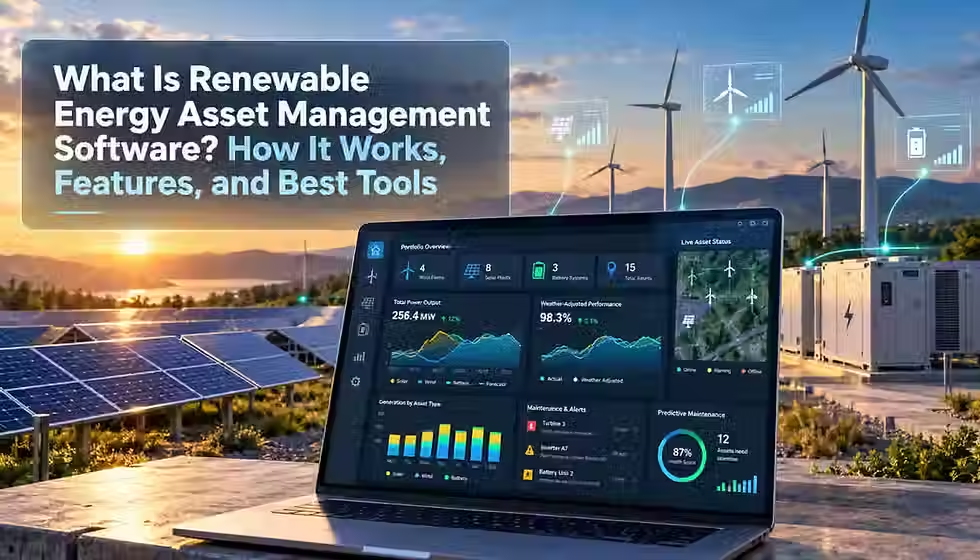
A single utility-scale solar plant can log readings from hundreds of inverters, thousands of strings, and dozens of weather sensors every few seconds. A wind fleet adds turbine SCADA, vibration, and oil data. Layer on PPA terms, warranty clocks, maintenance tickets, and lender reports, and one portfolio produces more information than any team can read by hand. Value leaks away when that information sits in OEM portals, spreadsheets, CMMS tools, and email threads. Renewable energy asset management software exists to close that gap.
TL;DR: the short version
What it is: a software layer that pulls data from SCADA, OEM portals, meters, weather feeds, contracts, and maintenance systems into one normalized model for solar, wind, and battery portfolios.
What it adds: expected-versus-actual analysis, loss accounting, alarms and events, availability calculations, reporting, and work-order handoff. Feature breadth varies by vendor.
What it is not: a replacement for SCADA control, EMS dispatch, or, in many cases, a CMMS or EAM. It sits above them.
Who needs it: owners, IPPs, utilities, O&M providers, and investors once spreadsheets and OEM portals stop scaling across sites and technologies.
What to focus on: data ownership and export rights, transparent KPI calculations, integrations, scenario-based demos, and total cost of ownership rather than feature counts.
What Is Renewable Energy Asset Management Software? (Quick Answer)
Renewable energy asset management software is a platform that collects operational, weather, contract, and maintenance data from solar, wind, and battery assets, normalizes it into one asset model, and turns it into performance analytics, alarms, loss accounting, reporting, and maintenance or commercial workflows across single sites and whole portfolios.
Which capability matters most when choosing renewable asset management software?
0%Data integration and normalization
0%Performance and loss analytics
0%Predictive maintenance and asset health
0%Work orders and maintenance workflows
Table of contents
What Is Renewable Energy Asset Management Software?
Renewable energy asset management software is a portfolio-level platform that unifies data from solar, wind, and battery assets so technical and commercial teams can monitor performance, explain losses, and act on them. In plain English, it is the shared workspace where a fleet's numbers, alarms, contracts, and maintenance history meet.
Each word in the name matters. The asset is the generating or storing equipment: turbines, inverters, trackers, modules, battery racks, transformers, and the substation that connects them to the grid. Management is the decision layer: what to fix first, whether an availability claim holds up, whether a site is on budget. The software is the data and workflow layer that makes those decisions repeatable across dozens or hundreds of sites.
The technical definition
Technically, the platform ingests time-series and event data through connectors, APIs, and files, validates and normalizes it, maps it onto an asset hierarchy, and applies calculation logic. Outputs include expected-versus-actual energy, categorized downtime, lost energy, alarms, and reports. Many platforms also send tickets to a maintenance system and read contract terms and prices for revenue analysis.
Technical versus commercial management
Technical asset management focuses on physical performance: availability, faults, degradation, and maintenance planning. Commercial asset management focuses on revenue and contracts: PPA compliance, invoicing, budget variance, and cash flow. The two share data. A curtailment event, for example, is a technical loss and a commercial claim at the same time.
Site versus portfolio, and lifecycle value
Site tools answer whether one plant is healthy. Portfolio tools answer which plants deserve attention first, and why. That comparison only works when every site uses the same definitions.
The lifecycle framing follows ISO's asset management standards. ISO 55000:2024 gives the vocabulary, overview, and principles, and ISO 55001:2024 sets requirements for an asset management system. ISO lists realized value from assets throughout their life among the intended results, and notes that the standard sets no financial, accounting, or technical requirements for specific asset types. Software therefore supports an asset management system. It does not replace one.
Why Renewable Energy Assets Need Specialized Management Software
Renewable assets need specialized software because their data is fast, uneven, and tied to physics, and because contracts and grid rules turn every lost kilowatt-hour into a question of cause and responsibility. Six pressures explain most of the gap.
Distributed fleets and mixed OEMs. Sites span regions and equipment brands, each with its own data format, tag names, and alarm codes. Comparing two sites often means translating before analyzing.
Weather dependence. Output swings with irradiance, wind speed, and temperature, so low production means little without an expected value that accounts for the weather.
Intermittency and curtailment. Grid operators can limit output. Software must separate curtailment from faults so teams neither chase phantom problems nor miss real ones.
Contracts. Availability guarantees, warranties, and PPAs decide who pays for downtime, and calculation rules differ by contract.
Batteries. BESS assets add state of charge, degradation, and warranty limits tied to temperature and cycling.
Reporting. Lenders, investors, and regulators expect consistent, auditable numbers.
Spreadsheets and OEM portals work for a handful of sites. Beyond that, every new site adds manual mapping, every OEM portal shows only its own equipment, and calculation methods drift between analysts. Nobody sees the whole portfolio on one basis.
The NREL-led best practices guide for PV operations and maintenance presents stronger O&M as a route to more predictable costs and better performance. The SunSpec Alliance summary adds that actuarial data (oSPARC, 2018) suggested comprehensive PV O&M could lift average performance ratio from 91.7% to at least 95%. Treat that as a directional PV figure, not a promise for any single fleet.
How Renewable Energy Asset Management Software Works
The software works as a pipeline: it collects data from assets and business systems, cleans and normalizes it, places it in an asset model, runs analytics, raises events, and routes actions to maintenance and commercial teams.
Sources. Inverters, turbines, meters, weather stations, and battery controllers feed SCADA. OEM portals, EMS and PPC systems, market prices, contract terms, and maintenance records add context.
Ingestion. Edge loggers or gateways poll devices, buffer data during outages, and forward it. Other connectors pull through APIs, file transfers, or historians.
Validation and normalization. Rules flag gaps, flatlines, spikes, and wrong units, then map vendor-specific tags to a common data model. Poor inputs undermine every later step; see this guide to data quality.
Context. Each signal attaches to an asset hierarchy: portfolio, site, block, inverter, string, or turbine and component.
Analytics. Expected-production models, rules, and machine learning compare actual with expected output and classify the difference.
Events and diagnostics. Deviations become alarms or events with start and end times, a likely cause, and estimated lost energy.
Workflow. Events turn into tickets, inspections, warranty claims, or commercial adjustments, often through a CMMS.
Reporting and feedback. Dashboards and scheduled reports serve owners and lenders. Resolved cases refine rules and forecasts.
A few terms explain the plumbing. A historian stores high-resolution time-series data, and APIs move data in and out. The on-site edge layer buffers data and can run local logic, while the cloud layer handles fleet-wide analytics and storage. A digital twin is a structured model of the plant, sometimes down to individual strings, that gives each reading a physical context. Dashboards, alerts, and work orders sit on top, and enterprise connectors send results to ERP, data warehouse, and BI tools.
Renewable Asset Management Software vs. SCADA, CMMS, EAM, APM, EMS, PPC and Other Systems
SCADA collects and controls operational plant data, while renewable asset management software adds portfolio analytics, performance benchmarking, loss analysis, workflows, and business context. The other categories in the table each cover a narrower job.
System | Primary Purpose | Typical Data/Functions | Main Users | What It Does Not Replace |
Renewable asset management platform | Portfolio performance and value | Normalized data, KPIs, loss accounting, events, reporting | Asset managers, performance engineers | Plant control, EMS dispatch, EAM or ERP |
APM | Asset health and performance analytics | Anomaly detection, event tracking, benchmarking | Performance and reliability engineers | Real-time control or financial ledgers |
SCADA | Plant monitoring and control | Device polling, setpoints, local alarms, local historian | Site operators, control room | Portfolio analytics or contract reporting |
CMMS | Maintenance execution | Work orders, schedules, parts, technician logs | O&M teams | Performance or loss analysis |
EAM | Enterprise asset lifecycle and cost | Asset registers, procurement, maintenance, finance links | Enterprise operations, finance | Renewable-specific analytics |
EMS | Energy dispatch and storage optimization | Schedules, market signals, battery control | Operators, traders | Long-term performance analysis |
PPC | Grid-code compliance at the plant | Active and reactive power, voltage, frequency control | Plant operators, grid engineers | Portfolio reporting |
Condition-monitoring system | Component health diagnostics | Vibration, oil, and temperature data | Reliability engineers | Commercial or fleet-wide reporting |
Historian or data platform | Time-series storage and access | Long-term storage, queries, APIs | Data engineers, analysts | Domain logic and workflows |
BI tool | Reporting and visualization | Dashboards, ad hoc analysis | Analysts, finance teams | Renewable-specific calculations |
These boundaries are not universal. Some vendors bundle SCADA, EMS, and APM in one suite, and others specialize in a single layer. GreenPowerMonitor, for example, lists on-site products such as GPM SCADA, PPC, and EMS separately from its cloud GPM Horizon platform, while Power Factors says its Unity suite unifies SCADA, EMS, APM, O&M, and commercial asset management. Ask each vendor which of these functions sit inside the product being quoted. For a primer on the EMS category, see this guide to energy management software.
Core Features of Renewable Energy Asset Management Software
Core features fall into six groups. Feature breadth varies widely by platform, so no vendor should be assumed to cover every item below.
Data and integration. Multi-site, multi-technology monitoring; connectors to SCADA, OEM portals, meters, and weather stations; APIs and exports; an asset hierarchy; data cleansing and normalization; weather and forecast inputs.
Performance analytics. Dashboards, expected-versus-actual generation, availability calculations, loss accounting, benchmarking, and anomaly detection.
Events and reliability. Alarm and event management with prioritization and escalation, condition monitoring, predictive maintenance, and digital twins.
Workflow. Work orders, CMMS integration, field service, maintenance history, and mobile access.
Commercial functions, where available. PPA and contract management, revenue and budget tracking, invoicing, and investor reporting.
Governance. Role-based access, permissions, audit trails, cybersecurity controls, and data governance.
Three features deserve extra scrutiny during evaluation.
Loss accounting. The platform must decide whether missing energy came from a fault, curtailment, weather, or a data gap. Inspect the logic, not just the chart.
Alarm management. Too many low-value alerts train teams to ignore the tool. Look for prioritization by lost energy and configurable rules.
Auditability. Availability figures used in contract disputes or lender reports must be reproducible. Look for visible formulas, versioned calculations, and event logs.
Two capability families rely on modeling. Predictive maintenance models look for early signs of failure, and expected-production and forecast models are time-series problems; this primer on time-series models explains the basics. Ask vendors how each model is validated on equipment like yours.
Renewable Energy Asset Management by Technology
Each technology fails and performs differently, so software must model them differently while keeping KPIs comparable.
Solar PV Asset Management
Solar plants contain many simple devices: hundreds of inverters, thousands of strings, and trackers spread across large sites. Typical issues include inverter faults and derating, string outages, clipping, soiling, degradation, tracker misalignment, and thermal hotspots. Useful data includes inverter and string currents, irradiance, module temperature, tracker positions, and aerial thermal inspections.
Key metrics are performance ratio, availability, energy yield, and actual versus expected output. IEC 61724-1:2021 covers terminology, equipment, and methods for PV performance monitoring, and IEC TS 63019:2019 provides an information model for PV availability. A typical workflow runs from alarm to likely cause, ticket, repair, and verification that output recovered.
Wind Asset Management
Wind fleets have fewer, larger machines with more mechanical complexity. Software works with turbine SCADA, power curves, yaw and pitch behavior, and drivetrain condition across the gearbox, generator, main bearing, and blades. NREL's drivetrain condition monitoring report notes that wind turbines have historically had reliability issues, mostly caused by drivetrain faults led by the main gearbox.
Important metrics include time-based and production-based availability, AEP variance, power curve deviation, and curtailment and wake effects. IEC 61400-26-1:2019 defines an information model for both availability types. OEM service contracts often tie payments to availability, so calculation transparency matters. Vibration and oil sensors add condition monitoring data that many operators route into a dedicated reliability tool.
Battery Energy Storage System (BESS) Asset Management
Battery systems add state of charge (SOC), state of health (SOH), round-trip efficiency, cycle counts, temperature, and warranty limits. Asset management asks whether the battery is available, degrading as expected, and operating within warranty terms.
Keep the roles separate. An EMS or dispatch controller decides when to charge and discharge in real time. Asset management software evaluates the outcome: availability, degradation, efficiency, and revenue against plan. Some vendors sell both, but the functions are distinct, and buyers should confirm which one they are getting.
Hybrid and Multi-Technology Portfolios
Mixed portfolios make normalization essential. A common asset hierarchy and shared KPI definitions let teams compare a wind farm, a solar plant, and a battery on one screen. Shared grid constraints complicate loss attribution: energy may be lost to curtailment, a charging limit, or a fault. Vendors differ in how well they handle hybrid sites, so test with one of your real hybrid assets during the demo.
Important KPIs and Metrics
The KPIs that matter most are availability, actual versus expected energy, performance ratio for solar, capacity factor, and lost energy, supported by reliability and cost metrics. Definitions vary by technology, contract, stakeholder, and calculation standard, so agree on formulas before comparing numbers.
Availability. The share of time, or of potential production, that an asset is able to operate. Time-based and production-based versions differ.
Contractual availability. Availability as an O&M contract defines it, with agreed exclusions. It can differ from technical availability, and disputes usually hinge on the definition.
Capacity factor. Actual energy divided by the energy the asset would produce at full rated output over the same period.
Performance ratio (PR). For solar, actual output relative to the output expected from measured irradiance. Weather-corrected variants exist.
Energy yield and actual versus expected production. Energy per installed kilowatt, and the gap between measured output and a model.
AEP variance. Annual energy production compared with the forecast used in financing or budgets.
Downtime, MTBF, and MTTR. How long assets are unavailable, the mean time between failures, and the mean time to repair.
Lost energy and curtailment loss. Energy not produced, split by cause: faults, grid limits, weather, or data gaps.
Component health and alarm burden. Health scores, plus alarm counts, durations, and false-positive share. A heavy burden hides real problems.
Maintenance backlog and O&M cost. Open work orders by age and priority, and cost per installed megawatt.
Revenue variance. Actual revenue against budget, separated into price and volume effects.
Forecast accuracy. Error between forecast and actual generation, relevant where markets penalize imbalance.
Keep a KPI dictionary: one entry per metric with its formula, data sources, exclusions, and owner. It prevents most reporting arguments.
Benefits and Business Value
The value comes from earlier detection, better prioritization, and less manual work, not from the dashboard itself.
Earlier issue detection. Automated comparison against expected output surfaces underperformance sooner than monthly reviews.
Less avoidable downtime. Faster diagnosis shortens the time from fault to fix.
Better prioritization. Ranking events by lost energy and revenue sends crews to the highest-value work first.
Higher data quality. Central validation reduces disputes over whose numbers are right.
Reporting automation. Standard reports replace manual assembly across portals and spreadsheets.
Portfolio visibility. Consistent KPIs support benchmarking and better investment and O&M contract decisions.
Warranty and contract support. Auditable availability and loss calculations provide evidence in claims.
Scalable operations. One shared record helps owners, O&M providers, and lenders work from the same facts.
ROI logic should stay simple and transparent. These formulas are illustrative frameworks, not promised outcomes.
Recovered production value = recovered MWh × realized energy value
Net benefit = avoided failure cost + recovered production value + labor and reporting savings − (software + integration + ongoing services)
Realized energy value depends on PPA price, merchant price, curtailment, and timing. Measure recovered MWh against a baseline, or the figure is a guess.
Best Renewable Energy Asset Management Software Tools
"Best" depends on asset mix, portfolio size, operating model, geography, required integrations, technical depth, commercial needs, and existing systems. This section does not rank tools or assign scores. It groups nine platforms by scope, using first-party product pages and announcements reviewed as of September 30, 2026. Vendor statements are attributed to the vendor, and no customer, capacity, or savings figure is independently verified.
Platform | Best Fit / Primary Use Case | Asset Types | Verified Strengths | Scope/Category | Pricing Transparency |
Power Factors Unity | Large mixed portfolios wanting one suite | Solar, wind, BESS, hybrid | APM, commercial asset management, EMS and SCADA options, REMI AI assistant (vendor-described) | Broad suite | No public pricing found; contact vendor |
GPM Horizon (GreenPowerMonitor, a DNV company) | Owners and asset managers needing a cloud layer across technologies | Solar, wind, BESS | Core, Pro, and Elite tiers; alarms, budgets, revenues, tickets, Gemini predictive module | Cloud asset management layer; SCADA, PPC, EMS sold separately | Tiered editions; quote on request |
Clir Portfolio | Owners and investors needing benchmarking and defensible reporting | Wind, solar, BESS | Performance monitoring, budget reconciliation, contractual availability reconciliation | Owner-focused APM and portfolio intelligence | No public pricing found; book a demo |
Raptor Solar (Raptor Maps) | Solar owners, O&Ms, and EPCs wanting field automation | Solar PV | Map-based digital twin, robotic inspections, offline mobile app | Solar digital-twin and O&M platform | No public pricing found; contact vendor |
Stem PowerTrack | Solar, storage, and hybrid owners wanting monitoring and control | Solar, storage, hybrid | Monitoring suite, APM, EMS, edge hardware | Monitoring and control platform with APM and EMS options | No public pricing found; contact vendor |
Bazefield | IPPs, utilities, and O&Ms wanting OEM-independent operations | Wind, solar, storage, hydro | Data engine, alarm workflows, availability and loss tracking, CMMS sync | Operations management platform | No public pricing found; contact vendor |
ONYX Cortex | Wind owners focused on reliability | Wind | Physics-informed AI, SCADA and CMS data, maintenance workflow | Wind condition monitoring and predictive maintenance | No public pricing found; contact vendor |
meteocontrol VCOM Cloud and mc Assetpilot | PV and BESS operators and O&Ms, plus owners needing a finance layer | PV and BESS (VCOM); solar, wind, battery (mc Assetpilot) | Monitoring, battery monitoring, CMMS, API; financial asset management | Monitoring and CMMS plus a separate commercial layer | No public pricing found; contact vendor |
3E SynaptiQ | Owners and O&Ms wanting hardware-agnostic performance analytics | Solar, wind, storage | Digital-twin smart alarms, Asset Operations app, BESS SOH and warranty logic | Performance and operations analytics SaaS | No public pricing found; contact vendor |
Strengths in the table reflect first-party descriptions, so treat them as claims to test in a demo, not independent validation. The tools fall into different categories: broad suites (Power Factors, GreenPowerMonitor, Bazefield, 3E), owner-focused analytics (Clir), monitoring and control platforms (Stem, meteocontrol), a solar-specialized digital-twin platform (Raptor Maps), and a wind-specialized reliability platform (ONYX). They are not interchangeable.
Power Factors Unity
According to Power Factors, Unity is a renewable energy management suite covering local SCADA, central EMS, technical asset management (Unity APM), and commercial asset management, including invoice management, for solar, wind, BESS, and hybrid portfolios. Unity APM combines capabilities from the company's earlier APM products, Drive and Greenbyte, so Greenbyte is legacy branding rather than a separate current product. In April 2026 the company launched Unity REMI, an AI assistant available to Unity APM users. European Energy announced in April 2025 that it would implement Unity APM across 2.4 GW. Fit: large mixed portfolios; confirm which modules are in scope. Pricing: no public price list found; contact vendor. Official source: Power Factors Unity.
GPM Horizon (GreenPowerMonitor, a DNV company)
GPM Horizon is GreenPowerMonitor's cloud platform for wind, solar, and battery storage portfolios; the multi-technology version with Horizon Storage was announced in 2025. GreenPowerMonitor lists three tiers: Core covers overview, monitoring, alarms, and data studio; Pro adds analysis, budgets, reports, revenues, and tickets; Elite adds logbook, KPIs, forecast, planning, the Gemini predictive module, and a mobile app. Navisun announced in June 2025 that it was implementing Horizon across 45 PV and BESS assets. Scope: Horizon is the cloud layer, while GPM SCADA, PPC, EMS, and HEMS are separate on-site products. Pricing: quote on request. Official source: GPM Horizon.
Clir Portfolio
Clir Renewables describes Clir Portfolio as an AI-based APM platform for asset owners with wind, solar, and BESS assets. Its pages emphasize automated portfolio reporting, performance monitoring on standardized SCADA data, budget reconciliation, and contractual availability reconciliation, meaning independent validation of OEM availability claims. Clir cites operational data from more than 350 GW of assets (vendor claim). In May 2026, Captiva, a technical and commercial asset manager, announced it selected Clir for wind, solar, and BESS monitoring and reporting. Fit: owners, investors, and asset managers who need benchmarking and defensible reporting. Scope: portfolio intelligence, not SCADA, EMS, or CMMS. Pricing: demo request; no public price list found. Official source: Clir Portfolio.
Raptor Solar (Raptor Maps)
Raptor Maps sells a solar-only platform, Raptor Solar, built around a map-based digital twin that aggregates and normalizes data from aerial, ground, sensor, and equipment sources. Its site describes remotely operated Sentry drone missions and an offline-capable mobile app for technicians. According to a Raptor Maps interview published by ENGIE, ENGIE uses the platform across 90 solar sites and more than 6.5 GW. Fit: solar owners, O&Ms, and EPCs that want field-work automation and equipment-level records. Scope: a solar digital-twin and O&M platform, not a multi-technology APM suite or a commercial asset management system. Pricing: no public price list found; contact vendor. Official source: Raptor Maps.
Stem PowerTrack
PowerTrack is Stem's software suite for solar, storage, and hybrid assets. Stem completed its acquisition of AlsoEnergy on February 1, 2022, so AlsoEnergy is historical branding, not a separate current product. Stem's products page lists C&I solar, utility solar, storage, and hybrid offerings under PowerTrack. Its 2024 PowerTrack APM announcement described a suite for technical and commercial asset managers that connects to existing data acquisition, BMS, and CMMS systems. Fit: solar-plus-storage owners wanting monitoring and control from one vendor. Scope: the materials reviewed cover solar, storage, and hybrid, not wind. Pricing: no public price list found; contact vendor. Official source: Stem products.
Bazefield
Bazefield is an operations management platform that company materials describe as owned by Univers, formerly Envision Digital. Its documentation describes OEM-independent monitoring and control for solar, wind, storage, and hydro, a data engine that ingests and normalizes data, alarm and event workflows, automated availability calculation and loss tracking, and bidirectional CMMS sync. According to the vendor, it is used across more than 2,500 sites and over 250 GW. Fit: IPPs, utilities, and O&M providers that want a configurable, technology-agnostic operations layer. Scope: strongest on operations, so ask which commercial and BI functions are included. Pricing: no public price list found; contact vendor. Official source: Bazefield documentation.
ONYX Cortex
ONYX Insight launched ONYX Cortex in September 2026. Windtech International reports that it combines condition monitoring, performance analytics, and maintenance workflows for wind turbines, using SCADA and condition monitoring data, including third-party systems. Results reach users through a web platform, mobile app, MCP server, or CMMS, and an API supports integration with EAM and ERP systems. Cortex builds on the fleetMonitor condition monitoring platform and uses physics-informed AI. Fit: wind owners and operators focused on drivetrain, blade, and tower reliability. Scope: wind-only reliability and predictive maintenance, not commercial asset management or a multi-technology suite. Because Cortex is newly launched, ask for reference customers. Pricing: no public price list found; contact vendor. Official source: ONYX Insight.
meteocontrol VCOM Cloud and mc Assetpilot
meteocontrol's VCOM Cloud covers PV and battery monitoring, technical operations management, and data hosting, with VCOM Monitoring, VCOM Battery Monitoring, VCOM CMMS, and a VCOM API. The company also offers mc Assetpilot, a separate cloud product for the financial management of solar, wind, or battery portfolios, covering contracts, cash flow, and financial models. Fit: PV and BESS operators and O&M providers that want monitoring and maintenance workflows in one cloud, with an optional financial layer. Scope: VCOM itself is PV- and battery-focused. Pricing: no public price list found; contact vendor. Official source: meteocontrol cloud products.
3E SynaptiQ
3E describes SynaptiQ as a SaaS platform for monitoring and optimizing solar, wind, and storage assets, positioned as hardware-agnostic. Its Asset Operations application uses a digital twin to generate smart alarms, and its BESS page describes tracking of state of health, round-trip efficiency, and built-in warranty logic. 3E states that 50 GW sits in the platform across 20,000 connected sites (vendor figures). Fit: owners, developers, and O&M providers that want performance analytics with advisory support from one vendor. Scope: performance and operations analytics, so check the depth of CMMS and commercial workflows. Pricing: no public price list found; contact vendor. Official source: SynaptiQ.
How to Choose Renewable Energy Asset Management Software
Choose by matching scope to your operating model first, then test each shortlisted vendor on data terms, calculation transparency, and integration.
Scope fit. Asset types, portfolio size in MW or GW, OEM diversity, geography, and language and support hours.
Architecture fit. Existing SCADA, EMS, CMMS, EAM, ERP, and data warehouse; native connectors; and whether anything truly needs replacing.
Data terms. Ownership of raw, normalized, and derived data; historical migration and backfill; API and export rights; exit terms.
Calculation transparency. Documented, configurable KPI formulas, availability and loss methods, and an audit trail.
Analytics depth. Alarm handling, condition and predictive capabilities, expected-energy models, and false-alarm control.
Commercial features. PPA, contract, budget, invoicing, and investor reporting, if your team needs them.
Security and access. Cybersecurity practices, role-based access control, audit logs, and mobile or offline use.
Delivery and cost. Implementation effort, support and SLA, scalability, reporting, lock-in risk, and total cost of ownership.
Use this buyer checklist to compare shortlisted vendors:
Can we export all raw and derived data, including history, in open formats?
Are KPI formulas visible, documented, and configurable?
Does it connect to our SCADA, CMMS, and ERP without custom builds?
Has the vendor supported a portfolio like ours, and can we speak to that customer?
Who owns the data if we leave?
What is the all-in cost over three years, including services?
Questions to Ask Vendors During a Software Evaluation
Use these questions in RFPs and demos. Ask vendors to answer with their own product screens and documentation, not slides.
How do you normalize data across OEMs, and who maintains the mappings?
Who owns raw, normalized, and derived data, and can we export all of it, including history?
Which integrations are native, and which need custom work?
How is historical data backfilled, and what does it cost?
How are availability and losses calculated, and can we audit and configure the logic?
How do you separate curtailment, weather, faults, and data gaps?
How are false alarms measured and reduced?
What is the cybersecurity architecture, and which independent audits can you document?
What happens to data and alarms when a site loses connectivity?
How long does onboarding take for a portfolio like ours, and who does the work?
Which functions require separate modules or additional licensing?
Can the platform integrate with our CMMS, ERP, and data warehouse?
What support hours, SLAs, and languages are included?
What are the exit and migration terms?
Implementation: From Data Audit to Portfolio Rollout
A realistic rollout runs in stages, and most delays come from data and process issues rather than software.
Objectives and use cases. Pick three to five decisions the software must improve, such as availability claims or monthly reporting.
Asset and stakeholder inventory. List sites, OEMs, contracts, and the teams who will use the platform.
Data-source audit. Check what each site exposes, at what resolution, and with what gaps.
Architecture and integration design. Decide connectors, edge hardware, and links to CMMS, ERP, and the data warehouse.
Data cleansing and mapping. Map tags to the asset hierarchy and fix units, time zones, and missing data.
KPI and calculation alignment. Write down formulas and exclusions, and reconcile them to contracts.
Pilot. Run two or three representative sites, including one problem site.
Validation. Compare outputs with trusted manual calculations against agreed acceptance criteria.
Workflows and training. Define who acts on which alarm, and train those people.
Phased rollout. Add sites in waves and watch data quality as volume grows.
Governance and continuous improvement. Assign data owners and review KPIs and alarm rules on a schedule.
Set acceptance criteria before the pilot. For example, calculated availability should match an agreed reference within a stated tolerance. Name an owner for data quality, because adoption fades when users stop trusting the numbers.
Common Implementation Mistakes
Most failures trace back to process and governance, not missing features.
Buying dashboards without workflows. A screen nobody acts on adds cost without value. Define who does what when an alarm fires.
Weak data governance. Without owners for tag mappings and data quality, errors accumulate and trust erodes.
Undefined KPI formulas. If teams calculate availability differently, the platform will automate the disagreement.
Alarm overload. Thousands of low-value alerts bury real faults. Tune thresholds and prioritize by lost energy.
Unnecessary rip-and-replace. Existing SCADA and CMMS often stay. Replace only what fails a clear requirement.
Skipping API and export due diligence. Weak exports create lock-in that shows up at renewal or exit.
Ignoring adoption. Training, champions, and changed routines matter as much as configuration.
Trusting AI blindly. Diagnoses need engineering review and evidence, especially before costly interventions.
Unclear data ownership. Settle rights to raw, normalized, and derived data in the contract.
Automating a broken process. Fix the workflow first, then encode it.
Buying feature counts instead of outcomes. Tie selection to measurable results, such as faster fault resolution or less reporting time.
How Much Does Renewable Energy Asset Management Software Cost?
No reliable public price list covers this category, so this article gives no dollar ranges. Most enterprise vendors quote based on scope, and some publish tier structures without prices. Common pricing drivers include:
Number of sites, assets, and devices, and the MW or GW under management
Technologies covered: solar, wind, BESS, or hybrid
Modules chosen, such as monitoring, APM, commercial, or condition monitoring
User counts and roles
Telemetry volume and data resolution
Integrations with CMMS, ERP, SCADA, and data warehouses
Historical data migration
Edge hardware and on-site installation
Custom analytics or report development
Implementation, training, support tier, and managed services
Quote-based pricing exists because scope varies so widely. Two portfolios with the same capacity can differ sharply in device counts, data sources, and required modules. GreenPowerMonitor, for example, publishes Core, Pro, and Elite tiers but routes pricing through a quote request.
Judge total cost of ownership, not the subscription line. Add integration work, data cleanup, internal staff time, training, hardware, renewal terms, and eventual exit costs. Compare quotes on the same scope: same sites, same modules, same data history.
AI, Digital Twins, and the Future of Renewable Asset Management
AI helps most today with anomaly detection, diagnostics, and finding answers in large datasets. Autonomous operation is still emerging, and claims should be tested on your own fleet.
Described by vendors today (vendor-reported):
Natural-language analysis and agentic actions. Power Factors says Unity REMI lets users query performance and events in plain language and supports tasks such as contract and compliance extraction, starting with Unity APM users (April 2026).
Machine learning on standardized data. Clir says it applies machine learning, instance-based learning, and large language models on a renewables-specific data model.
Physics-informed AI for wind. ONYX reportedly combines engineering models with operational data across the drivetrain, blades, blade roots, tower, and foundation in Cortex.
Digital-twin alarms and inspections. 3E describes smart alarms generated by a digital twin, and Raptor Maps feeds robotic inspection data into a map-based digital twin.
Predictive modules. GreenPowerMonitor describes Gemini as a predictive diagnostics and advanced analytics module in GPM Horizon.
Emerging possibilities, not yet broadly verified:
Semi-autonomous workflows that open, route, and close tickets with minimal human input
Root-cause assistants that trace a loss across SCADA, weather, and maintenance history
Maintenance prioritization that weighs parts, crews, and revenue at once
Physics-informed forecasting that blends engineering models with learned corrections
Portfolio benchmarking across owners, subject to data-sharing terms
Human oversight still matters. Models are only as good as the data and asset context behind them. Ask for traceability from each recommendation back to source data, require engineering validation before major interventions, measure false positives on your own assets, and confirm how the vendor secures data and controls automated actions.
Who Needs Renewable Energy Asset Management Software?
Any organization whose portfolio has outgrown a single OEM portal and a spreadsheet is a candidate. Needs differ by role.
Small operators. With a few sites on one technology, vendor monitoring plus a CMMS may be enough.
Scaling IPPs. Growth in sites and OEMs makes manual reporting and inconsistent KPIs costly. This is where a common data model starts to pay off.
Utilities. Mixed generation fleets and regulatory reporting favor platforms that integrate with enterprise EAM and ERP.
Multi-GW owners. Scale, benchmarking, and standardized reporting across regions matter most, along with strong APIs.
O&M providers. Contractual availability, fast ticketing, and client-ready reports drive value.
Technical asset managers. Loss accounting, diagnostics, and condition data support day-to-day decisions.
Commercial asset managers. Contracts, budgets, invoicing, and revenue variance need technical data tied to money.
Investors and infrastructure funds. Consistent, auditable reporting across many assets supports oversight, valuation, and refinancing.
A simpler setup can be enough when one technology runs on one OEM's platform, reporting needs are light, and tickets are handled in a CMMS. An integrated platform earns its cost when data comes from several OEMs or technologies, contracts depend on calculated availability, or investors expect consistent reports.
FAQ
What is renewable energy asset management software?
It is a platform that gathers data from solar, wind, and battery assets and their business systems, normalizes it into one model, and produces performance analytics, alarms, loss accounting, reports, and maintenance or commercial workflows. It works at site and portfolio level and supports both technical and commercial asset managers.
How is renewable energy asset management software different from SCADA?
SCADA monitors and controls equipment at a plant in real time. Asset management software works above it, combining data from many sites and systems to benchmark performance, calculate availability and losses, and drive maintenance and reporting workflows. It usually reads SCADA data rather than replacing SCADA control.
What is APM in renewable energy?
APM stands for asset performance management. In renewables it is the analytics layer that compares actual and expected output, detects anomalies, classifies events, and estimates lost energy. Some vendors sell APM as a standalone product, and others bundle it with monitoring, control, or commercial asset management in a wider suite.
Does renewable asset management software replace a CMMS?
Not necessarily. A CMMS manages maintenance execution, such as work orders, schedules, and parts. Asset management software finds and prioritizes performance issues, then often sends tickets to a CMMS. Some platforms include CMMS functions, so check what is built in, what integrates, and whether your team wants one tool or two.
Can one platform manage solar, wind, and BESS?
Some can. Several vendors describe multi-technology support across solar, wind, and storage, while others specialize in one technology. Depth still varies, so test each technology with your own assets. Confirm that KPIs, alarms, and reports are comparable across technologies, and check how hybrid sites are handled.
What data does renewable asset management software use?
Typical inputs include SCADA and device telemetry, meter data, weather and irradiance measurements, forecasts, alarm and event logs, condition monitoring data, maintenance records, contract terms, prices, and budgets. Platforms normalize these sources into a common asset model so technical and commercial questions can be answered from the same data.
Which KPIs should renewable asset managers track?
Start with availability, contractual availability, actual versus expected energy, capacity factor, performance ratio for solar, lost energy, and curtailment loss. Add MTBF, MTTR, alarm burden, maintenance backlog, O&M cost, revenue variance, and forecast accuracy. Document each formula and its exclusions, because definitions vary by technology and contract.
How does AI help renewable asset management?
AI helps with anomaly detection, diagnostics, prioritizing events, answering questions in plain language, and drafting reports. Vendors also describe physics-informed models for wind and AI-driven inspections for solar. Results depend on data quality, so validate recommendations with engineers, request traceability, and measure false alarms on your own portfolio.
How much does renewable energy asset management software cost?
Most vendors quote by scope rather than publishing prices. Drivers include the number of sites and devices, MW or GW, technologies, modules, users, data volume, integrations, migration, hardware, and services. Compare quotes on the same scope and include implementation, internal time, and exit costs in the total cost of ownership.
What should buyers compare between vendors?
Compare asset coverage, integrations, data ownership and export rights, KPI and calculation transparency, alarm quality, commercial features, cybersecurity, implementation support, scalability, and total cost. Use scenario-based demos with your data, and separate broad suites from specialized tools so you compare like with like.
Can it integrate with SCADA, ERP, and CMMS systems?
Most platforms integrate with SCADA and other data sources through connectors, APIs, or files, and many connect to CMMS tools. ERP and data warehouse links vary. Ask which integrations are native, which need custom work, whether they are bidirectional, and whether you keep export rights to raw and derived data.
What is the difference between technical and commercial asset management?
Technical asset management focuses on physical performance, including availability, faults, degradation, and maintenance. Commercial asset management focuses on contracts, revenue, budgets, invoicing, and financial reporting. They overlap because technical events, such as downtime or curtailment, change revenue and trigger contract claims.
Is renewable asset management software useful for small portfolios?
It can be, but it is not always necessary. A few sites on one technology may be well served by vendor monitoring plus a CMMS. A platform becomes more valuable as sites, OEMs, contracts, and reporting demands grow, or when investors expect consistent, auditable KPIs.
How long does implementation take?
It depends on the number of sites, data quality, integrations, and how much history must be migrated. A pilot on a few representative sites is usually faster than a full rollout, and data cleanup is a common bottleneck. Ask each vendor for a timeline based on a comparable portfolio, and confirm it with references.
Key Takeaways
The category is a layer, not a single product. SCADA, EMS, PPC, CMMS, and EAM each keep their jobs, and vendors draw the boundaries differently.
Data normalization and a shared asset hierarchy come first. Analytics on unclean or unmapped data produce confident but wrong answers.
KPI definitions decide outcomes. Availability, performance ratio, and lost energy vary by contract, technology, and standard, so write the formulas down.
Loss accounting and auditability are the hardest features to fake. Test how the platform separates faults, curtailment, weather, and data gaps.
Scope differs sharply between tools. Broad suites, owner analytics, monitoring and control platforms, solar digital twins, and wind reliability tools solve different problems.
Public pricing is scarce. Compare quotes on identical scope and count integration, data cleanup, and exit costs.
AI is useful for detection, diagnosis, and search today. Fully autonomous operation is still emerging and needs traceability and engineering review.
Data ownership and export rights protect you from lock-in and belong in the contract before signature.
Actionable Next Steps
Define three to five use cases and the decisions they should improve.
Inventory systems and data: SCADA, OEM portals, CMMS, ERP, meters, weather sources, and contracts.
Standardize KPI definitions, formulas, and exclusions in a shared dictionary.
Shortlist vendors by category fit, not by feature count.
Run scenario-based demos using your own data, including a hybrid or problem site.
Validate exports, data ownership, integrations, and security documentation.
Pilot on two or three representative sites against agreed acceptance criteria.
Measure business impact: recovered energy, resolution time, and reporting hours saved.
Scale in phases and assign owners for data quality and KPI governance.
Glossary
AEP: Annual energy production, the energy a plant generates in a year, often compared with a forecast.
APM: Asset performance management, analytics that compare actual and expected performance, detect issues, and prioritize actions.
Asset hierarchy: The structure linking equipment from portfolio and site down to inverter, string, turbine, or component.
Availability: The share of time, or of potential production, that an asset can operate.
BESS: Battery energy storage system.
Capacity factor: Actual energy divided by the energy at full rated output over the same period.
CMMS: Computerized maintenance management system for work orders, schedules, and maintenance records.
Condition monitoring: Sensor-based tracking of component health, such as vibration or oil condition.
Curtailment: A reduction in output requested or forced by grid or market conditions.
Digital twin: A structured virtual model of an asset or plant enriched with live and historical data.
EAM: Enterprise asset management, broader systems for asset lifecycle, cost, and maintenance.
EMS: Energy management system that coordinates dispatch and storage operation.
ERP: Enterprise resource planning software for finance, procurement, and operations.
KPI: Key performance indicator, a metric used to track performance against a goal.
Lost energy: Energy not produced because of faults, curtailment, or other losses, compared with the expected amount.
MTBF: Mean time between failures.
MTTR: Mean time to repair.
O&M: Operations and maintenance.
OEM: Original equipment manufacturer.
PPA: Power purchase agreement, the contract that sets the price and terms for selling electricity.
PPC: Power plant controller, which regulates plant output to meet grid-code requirements.
Performance ratio: A solar metric comparing actual output with the output expected from measured irradiance.
SCADA: Supervisory control and data acquisition, systems for monitoring and controlling equipment.
SOC: State of charge, how full a battery is.
SOH: State of health, a battery's condition compared with when it was new.
Technical asset management: Management of physical performance, reliability, and maintenance.
Sources & References
Vendor and product pages were reviewed on September 30, 2026 unless another date is shown.
ISO 55000:2024, Asset management: Vocabulary, overview and principles. International Organization for Standardization, published July 2024.
ISO 55001:2024, Asset management: Asset management system: Requirements. International Organization for Standardization, published July 2024.
Best Practices for Operation and Maintenance of Photovoltaic and Energy Storage Systems, 3rd Edition (NREL/TP-7A40-73822). National Renewable Energy Laboratory, December 2018.
Best Practices for Operation and Maintenance of Photovoltaic and Energy Storage Systems, 3rd Edition (summary). SunSpec Alliance, December 1, 2018.
Wind Turbine Drivetrain Condition Monitoring During GRC Phase 1 and Phase 2 Testing (NREL/TP-5000-52748). National Renewable Energy Laboratory, October 2011.
IEC 61724-1:2021, Photovoltaic system performance, Part 1: Monitoring. International Electrotechnical Commission, 2021.
IEC 61400-26-1:2019, Availability for wind energy generation systems. International Electrotechnical Commission, 2019.
IEC TS 63019:2019, Photovoltaic power systems: Information model for availability. International Electrotechnical Commission, May 9, 2019.
Meet Unity. Power Factors.
Power Factors loops AI into renewable energy portfolio management platform. Solar Power World, April 29, 2026.
Power Factors taps AI for enhanced solar asset management offerings. Solar Power World, October 2024.
European Energy partners with Power Factors to boost asset performance. European Energy, April 9, 2025.
GPM Horizon. GreenPowerMonitor, a DNV company.
GreenPowerMonitor, a DNV company, unveils complete GPM Horizon for multi-tech portfolios. DNV, 2025.
GreenPowerMonitor, a DNV company partners with Navisun. GreenPowerMonitor, June 4, 2025.
Clir Portfolio. Clir Renewables.
Clir Renewables news, including the May 7, 2026 Captiva announcement. Clir Renewables.
Raptor Maps. Raptor Maps, Inc.
AI with Impact: How Raptor Maps Is Redefining Solar Asset Management. ENGIE Innovation.
Stem products. Stem, Inc.
Stem Announces PowerTrack APM for Comprehensive Solar and Storage Energy Portfolio Management. Stem, Inc., 2024.
Stem to unlock significant value in renewables software solutions after closing AlsoEnergy deal. PV Tech, February 2022.
About Bazefield. Bazefield documentation, updated June 16, 2025.
Bazefield: About. Bazefield.
ONYX Insight. ONYX Insight.
Onyx Insight launches Cortex platform for wind turbine monitoring. Windtech International, September 22, 2026.
Cloud products. meteocontrol GmbH.
VCOM Cloud. meteocontrol GmbH.
Efficient financial asset management: meteocontrol introduces new product mc Assetpilot at Smarter E Europe 2024. meteocontrol GmbH, 2024.
SynaptiQ. 3E.
Asset Operations. 3E.


