


What Is Network Security? How It Works, Key Threats, Best Practices, and How to Choose the Right Solution
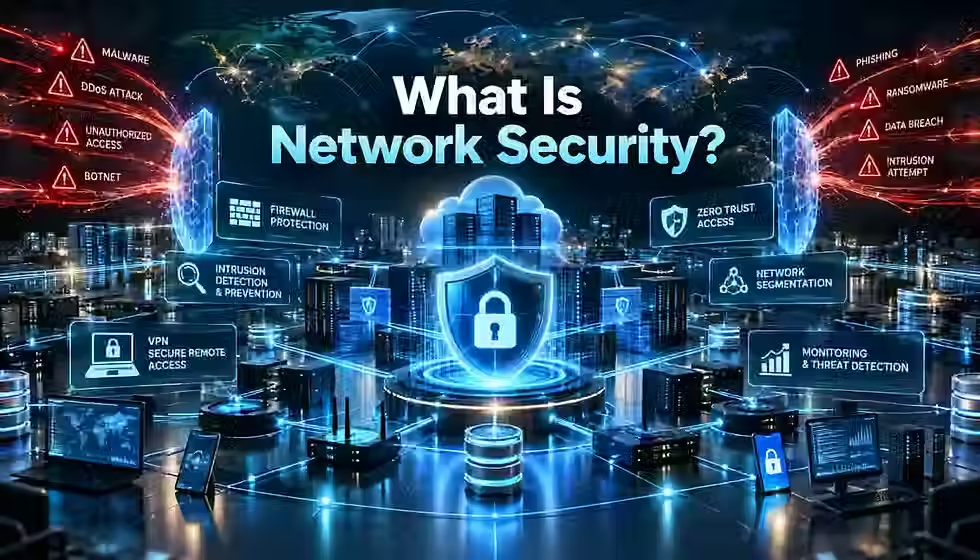
Most organizations no longer have a single, neat perimeter to defend. Employees sign in from homes and airports, applications run in SaaS platforms and several clouds, branch offices connect over the internet, partners need access to specific systems, and internet-facing services exchange data around the clock. Network security is the discipline that decides who and what may communicate across all of those paths, inspects what flows through them, and limits the damage when something goes wrong. This guide explains what network security is, how it works, which threats matter most according to current research, which best practices hold up, and how to translate your own risks and architecture into a sensible solution choice.
TL;DR
Definition: Network security protects the data, devices, applications, and connections on a network through access control, traffic filtering, segmentation, encryption, monitoring, and response. It is one layer of cybersecurity, not a synonym for it.
How it works: Controls verify identity and device, apply least-privilege policy, filter and encrypt traffic, separate systems, and watch for abnormal behavior, so threats can be blocked or contained and events recorded for investigation.
Threats: Recent reports point to exploited vulnerabilities (especially on internet-facing systems), phishing and stolen credentials, ransomware, third-party exposure, and DDoS as the main pressure points.
Best practices: Know your assets and data flows, patch exposed systems fast, use phishing-resistant MFA and least privilege, segment, centralize logs, rehearse incident response, and measure outcomes.
Choosing a solution: There is rarely one product. Map risks and architecture to capabilities, test with a scoped proof of concept, and weigh integration, staffing, total cost, and lock-in.
Quick answer: what is network security?
Network security is the practice of protecting the data, devices, applications, and connections that make up a network from unauthorized access, misuse, disruption, and theft. It combines access controls, traffic filtering, segmentation, encryption, monitoring, and response so that only legitimate users and systems can communicate, and problems are detected and contained quickly.
Table of Contents
What Is Network Security?
Network security is the combination of policies, technologies, and day-to-day practices that protect a network and the traffic crossing it. The word "network" covers more than the office LAN. It includes Wi-Fi, data-center and cloud networks, remote-access paths, links between sites, connections to partners, and everything that touches the internet.
What is protected is the set of users, devices, applications, workloads, and data that communicate over those paths. What they are protected from includes unauthorized access, malware, misuse of stolen credentials, interception, disruption such as distributed denial-of-service (DDoS) floods, and data theft.
The controls do four jobs. They decide who and what may connect (identity, authentication, and authorization). They control what traffic may flow (firewalls, segmentation, gateways). They protect traffic in transit (encryption). And they provide visibility and response (monitoring, detection, containment, and recovery).
How network security fits inside cybersecurity
Cybersecurity is the wider field. It also covers endpoints, applications, cloud configuration, data protection, people, and governance. Network security is the part concerned with communication paths and the systems that control them. The two overlap heavily, because identity decisions increasingly drive network policy and network telemetry feeds detection, but neither replaces the other. A firewall cannot fix a vulnerable application, and endpoint software cannot see traffic between unmanaged devices. For the broader picture, see our guide to what cybersecurity is.
Confidentiality, integrity, availability, and resilience
Security goals are often summarized as the confidentiality, integrity, and availability (CIA) triad. Confidentiality means only authorized parties can read data. Integrity means data is not altered without detection. Availability means systems are reachable when needed. Encryption and access control mainly serve confidentiality, authentication and tamper detection serve integrity, and DDoS protection and redundancy serve availability.
Resilience adds the ability to keep operating under stress, contain an incident, and recover. The NIST Cybersecurity Framework (CSF) 2.0 expresses this as outcomes grouped into six functions: Govern, Identify, Protect, Detect, Respond, and Recover. That structure is a useful checklist for network security programs of any size.
Why Network Security Matters
Networks are where attackers travel once they gain a foothold, and where defenders get some of their best chances to notice them. Current research from several independent sources points to the same pressure points: exposed systems, identity abuse, and speed. Each source measures something different, so the figures below are snapshots of specific datasets, not one global statistic.
Verizon: In the 2026 Data Breach Investigations Report (incidents from November 1, 2024 to October 31, 2025), Verizon reports that 31% of breaches began with exploitation of software vulnerabilities, ahead of stolen credentials as the leading way in, and that ransomware was involved in 48% of breaches.
Microsoft: In the Microsoft Digital Defense Report 2026 (July 2025 to June 2026), exploitation of public-facing applications (24%, up from 15%) and phishing (23%, up from 7%) were among the most common initial access vectors in Microsoft's incident-response findings. Microsoft also reports that the median time from discovering a vulnerability in the wild to weaponizing it has collapsed to well below 24 hours.
Mandiant: M-Trends 2026, based on Mandiant investigations during 2025, found that exploits were the most common initial infection vector (32%) for the sixth consecutive year, and that global median dwell time rose to 14 days from 11.
ENISA: The ENISA Threat Landscape 2026 covers incidents affecting the European Union in 2025. DDoS accounted for 51% of recorded cases, mostly low impact, while ransomware remained the most impactful type in the short term. Where ENISA could identify the intrusion vector in unauthorized-access incidents, 60% involved a vulnerability.
Cloudflare: In its DDoS Threat Report for the first half of 2026, Cloudflare reports mitigating 935 network-layer DDoS attacks above 1 terabit per second, with the largest class up 519% from the first to the second quarter.
The practical reading is consistent across these sources. Attackers favor whatever is reachable and unpatched, then use valid access to move around. Network security reduces exposure, limits what a stolen account or compromised system can reach, and shortens the time a problem goes unnoticed.
How Does Network Security Work?
Network security works as a chain of decisions and checks applied to every connection, with monitoring and response behind them. The tools vary, but a realistic defensive flow looks like this:
Discover assets and traffic. Identify what is on the network and which systems talk to which, so policy reflects reality rather than assumption.
Establish identity. Give users, devices, services, and workloads identities that can be verified.
Authenticate. Confirm the user and device are who they claim to be, ideally with phishing-resistant multifactor authentication (MFA).
Authorize. Apply policy that grants only the access the role and context justify (least privilege).
Filter traffic. Use firewalls, gateways, and access control lists (ACLs) to allow, block, or inspect connections.
Segment. Separate systems so a compromise in one area cannot reach everything.
Encrypt. Protect data in transit with Transport Layer Security (TLS) and other encrypted channels.
Monitor. Collect traffic metadata, logs, and alerts from network, identity, endpoint, and cloud sources.
Detect. Use rules and behavioral analytics to spot suspicious activity.
Block or contain. Drop malicious traffic, isolate a device, or revoke a session.
Log and analyze. Keep tamper-resistant records for investigation and tuning.
Respond and recover. Follow rehearsed procedures to remove the threat and restore operations.
A hypothetical example
Consider a hypothetical remote employee opening an internal finance application. The sign-in is checked against the identity provider, and phishing-resistant MFA confirms the person. A device check confirms the laptop is managed and patched. A zero trust network access (ZTNA) broker grants access to that one application, not the whole network. Traffic is encrypted end to end, and the application sits in a segment that only approved sources can reach. If the laptop later begins scanning other servers, monitoring flags the unusual behavior, and policy can cut the session while the security team investigates. Each layer is imperfect alone; together they limit what any single failure can do.
Core Principles of Network Security
A few principles shape almost every good design, regardless of vendor or architecture.
Defense in depth: Use multiple, independent layers so one failure does not become a breach.
Least privilege: Grant users, devices, and services only the access they need, for only as long as they need it.
Zero trust: NIST SP 800-207 describes zero trust as an evolving set of paradigms that move defenses from static network perimeters to users, assets, and resources. It assumes no implicit trust based on network location or ownership and treats authentication and authorization as discrete functions performed before a session is established. Zero trust is an architecture and operating model, not a single product.
Segmentation: Divide the network into zones with controlled paths between them to limit lateral movement.
Visibility: You cannot defend or investigate what you cannot see, so telemetry coverage matters as much as prevention.
Secure defaults and hygiene: Change default credentials, disable unneeded services, and keep configurations documented and reviewed.
Resilience: Assume some controls will fail, and plan to contain, recover, and keep critical services running.
These principles describe decisions and outcomes rather than boxes. A product can support them, but it cannot substitute for them.
Types of Network Security Controls and Technologies
The table below summarizes the major technologies, where each operates, and what each does not replace. The sections after it explain the distinctions readers most often confuse.
Technology | What it does | Where it operates | Does not replace | |
|---|---|---|---|---|
Firewall / NGFW | Allows or blocks traffic by rules; NGFW adds application and user awareness and often intrusion prevention | Network edges, data-center and cloud boundaries, internal zones | Patching, identity controls, endpoint protection | |
IDS | Detects suspicious traffic and alerts | Out-of-band sensors on mirrored traffic | Blocking or investigation | |
IPS | Detects and blocks malicious traffic in line | Inline at key network points | Behavioral detection of unknown threats | |
NDR | Analyzes network telemetry to detect and help respond to threats | Network and cloud traffic, including internal paths | EDR or SIEM | |
NAC | Checks device identity and posture before granting network access | Wired, wireless, and remote access points | Application-level authorization | |
DNS security | Blocks malicious domains and flags suspicious DNS behavior | DNS resolvers | Full web or traffic inspection | |
Secure web gateway | Filters web traffic, enforces policy, inspects for malware | Cloud or on-premises proxy | Private application access control | |
VPN | Encrypted tunnel into a network | Remote user to gateway | Fine-grained, per-application access | |
ZTNA | Per-application access based on identity and device context | Broker between users and applications | Threat detection | |
Segmentation / microsegmentation | Limits which systems can communicate | VLANs, firewalls, host or workload policy | Detection and response | |
DDoS protection | Absorbs or filters flood traffic | Upstream provider, CDN, or scrubbing service | Intrusion prevention | |
WAF | Filters HTTP and HTTPS requests to web apps and APIs | In front of web applications | Network firewalls or secure coding | |
Encryption / TLS | Protects data in transit | Between clients, services, and sites | Access control | |
Wi-Fi security | Strong authentication and encryption for wireless access | Access points and controllers | Wired and internal segmentation | |
Cloud-native controls | Security groups, network ACLs, cloud firewalls, flow logs | Virtual networks in cloud platforms | Application and identity security |
Firewalls and next-generation firewalls
A firewall enforces rules about which connections may pass between networks or zones. A next-generation firewall (NGFW) adds application awareness, user identity, and typically intrusion prevention and threat intelligence. Firewalls remain the workhorse for network edges, data-center boundaries, and internal segmentation. Their trade-offs are rule sprawl, performance under deep inspection, and limited visibility into encrypted traffic unless decryption is configured.
IDS vs IPS vs NDR
An intrusion detection system (IDS) watches traffic and alerts. An intrusion prevention system (IPS) sits in line and can block. Network detection and response (NDR) analyzes network telemetry with behavioral analytics to find threats that signatures miss, and often supports investigation and response. NDR is not endpoint detection and response (EDR), which watches activity on individual devices, and it is not a security information and event management (SIEM) platform, which aggregates and correlates logs from many sources. They complement each other. For SIEM background, see our SIEM guide.
Aspect | IDS | IPS | NDR | |
|---|---|---|---|---|
Position | Out of band (taps, mirrors) | Inline | Sensors, taps, flow and cloud telemetry | |
Primary action | Alert | Block or drop | Detect behavior; support investigation and response | |
Typical method | Signatures and rules | Signatures, rules, some anomaly detection | Behavioral analytics and traffic analysis | |
Strength | Low risk to traffic flow | Stops known threats automatically | Finds unknown or stealthy activity, including internal | |
Limitation | Does not stop attacks itself | Can disrupt traffic if poorly tuned | Needs baselines and tuning; limited by encryption |
VPN vs ZTNA
A virtual private network (VPN) extends a network to a remote user through an encrypted tunnel. Zero trust network access (ZTNA) grants access to specific applications after evaluating identity and device context. Many organizations run both during a transition.
Aspect | VPN | ZTNA | |
|---|---|---|---|
Access scope | Network level, often broad | Per application or resource | |
Trust model | Connected users often get wide reach | Access evaluated by identity and device context | |
Lateral movement risk | Higher when network reach is broad | Lower with narrow access | |
Best fit | Legacy or network-level needs, simple deployments | Remote workforce, partners, application-level control | |
Trade-offs | Broad access; scaling at the gateway | Legacy protocol support varies by product; policy design effort |
SASE vs SSE
Secure access service edge (SASE) combines network connectivity, typically software-defined WAN, with cloud-delivered security. Security service edge (SSE) is the security portion of that idea: commonly a secure web gateway, ZTNA, and a cloud access security broker delivered as a cloud service. In short, SASE is SSE plus networking. SSE suits organizations that keep their existing network and want to modernize security; SASE suits those redesigning both. Bundles vary by vendor, so verify exactly which capabilities a product includes.
Segmentation vs microsegmentation
Network segmentation separates a network into zones, commonly with VLANs, subnets, and firewalls, so traffic between zones is controlled. Microsegmentation applies finer policy, often per workload or application, frequently enforced by host agents, hypervisors, or cloud controls. Segmentation is the foundation; microsegmentation adds granularity where the risk and operational capacity justify it.
WAF vs network firewall
A web application firewall (WAF) inspects HTTP and HTTPS requests to web applications and APIs, looking for attack patterns such as injection attempts. A network firewall works mainly on addresses, ports, protocols, and sessions. Use both where web applications are exposed, and remember that neither fixes insecure code.
Encryption vs access control
Encryption protects data in transit so interceptors cannot read it. Access control decides who may reach the data in the first place. TLS secures a connection but does not decide whether the party on the other end should have access. Encrypted traffic also reduces what inspection tools can see, which is a design trade-off to plan for.
Common Network Security Threats and Attack Methods
Threats are best understood by what they exploit and what stops them. The table maps common threats to risks and defensive controls. It is deliberately defensive and does not describe how to carry out attacks.
Threat | Main risk | Defensive controls | |
|---|---|---|---|
Exploited vulnerabilities and exposed services | Initial access through unpatched internet-facing systems | Asset and exposure inventory, rapid patching, removing unneeded exposure, WAF and IPS as compensating layers | |
Credential theft and phishing | Valid accounts used to sign in rather than break in | Phishing-resistant MFA, least privilege, email and DNS filtering | |
Malware and ransomware | Encryption, extortion, disruption | Segmentation, EDR plus network detection, tested offline backups, egress filtering | |
DDoS | Loss of availability | Upstream mitigation, always-on automated protection, capacity and redundancy | |
Misconfiguration and cloud exposure | Open ports, overly broad rules, public storage | Policy as code, configuration review, flow-log monitoring | |
Insider and third-party risk | Misuse of legitimate access, supplier compromise | Least privilege, per-application access, contract requirements, activity monitoring | |
Lateral movement | Spread from one system to many | Segmentation, microsegmentation, internal traffic monitoring (NDR) | |
Command-and-control and data exfiltration | Hidden channels and data theft | DNS security, egress controls, NDR, TLS inspection where appropriate | |
Unmanaged devices and shadow IT | Unknown assets bypass controls | Discovery, NAC, device posture checks, approval processes | |
IoT and OT exposure | Unpatchable devices reachable from other networks | Deny-by-default segmentation, monitored intermediaries, no public exposure |
Two themes deserve emphasis. First, third-party and supply-chain exposure: ENISA's 2026 assessment highlights attacks on cyber dependencies, including supply-chain and third-party attacks, which usually produce large-scale or impactful incidents. Second, artificial intelligence (AI). Microsoft reports that AI is compressing attack timelines and that fully autonomous attack chains have been demonstrated in lab evaluations, while most real-world campaigns it observes still retain human direction. ENISA likewise describes AI mainly as a tool that facilitates or enhances existing malicious activity. The defensive implication is speed: patching, detection, and credential revocation must keep pace.
How Modern Network Attacks Progress
Most intrusions follow a familiar arc, which is useful because every stage is a chance to detect or block. Described at a high level:
Initial access: An exposed vulnerable service, a phishing message, or stolen credentials provide the first foothold.
Foothold and persistence: The attacker establishes a way back in, often using legitimate tools and accounts.
Discovery and privilege escalation: They learn what the network contains and seek higher privileges.
Lateral movement: They move between systems using remote services and valid credentials.
Command and control (C2): Compromised systems communicate with attacker infrastructure, sometimes blending into normal web traffic.
Exfiltration or impact: Data is stolen, encrypted, or destroyed, or services are disrupted.
Defenders can interrupt each stage: reduce exposed services and patch quickly, require phishing-resistant MFA, segment and restrict internal paths, monitor for unusual internal scanning and unexpected outbound connections, and keep recoverable backups. Time matters. Mandiant reports a global median dwell time of 14 days in M-Trends 2026, which means many intrusions are active for days before discovery, and Microsoft notes that AI is shortening the time between steps. Detection coverage inside the network is therefore as important as the perimeter.
Network Security for Cloud, Hybrid, Remote, and On-Premises Environments
Different environments change where controls live, not whether they are needed.
On-premises networks
Traditional controls still matter: perimeter and internal firewalls, segmentation, network access control (NAC), wireless security, and monitoring at key choke points. The common weakness is a flat internal network where one compromised device can reach many others.
Cloud networks
In public cloud, the provider secures the underlying infrastructure while the customer configures networks, access policies, and workloads under a shared responsibility model. Cloud-native controls include security groups, network ACLs, cloud firewalls, private connectivity, and flow logs. Misconfiguration is the typical failure, so policy as code and continuous configuration review help. For background, see our guides to public cloud and virtual private clouds.
Hybrid and multi-cloud
The main risk is inconsistent policy: different tools, naming, and rules in each environment create gaps. Aim for common identity, a shared policy model, and unified logging. Our multi-cloud guide discusses the architecture trade-offs.
Remote work and branches
With users and sites outside a central office, routing everything through a data-center VPN adds latency and risk. ZTNA, SSE, or SASE bring policy enforcement closer to users and applications, with consistent identity and device checks.
IoT and operational technology
Many Internet of Things (IoT) and operational technology (OT) devices cannot be patched quickly or run security agents, so network controls carry more of the load. CISA's Cross-Sector Cybersecurity Performance Goals recommend denying connections to OT networks by default, routing necessary IT-to-OT paths through a monitored intermediary such as a firewall, bastion host, or demilitarized zone, and keeping OT assets off the public internet unless operationally required.
Network Security Best Practices
The practices below align with NIST CSF 2.0 functions and with CISA's voluntary Cross-Sector Cybersecurity Performance Goals (CPGs), which prioritize a limited set of high-impact actions.
Know what you have (Identify)
Maintain an asset inventory. CISA's CPGs recommend a regularly updated inventory of all assets with an IP address, including OT, refreshed at least monthly.
Map data flows and document topology. Accurate network diagrams and baseline configurations speed up both defense and recovery.
Reduce exposure (Protect)
Patch exposed systems quickly. The CPGs call for known exploited vulnerabilities in internet-facing systems to be patched or mitigated within a risk-informed time, critical assets first. Microsoft's research argues that patch velocity, not patch availability, is what matters.
Remove exploitable services from the internet. Avoid exposing services such as remote desktop; where exposure is necessary, add compensating controls.
Harden edge devices. Firewalls, VPN gateways, and routers are high-value targets. Keep them updated, restrict management interfaces, and log centrally.
Strengthen identity (Protect)
Use phishing-resistant MFA where practical. CISA ranks hardware-based, phishing-resistant MFA (FIDO/WebAuthn) as the strongest option, and Microsoft likewise recommends passkeys and phishing-resistant MFA.
Apply least privilege. Separate administrator and everyday accounts, review privileges regularly, and revoke access for departing staff by the day they leave.
Contain and encrypt (Protect)
Segment networks and restrict lateral movement, with deny-by-default rules between zones.
Secure remote and third-party access with per-application access rather than broad network access.
Encrypt traffic with current TLS configurations, and use DNS security to block known-malicious destinations.
See and respond (Detect, Respond, Recover)
Centralize meaningful logs from firewalls, VPN or ZTNA, DNS, identity, and cloud sources, and protect them from tampering.
Tune detection around the threats relevant to your sector, and alert on repeated failed logins.
Test incident response with realistic exercises at least annually, and keep tested backups stored separately from source systems.
Govern and verify (Govern)
Review firewall and access rules on a schedule and remove stale ones.
Validate controls through third-party tests or assume-breach exercises, and test changes before deployment.
Manage third-party risk by writing incident-notification and security requirements into contracts.
Measure outcomes rather than counting tools purchased.
How to Build or Improve a Network Security Program
A maturity-based sequence keeps effort aligned with risk. Treat it as a loop, not a one-time project.
Understand. Inventory assets, users, data, connections, and external exposure. Identify the applications and data that would hurt most to lose.
Establish the baseline. Strengthen identity and MFA, patch management, secure configuration, firewalling, logging, and backups with recovery tests.
Reduce attack paths. Add segmentation, move toward ZTNA or equivalent per-application access, cut standing privileges, and shrink internet exposure.
Improve detection and response. Add NDR, SIEM, and security operations center (SOC) workflows or a managed service, tune alerts, and write and rehearse incident response.
Optimize. Use metrics, automation, validation testing, and architecture reviews to keep improving.
SMB vs enterprise priorities
A small business with a small IT team should concentrate on the baseline: strong identity, rapid patching, a well-configured firewall, secure remote access, backups, and basic monitoring, often delivered through managed services. A larger enterprise typically needs the same baseline plus segmentation at scale, centralized policy across sites and clouds, dedicated detection and response capability, and formal governance. In both cases, our overview of cybersecurity infrastructure can help frame what supports what.
How to Choose the Right Network Security Solution
"Network security solution" rarely means one universal product. It usually means a combination of capabilities delivered through appliances, virtual or cloud services, software agents, or a managed provider. The goal is to translate your risks and architecture into required capabilities, then evaluate products against those requirements.
Start with requirements
Begin with the factors that shape needs: organization size and industry, regulatory obligations, risk profile, topology and number of sites, the mix of on-premises, cloud, and hybrid systems, remote workforce, application architecture, internet exposure, and what you already own. Then list the capabilities you need (for example, segmentation, per-application remote access, DNS filtering, or detection) and rank them by risk reduction.
Match capabilities to organizational profiles
Organization profile | Capabilities to prioritize | Why | |
|---|---|---|---|
Small IT team | Centralized management, managed monitoring, automation, simple per-application access | Limits operational burden | |
Multi-site company | Consistent branch policy (SD-WAN or SASE), central logging, standard firewall templates | Prevents policy drift across sites | |
Cloud-first company | Cloud-native controls, identity-based access, SSE, flow-log analytics | Matches where workloads live | |
Hybrid enterprise | One policy model across environments, segmentation, strong SIEM and identity integration | Reduces gaps between environments | |
Regulated organization | Strong logging and retention, data residency controls, audit reporting, segmentation of regulated data | Supports evidence and compliance | |
Large remote workforce | ZTNA or SSE, device posture checks, DNS and web security | Protects access beyond the office | |
Material IoT or OT | Passive asset discovery, deny-by-default segmentation, monitored IT/OT boundaries | Protects devices that cannot be patched or agented | |
High DDoS exposure | Upstream mitigation, automated always-on protection, capacity planning | Preserves availability |
Weigh the trade-offs
Consolidating onto fewer platforms can reduce complexity, integration work, and cost, but it can also increase vendor concentration, lock-in, and the impact of a single outage or flaw. Buying more tools does not equal better security; unused features and unmonitored alerts add cost without reducing risk. Decide deliberately which capabilities merit best-of-breed depth and which can sit on a shared platform.
Self-managed or managed
Self-managed controls give more control but require skills, coverage, and on-call capacity. Managed services can fill staffing gaps and provide round-the-clock monitoring, but you should clarify who owns policy changes, how quickly incidents are escalated, what data the provider can access, and how you would exit. Outsourcing operations does not transfer accountability.
Total cost of ownership
Compare more than license price: hardware or cloud consumption, throughput or user-based tiers, support, integration and migration work, training, staff time for tuning, logging volume costs, and the cost of exit. Request pricing in writing for your actual scale and verify claims against current official documentation, since pricing and packaging change often. This guide does not rank vendors, because credible rankings require testing in your own environment.
Run a proof of concept
A proof of concept (PoC) should test your use cases, not a vendor demo. Define success criteria in advance and use representative traffic and users. Test performance and latency under load, failure behavior, integration with your identity provider, SIEM, and endpoint tools, and the day-to-day experience of the administrators who will run it.
Network Security Solution Evaluation Checklist
Take these questions into vendor meetings and your PoC. They are grouped so different stakeholders can own different parts.
Security fit: Which of our top threats and attack paths does it address? What does it explicitly not cover? How is detection content updated and validated?
Architecture and performance: What throughput, latency, and availability do we get at our scale with inspection and decryption enabled? How does it fail, open or closed?
Policy: How granular is policy? Can one policy model span on-premises, cloud, and remote users?
Integration: Does it integrate with our identity provider, endpoint tools, SIEM, ticketing, and automation, and are its APIs complete?
Operations: What are the deployment effort, change process, and daily workload? What skills do we need, and is a managed option available?
Visibility and reporting: Which logs and telemetry are available, how long are they retained, and can we export them without penalty?
Support and roadmap: What are the support hours and escalation paths? How does the vendor handle vulnerabilities and disclose incidents in its own products?
Data and privacy: Where is traffic processed and stored? Which residency, privacy, and compliance commitments are contractual?
Commercial: What is the three-to-five-year total cost? What are the renewal terms, overage rules, and minimums?
Exit and lock-in: Can we export configurations and logs? What would migration require?
Governance: Who owns the control, who approves changes, and how will we review it?
Network Security Metrics: How to Measure Effectiveness
Good metrics show whether risk is falling. Microsoft's 2026 report urges shifting from the number of patches deployed to exposure reduced, detection coverage increased, and time to mitigate compressed. The table lists outcome-oriented measures and the caveat for each.
Metric | What it shows | Caveat | |
|---|---|---|---|
MFA coverage | Share of accounts, especially privileged and remote, protected by MFA | Weight phishing-resistant methods more heavily | |
Asset inventory coverage | How much of the environment is known | Depends on discovery quality | |
Internet-exposed assets | Attack surface trend | Track severity, not only count | |
Patch and remediation latency | How fast known issues are fixed | Track critical and exposed systems separately | |
Monitored-traffic coverage | Share of traffic and segments with visibility | Encrypted and cloud traffic may be undercounted | |
Firewall-rule review coverage | Share of rules reviewed in a set period | Review quality matters, not just completion | |
Unmanaged devices | Devices without ownership or controls | Depends on discovery | |
Segmentation-policy violations | Attempts to cross boundaries | High counts can mean probing or misconfiguration | |
Detection false-positive rate | Alert quality and analyst workload | Very low rates can mean missed detections | |
Mean time to detect, respond, and contain | Speed of operations | Averages hide outliers; use medians and percentiles | |
Recovery-test success | Whether backups and plans work | Test realistic scenarios |
Metrics have limits. Percentages can hide the one critical asset that is uncovered, and detection counts can reward noise. Pair every metric with a threshold, an owner, and a link to business risk, and review them regularly instead of collecting everything measurable.
Common Network Security Mistakes to Avoid
Treating the perimeter as the whole defense. Internal paths and identity matter as much as the edge.
Leaving networks flat. Without segmentation, one compromised account or device can reach too much.
Letting firewall rules accumulate. Old, overly broad rules quietly widen exposure.
Skipping edge-device hygiene. Internet-facing appliances are frequent targets and need fast updates and tight management access.
Buying tools without operating them. Unmonitored alerts and unused features add cost, not protection.
Ignoring encrypted traffic and cloud flows, which can leave blind spots in monitoring.
Never testing recovery or response. Untested backups and plans often fail when they are needed.
Assuming a zero trust product equals zero trust. The model requires policy, identity, device, and data work.
The Future of Network Security
Some trends are established practice and others are emerging direction. Distinguishing them helps with planning.
Current practice: identity-centric security and zero trust. Microsoft and CISA both emphasize strong identity controls, and zero trust architectures are increasingly the design reference.
Current practice: SASE and SSE. Cloud-delivered security continues to absorb functions once handled by branch and data-center appliances, along with pressure to consolidate vendors.
Emerging: AI on both sides. Microsoft and ENISA expect AI to increase attacker speed and scale, while defenders use it for correlation, prioritization, and response. Human oversight and governance remain essential.
Emerging: machine and agent identities. As organizations deploy AI agents, Microsoft says each needs its own identity, scoped credentials, and a human sponsor. See our guide to agentic AI security.
Ongoing challenge: encrypted-traffic visibility, which pushes monitoring toward metadata, endpoints, identity signals, and selective decryption.
Emerging: exposure management and continuous validation, replacing periodic scans and annual tests with continuous discovery and testing.
Planning item: post-quantum cryptography. CISA's CPGs encourage planning for post-quantum implications, and Microsoft recommends building a cryptographic inventory. See our quantum cybersecurity guide.
FAQ
What is network security in simple terms?
Network security is protecting the computers, applications, and data that communicate over a network from unauthorized access, misuse, and disruption. It works by controlling who can connect, filtering and encrypting traffic, separating systems, and watching for suspicious behavior so problems can be stopped and investigated.
What is the difference between network security and cybersecurity?
Cybersecurity is the broader discipline covering endpoints, applications, identities, cloud configuration, data, people, and governance. Network security is the part focused on communication paths and the controls that govern them, such as firewalls, segmentation, secure remote access, and traffic monitoring. The two overlap but do not replace each other.
What are the main types of network security?
Common types include firewalls and next-generation firewalls, intrusion detection and prevention systems, network detection and response, network access control, DNS and web security, VPN and zero trust network access, segmentation and microsegmentation, DDoS protection, web application firewalls, encryption, wireless security, and cloud-native network controls. Most organizations combine several.
What are the biggest network security threats?
Current research highlights exploited vulnerabilities on internet-facing systems, phishing and stolen credentials, ransomware, third-party and supply-chain exposure, misconfiguration, and DDoS attacks. The most common entry point differs by dataset, so prioritize reducing exposure, strengthening identity, and detecting movement inside the network.
Is a firewall enough?
No. A firewall controls which connections are allowed, but it does not fix vulnerable applications, stop stolen credentials from being used, or detect every attacker already inside the network. It works best as one layer alongside strong identity, patching, segmentation, monitoring, and tested recovery.
What is zero trust network security?
Zero trust is a security model that removes implicit trust based on network location or ownership. NIST SP 800-207 describes performing authentication and authorization before a session to a resource is established and focusing protection on resources rather than network segments. It is an architecture, not a single product.
What is the difference between VPN and ZTNA?
A VPN connects a user to a network through an encrypted tunnel, often with broad reach once connected. ZTNA grants access to specific applications after checking identity and device context, which narrows what a compromised account can reach. Many organizations run both while they migrate.
What is network segmentation?
Network segmentation divides a network into zones and controls the traffic allowed between them, so a compromise in one zone cannot easily spread to others. Microsegmentation applies finer rules, often per workload or application. Segmentation is a core way to limit lateral movement.
What is the difference between SASE and SSE?
SASE combines network connectivity, such as software-defined WAN, with cloud-delivered security. SSE is the security portion, typically a secure web gateway, ZTNA, and a cloud access security broker. Because bundles vary by vendor, confirm exactly which capabilities each product includes.
How does cloud network security differ from traditional network security?
Traditional designs focus on a physical perimeter and appliances. In the cloud, the provider secures the underlying infrastructure, while customers configure virtual networks, security groups, access policies, and logging under a shared responsibility model. Misconfiguration and inconsistent policy across environments are the usual risks.
What network security does a small business need?
A small business should prioritize strong identity with MFA, rapid patching, a properly configured firewall, secure remote access, DNS or web filtering, separated guest and device networks, backups with tested recovery, and basic monitoring. Managed services can cover gaps in staffing and round-the-clock coverage.
How do you choose a network security solution?
Start with your risks, architecture, and existing tools, then translate them into required capabilities. Shortlist options, compare integration, performance, operational burden, support, data handling, total cost, and lock-in, and validate finalists in a proof of concept using your own use cases and success criteria.
Key Takeaways
Network security is layered. No single control prevents every attack, and each layer covers gaps in the others.
Identity and networking now overlap. Access decisions increasingly depend on who and what is connecting, not only where they connect from.
Perimeter-only designs are insufficient for architectures that span clouds, SaaS, branches, and remote users.
Exposed, unpatched systems and compromised accounts recur as entry points in current research, so reducing exposure and strengthening identity pay off disproportionately.
Visibility and segmentation limit damage. They turn a foothold into a contained incident rather than a breach.
Controls must be operated, tuned, tested, and measured, not just purchased.
Selection depends on risk, architecture, skills, and integration, so run a scoped proof of concept and weigh cost, lock-in, and exit options.
Network security is continuous risk management, not a project with an end date.
Actionable Next Steps
Inventory your assets and external exposure, including cloud and remote-access services.
Map critical applications, data, and the traffic flows between them.
Review identity and MFA coverage, starting with administrators and remote access.
Fix the most exposed systems first: patch, remove unnecessary services, and harden edge devices.
Assess segmentation and decide which boundaries to add or tighten first.
Identify monitoring and detection gaps, including cloud and internal traffic.
Rank gaps by business risk and decide what to address in the next quarter.
Define requirements and a shortlist using the evaluation checklist above.
Run a controlled proof of concept against written success criteria.
Establish metrics, owners, an incident-response exercise, and a recurring review cadence.
Glossary
ACL (access control list): A set of rules that permits or denies traffic or access to a resource.
Attack surface: All the points where an attacker could try to enter or affect a system.
Authentication: Verifying that a user, device, or service is who it claims to be.
Authorization: Deciding what an authenticated identity is allowed to do.
CIA triad: Confidentiality, integrity, and availability, the three core security goals.
DDoS: A distributed denial-of-service attack that floods a target to make it unavailable.
DNS security: Controls that block malicious domains and detect abuse of the Domain Name System.
EDR: Endpoint detection and response, which monitors and responds to activity on individual devices.
Firewall: A control that allows or blocks connections based on rules.
IDS: An intrusion detection system that alerts on suspicious activity.
IPS: An intrusion prevention system that detects and blocks threats in line.
Least privilege: Giving only the minimum access needed to do a task.
MFA: Multifactor authentication, which requires more than one proof of identity.
Microsegmentation: Fine-grained segmentation that controls traffic between individual workloads or applications.
NAC: Network access control, which checks device identity and posture before granting access.
NDR: Network detection and response, which analyzes network traffic to detect and respond to threats.
NGFW: A next-generation firewall that adds application and user awareness and threat prevention.
Network segmentation: Dividing a network into zones with controlled paths between them.
SASE: Secure access service edge, which combines networking and cloud-delivered security.
SIEM: Security information and event management, which aggregates and correlates logs and alerts.
SOC: A security operations center, the team and processes that monitor and respond to threats.
SSE: Security service edge, the cloud-delivered security portion of SASE.
TLS: Transport Layer Security, the protocol that encrypts data in transit.
VPN: A virtual private network that creates an encrypted tunnel to a network.
WAF: A web application firewall that filters requests to web applications and APIs.
Zero trust: A security model that removes implicit trust based on network location or ownership.
ZTNA: Zero trust network access, which grants per-application access based on identity and context.
Sources & References
National Institute of Standards and Technology (NIST). The NIST Cybersecurity Framework (CSF) 2.0, NIST CSWP 29. February 2024. https://doi.org/10.6028/NIST.CSWP.29
Rose, S., Borchert, O., Mitchell, S., and Connelly, S. NIST. Zero Trust Architecture, NIST SP 800-207. August 2020. https://doi.org/10.6028/NIST.SP.800-207
Cybersecurity and Infrastructure Security Agency (CISA). Cross-Sector Cybersecurity Performance Goals. Current web version, accessed October 9, 2026. https://www.cisa.gov/cross-sector-cybersecurity-performance-goals
Verizon Business. 2026 Data Breach Investigations Report. May 2026. https://www.verizon.com/business/resources/reports/dbir/
Microsoft. Microsoft Digital Defense Report 2026. October 1, 2026. Report PDF
European Union Agency for Cybersecurity (ENISA). Exploring the evolution of the cyber threat landscape: How dependencies weaken our digital resilience (press release for the ENISA Threat Landscape 2026). September 22, 2026. https://www.enisa.europa.eu/news/exploring-the-evolution-of-the-cyber-threat-landscape-how-dependencies-weaken-our-digital-resilience
Google Cloud (Mandiant). M-Trends 2026 Report, Executive Edition. 2026 (investigations from January 1 to December 31, 2025). https://cloud.google.com/security/resources/m-trends-executive-edition
Cloudflare. Cloudflare DDoS Threat Report H1 2026 (25th edition). August 2026. https://blog.cloudflare.com/ddos-threat-report-2026-h1/


