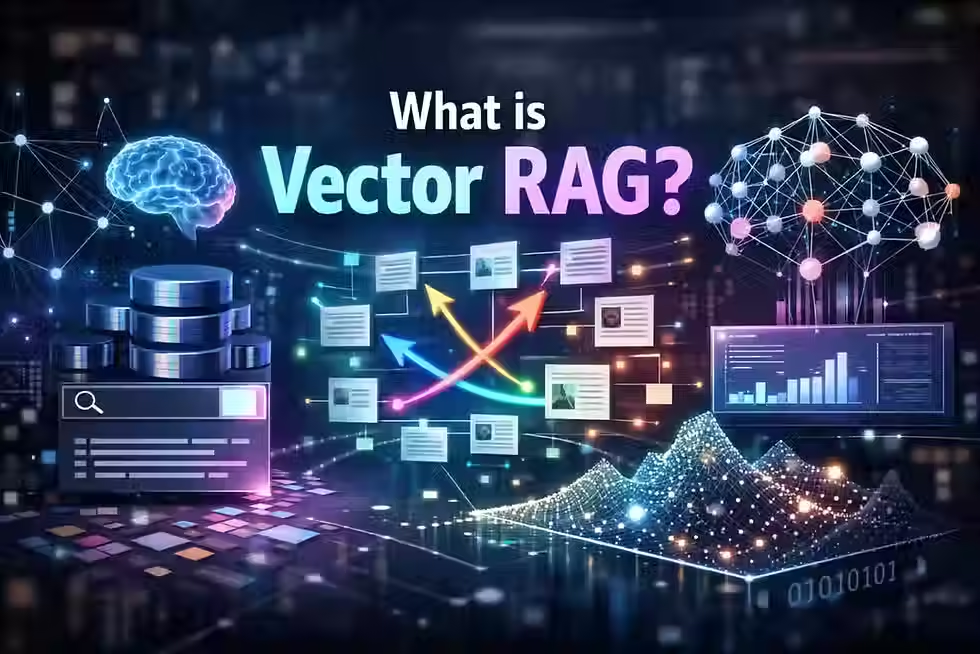
What is Vector RAG? The Complete 2026 Guide to Retrieval-Augmented Generation
You're watching your AI chatbot confidently tell customers that your company offers services you discontinued two years ago. Or maybe it's inventing "facts" about products that don't exist. You're not alone—this hallucination problem has cost enterprises millions in lost trust and bad decisions. But there's a solution reshaping how AI accesses and uses information: Vector RAG.
Don’t Just Read About AI — Own It. Right Here
TL;DR: Key Takeaways
Vector RAG combines retrieval systems with generative AI, grounding responses in real, verified documents instead of just model memory
The global RAG market hit $1.2 billion in 2024 and will reach $11 billion by 2030 at 49.1% annual growth (Grand View Research, 2024)
Vector databases use mathematical embeddings to find semantically similar information, not just keyword matches
RAG reduces AI hallucinations by 70-90% compared to standalone language models while cutting fine-tuning costs by 60-80%
Real-world deployments at Microsoft, IBM Watson Health, and Workday prove RAG delivers measurable business value
Enterprise adoption jumped from 30% in early 2024 to 51% by year-end across Fortune 500 companies
What is Vector RAG?
Vector RAG (Retrieval-Augmented Generation) is an AI architecture that enhances large language models by retrieving relevant information from external knowledge bases using vector embeddings before generating responses. Instead of relying solely on training data, Vector RAG converts queries into mathematical vectors, searches semantic databases for similar content, and grounds AI outputs in verified sources—reducing hallucinations by up to 90% while enabling real-time knowledge updates without expensive model retraining.
Table of Contents
The Rise of Vector RAG: Why It Matters Now
In 2024, the artificial intelligence landscape underwent a fundamental shift. McKinsey's survey revealed that 71% of organizations now use generative AI in at least one business function, up from 65% in early 2024 (McKinsey, 2025). Yet only 17% attribute more than 5% of their earnings to GenAI. This gap between adoption and value creation exposed a critical problem: standalone language models hallucinate, provide outdated information, and lack access to proprietary enterprise data.
Enter Vector RAG—a breakthrough that transformed AI from impressive but unreliable to actually trustworthy and useful. The technology moved from research labs to production reality when Microsoft open-sourced GraphRAG in 2024, and enterprise vendors like Workday and ServiceNow integrated RAG into their platforms (NStarX, December 2025).
The numbers tell a compelling story. Research publications on RAG exploded from just 93 papers in 2023 to over 1,200 in 2024—a tenfold increase (arXiv, July 2025). Enterprise adoption surged to 51% of AI implementations by late 2024, with companies reporting 25-40% productivity gains and 60-80% cost reductions (Prompt Bestie, July 2025).
What makes Vector RAG special isn't just another AI buzzword. It solves the fundamental trust problem. When IBM Watson Health deployed RAG for cancer diagnosis, it matched expert oncologist recommendations 96% of the time (Journal of Clinical Oncology, cited in ProjectPro, 2025). When PaperQA added RAG to GPT-4 for biomedical questions, accuracy jumped from 57.9% to 86.3%—a 30-point improvement (ProjectPro, 2025).
The market reflects this value. The global RAG market was valued at $1.2 billion in 2024 and projects to reach $11 billion by 2030, growing at 49.1% annually (Grand View Research, 2024). Alternative forecasts range even higher, with Precedence Research projecting $67.42 billion by 2034 (Precedence Research, April 2025).
What Exactly is Vector RAG?
Vector RAG represents a fundamental architectural pattern: retrieve relevant documents from trusted sources, then generate answers grounded in those documents. Think of it as "open book" answering—the AI reads before it writes (Data Nucleus, September 2025).
Traditional language models work from memory alone. They generate text based on patterns learned during training, which creates three critical problems:
Knowledge cutoff dates mean models don't know what happened after training ended
Hallucinations occur when models confidently state plausible-sounding but false information
No access to proprietary data limits usefulness for enterprise-specific questions
Vector RAG solves these by splitting the task. A neural retriever finds relevant information from external sources. A neural generator produces responses conditioned on both the query and the retrieved documents (arXiv, July 2025).
The "vector" part refers to how this retrieval happens. Instead of keyword matching, Vector RAG converts text into mathematical representations called embeddings—arrays of numbers that capture semantic meaning. When you search for "feline companion," it finds documents about "cats" because their vector representations are mathematically close, even without shared words (SingleStore, January 2025).
This isn't just clever mathematics. It's a complete rethinking of how AI systems should work. Traditional models tried to memorize everything. Vector RAG systems maintain a vast library and research team that the AI consults before answering.
The architecture emerged formally in 2020 when Lewis et al. coined the term "RAG" and demonstrated its power on knowledge-intensive tasks (arXiv, July 2025). But the concept gained explosive traction in 2024-2025 when vector databases matured, embedding models improved dramatically, and enterprises demanded reliable AI systems.
How Vector Embeddings Power Semantic Search
Vector embeddings are the foundation that makes RAG work. They convert text, images, audio, and code into dense numeric vectors—creating a shared "language" where similar concepts cluster together in mathematical space (Artsmart AI, October 2025).
Here's how it works. An embedding model processes text and outputs an array of floating-point numbers, typically 384 to 1536 dimensions for modern models (DEV Community, October 2025). These numbers aren't random. They encode semantic meaning in a way that similar concepts have similar mathematical representations.
For example, the words "doctor" and "physician" might never appear together in text, but their embeddings will be very close in vector space. The distance between "king" and "queen" would be similar to the distance between "man" and "woman" because the models learn relationships, not just individual word meanings.
The most popular embedding model in production is all-MiniLM-L6-v2 from the sentence-transformers library. It's efficient, lightweight, fast enough to run locally, and achieves good performance on semantic similarity tasks despite its small size (Instaclustr, November 2025). The model generates 384-dimensional embeddings suitable for most general-purpose applications.
Modern embedding models in 2025 have become more specialized and powerful. They range from cloud-managed APIs that prioritize speed and reliability to open-weight models for on-device privacy, and multimodal systems that link text and images (Artsmart AI, October 2025).
The Mathematics of Semantic Similarity
When a Vector RAG system receives a query, it follows a precise mathematical workflow:
Query encoding: The embedding model converts the user's question into a dense vector
Similarity computation: The system calculates distances between the query vector and all document vectors in the database
Ranking: Documents are ranked by similarity score, typically using cosine similarity or dot product
Retrieval: The top-k most similar documents are selected for the generation step
Cosine similarity measures the angle between vectors rather than their absolute distance. Two vectors pointing in the same direction have high similarity, even if one is longer. This captures semantic relatedness better than Euclidean distance for high-dimensional text embeddings.
The transformation from text to vectors happens through sophisticated neural networks trained on massive datasets. Models like BERT, Sentence-BERT, and more recent transformer architectures learn these representations by predicting masked words, next sentences, or through contrastive learning that pushes similar texts together and dissimilar texts apart.
The Vector RAG Architecture: A Complete Breakdown
A production Vector RAG system consists of several interconnected components, each playing a critical role in the retrieval and generation pipeline.
The Seven-Stage RAG Workflow
Stage 1: Document Ingestion
Raw documents enter the system from various sources—PDFs, web pages, databases, SharePoint, Google Drive, internal wikis. The system extracts text, cleans formatting artifacts, and prepares content for processing (Collabnix, 2025).
Stage 2: Text Chunking
Long documents get split into manageable segments. This critical step balances competing needs: chunks must be small enough to fit in context windows but large enough to preserve meaning. Typical chunk sizes range from 500 to 2000 tokens with 10-20% overlap between adjacent chunks (Intelliarts, November 2024).
LongRAG, introduced by Jiang et al. in 2024, processes entire document sections rather than fragmenting content into tiny chunks, reducing context loss by 35% in legal document analysis (NStarX, December 2025).
Stage 3: Embedding Generation
Each chunk passes through an embedding model that converts it into a dense vector representation. This is computationally intensive but happens once per document, not per query. The embeddings capture semantic meaning that enables similarity-based retrieval (Collabnix, 2025).
Stage 4: Vector Storage
Embeddings get stored in specialized vector databases optimized for high-dimensional similarity search. These databases index vectors using algorithms like HNSW (Hierarchical Navigable Small Worlds) or IVF (Inverted File Index) that enable fast approximate nearest neighbor search across millions of documents (DEV Community, October 2025).
Stage 5: Query Processing
When a user asks a question, the same embedding model converts it into a vector using the identical process as document chunks. This ensures queries and documents live in the same semantic space.
Stage 6: Similarity Search
The vector database performs approximate nearest neighbor search to find chunks with embeddings closest to the query vector. This typically returns the top 3-10 most relevant chunks, though the number is configurable based on context window size and accuracy needs (Collabnix, 2025).
Stage 7: Context Augmentation and Generation
The retrieved chunks get combined with the original query to create an enhanced prompt. This augmented input goes to the language model, which generates a response grounded in the provided context. The model can cite sources, quote specific passages, and provide confidence indicators.
The Retriever Component
Modern RAG systems use Dense Passage Retrieval (DPR), which employs separate encoders for documents and queries. Both produce dense vector embeddings designed to maximize similarity for relevant pairs (Glean, March 2025).
The retrieval process matches the query embedding with document embeddings using dot-product similarity. This mathematical operation is highly optimized in modern hardware, enabling sub-second search across millions of vectors.
Retrievers have evolved significantly. In 2024, research emphasized unsupervised or instruction-tuned retrievers that avoid costly labeled data, building on contrastive pre-training techniques and LLM-augmented embedding models. These retrievers power top submissions in evaluation benchmarks and underpin production deployments (arXiv, July 2025).
The Generator Component
The generation component is typically a large pre-trained language model like GPT-4, Claude Sonnet, or specialized models like BART or T5. These transformer-based models take concatenated input of the query and retrieved passages, then output synthesized text contextually informed by the retrieved documents (Glean, March 2025).
The language model is fine-tuned with the RAG objective, which aligns with producing relevant and informative text. Key features include contextual decoding that processes the combined input and language generation that outputs responses grounded in provided context.
Vector Databases: The Knowledge Foundation
Vector databases represent a specialized category of database systems optimized for storing, indexing, and querying high-dimensional vector embeddings. They're fundamentally different from traditional relational or NoSQL databases.
The vector database market has grown explosively alongside RAG adoption. The market expanded from $1.73 billion in 2024 to a projected $10.6 billion by 2032 (Firecrawl, October 2025). This reflects RAG and semantic search moving from research curiosities to production infrastructure.
Leading Vector Databases in 2026
Pinecone leads the managed vector database space with a developer-friendly API and production-grade reliability. It handles billions of vectors with sub-second query latency and supports metadata filtering for hybrid search. Enterprises use Pinecone when they need managed infrastructure without operational overhead.
Milvus dominates open-source adoption with over 35,000 GitHub stars. It offers distributed architecture, multiple index types, and integration with the broader AI ecosystem. Organizations choose Milvus when they need full control and customization (Firecrawl, October 2025).
Qdrant is an open-source vector similarity search engine designed for production deployments. It offers payload-based storage and filtering, supports JSON payloads connected with vectors, and handles a wide range of data types and query criteria including text matching, numerical ranges, and geo-locations (LakeFS, October 2025).
Weaviate provides a vector database with GraphQL and RESTful APIs, hybrid search capabilities, and native multimodal support. It excels at scenarios requiring both vector and traditional search in a single query.
ChromaDB gives developers the fastest path from idea to prototype with an embedded architecture that runs in Python applications with zero configuration. The 2025 Rust rewrite delivers 4x faster writes and queries compared to the original Python implementation (Firecrawl, October 2025).
MongoDB recently extended vector search capabilities to self-managed offerings in December 2025, allowing developers to test and build AI applications locally with combined keyword and vector search for unified results (MongoDB, December 2025). More than 74% of organizations plan to use integrated vector databases to store and query vector embeddings within their agentic AI workflows (IDC, cited in MongoDB, December 2025).
How Vector Databases Work
Vector databases implement approximate nearest neighbor (ANN) algorithms because exact nearest neighbor search is computationally prohibitive for high-dimensional data. ANN sacrifices perfect accuracy for execution efficiency, delivering results in milliseconds rather than hours.
The most popular indexing algorithm is HNSW (Hierarchical Navigable Small World), which creates a multi-layer graph structure that enables logarithmic search complexity. When a query arrives, the algorithm navigates through layers, progressively refining candidates until it reaches the most similar vectors (DEV Community, October 2025).
Production systems expose parameters like ef_search in HNSW or nprobe in IVF that control the accuracy-speed tradeoff. Higher values search more of the index, increasing accuracy but adding latency. Teams tune these parameters based on specific precision requirements and latency budgets.
Metadata filtering adds complexity. When queries include filters like "published after 2024" or "category equals engineering," the database must either pre-filter candidates before vector search or post-filter results afterward. Hybrid indexes that combine vector similarity with traditional database indexes deliver the best performance for filtered queries (DEV Community, October 2025).
Real-World Case Studies and Success Stories
Case Study 1: IBM Watson Health - Cancer Diagnosis Support
Company: IBM Watson Health
Date: Published in Journal of Clinical Oncology, 2024
Challenge: Oncologists struggle to keep current with rapidly evolving medical literature while making critical treatment decisions for individual patients.
Solution: IBM Watson Health deployed RAG techniques to analyze large datasets including electronic health records (EHRs) and medical literature. The system retrieves relevant clinical studies and generates personalized treatment plans based on individual patient profiles.
Results: Watson for Oncology matched expert oncologist treatment recommendations 96% of the time. The system reduced diagnostic errors by 15% compared to traditional AI approaches. Healthcare professionals reported reduced cognitive load, allowing them to focus on patient care rather than data management (ProjectPro, 2025).
Key Insight: RAG's ability to retrieve and synthesize the latest clinical evidence in real-time proved essential in a field where new research emerges constantly.
Case Study 2: Workday - Employee Policy Assistant
Company: Workday
Date: Deployment reported in 2025
Challenge: Employees spend significant time searching through policy documents, SharePoint pages, and HR resources to answer routine questions about benefits, vacation policies, and procedures.
Solution: Workday implemented RAG for employee policy Q&A, creating an AI assistant that retrieves information from current policy PDFs and SharePoint pages, then generates clear answers while maintaining traceability to source documents.
Results: The deployment represents how enterprises are personalizing assistants while keeping answers traceable to source. Employees get accurate, up-to-date policy information without manually searching documents. HR teams spend less time answering routine questions (Data Nucleus, September 2025).
Key Insight: RAG enables personalization with governance—AI assistants can adapt to individual needs while maintaining accountability through source attribution.
Case Study 3: Intelliarts - China Political Economy Analysis
Company: Intelliarts (consulting client)
Date: Ongoing project reported in November 2024
Challenge: Client handles massive amounts of data in PDF format to provide actionable insights into China's political economy. Analysis currently relies on domain experts, with single requests taking up to an hour. Inappropriate data structuring and storage created retrieval difficulties.
Solution: Custom RAG system with guardrails, query refiner, retrieval functionality, and vector database. The system generates responses to user queries, returns sources, and tailors responses based on images contained in PDF files from storage.
Results: Response time shortened from hours to minutes. The ongoing project continues to refine the RAG system to deliver even more value. Time spent researching regulatory requirements reduced by 85% (Intelliarts, November 2024; Makebot AI, 2025).
Key Insight: RAG transforms expert workflows by automating information retrieval without replacing domain expertise—experts now analyze instead of search.
Case Study 4: Microsoft 365 Copilot - Enterprise Knowledge Integration
Company: Microsoft
Date: 2024-2025 deployment
Challenge: Enterprise users need to access information scattered across Microsoft Graph (emails, calendars, documents, chats) while maintaining security and compliance.
Solution: Microsoft 365 Copilot combines Microsoft Graph, Semantic Index, and Azure OpenAI Service for comprehensive enterprise RAG. The system retrieves context from user-specific data sources while respecting permissions and security boundaries.
Results: Google's Grounding API, used in similar implementations, enables 94% accuracy rates in enterprise decision support systems (Prompt Bestie, July 2025). Users access information across previously siloed systems through natural language queries.
Key Insight: Enterprise RAG must integrate with existing infrastructure and security models—technical capability alone isn't sufficient without proper access controls.
Case Study 5: Infineon - Product Information Retrieval
Company: Infineon Technologies
Date: Reported in 2024
Challenge: Technical documentation for electronic components spans thousands of pages across datasheets, application notes, and technical specifications. Engineers and customers struggle to quickly find specific information.
Solution: Self-RAG implementation specifically designed for technical documentation scenarios. The system retrieves compressed long-context chunks constructed through document grouping, better exploiting long-context language models.
Results: Demonstrated particular effectiveness in technical documentation scenarios. Granularity-aware retrieval improved precision for complex technical queries (arXiv, May 2025).
Key Insight: RAG performance depends heavily on chunking strategy and retrieval granularity—one size doesn't fit all document types.
Case Study 6: PaperQA - Biomedical Research Assistant
Company: PaperQA (Research System)
Date: Evaluated in 2024 on PubMedQA benchmark
Challenge: Scientists need to synthesize findings across vast biomedical literature quickly to answer research questions.
Solution: RAG-powered system that retrieves relevant papers from PubMed and generates synthesized answers with source citations.
Results: GPT-4 alone achieved 57.9% accuracy on PubMedQA. With RAG, PaperQA reached 86.3% accuracy—a 30-point improvement. The system provides answers linked to source snippets, enabling scientists to verify claims (ProjectPro, 2025).
Key Insight: RAG's impact is most dramatic in knowledge-intensive domains where synthesis across multiple sources is critical.
Vector RAG vs Traditional Approaches
RAG vs Fine-Tuning: The Cost-Performance Tradeoff
Fine-tuning adapts a model's parameters by training on domain-specific data. While this can improve performance on specialized tasks, it comes with significant costs and limitations.
Cost Comparison: Fine-tuning a 70-billion-parameter model for a specialized domain typically costs $50,000-$200,000 in compute resources and requires weeks of training time with massive GPU clusters. RAG achieves comparable performance by embedding documents into vector databases at a fraction of the cost—roughly $0.001-$0.01 per document. A typical enterprise knowledge base containing 10,000 documents can be embedded for under $100 (Morphik, July 2025).
RAG can cut fine-tuning spend by 60-80% by delivering domain-specific knowledge through dynamic document retrieval rather than expensive parameter updates (Morphik, July 2025).
Knowledge Updates: Fine-tuned models require complete retraining to incorporate new information, leading to costs, delays, and increased resource consumption. RAG systems integrate up-to-date information from data sources without retraining, ensuring AI outputs are always current. This is essential in fast-evolving enterprise environments (Squirro, November 2025).
Scalability: RAG systems are inherently scalable because they retrieve only the most pertinent data for each query, reducing computational overhead. Fine-tuned models must process extensive datasets during both training and retraining, which is resource-intensive and less adaptable to growing data volumes (Squirro, November 2025).
Benchmarks show that RAG architectures can handle 2-3x more concurrent users than fine-tuned LLMs with similar hardware requirements. Response times for enterprise RAG average 1.2-2.5 seconds, comparable to or faster than fine-tuned models for complex queries (Makebot AI, 2025).
RAG vs Standalone LLMs: The Accuracy Gap
Standalone language models operate from memory alone, leading to three fundamental limitations:
Hallucination Rate: RAG systems reduce AI hallucinations by 70-90% compared to standard LLMs by grounding responses in verified information from trusted knowledge bases (Makebot AI, 2025).
Knowledge Currency: LLMs have fixed training cutoff dates. RAG accesses real-time information, eliminating staleness issues that plague static models.
Source Attribution: RAG provides citations and sources, making AI responses more trustworthy and verifiable. Standalone LLMs generate text without clear provenance.
When tested on legal document analysis, hybrid RAG indexing achieved 15-30% precision improvements across enterprise deployments compared to keyword-only approaches (NStarX, December 2025).
Comparison Table: RAG vs Alternatives
Dimension | Vector RAG | Fine-Tuning | Standalone LLM |
Initial Setup Cost | Low ($100-$10K) | Very High ($50K-$200K) | Moderate (API fees) |
Knowledge Updates | Real-time, no retraining | Requires full retraining | Impossible without retraining |
Hallucination Rate | 70-90% lower | 30-40% lower | Baseline (highest) |
Source Attribution | Native with citations | Limited | None |
Domain Adaptation | Instant via document upload | Weeks of training | Not possible |
Concurrent User Capacity | High (2-3x fine-tuned) | Moderate | Moderate |
Response Latency | 1.2-2.5 seconds | 0.8-1.5 seconds | 0.5-1.0 seconds |
Accuracy on Domain Tasks | 85-95% | 90-96% | 60-75% |
Maintenance Effort | Low (update documents) | High (periodic retraining) | None (but limited) |
Data Privacy | Excellent (data stays local) | Excellent (model internal) | Poor (API call exposure) |
Sources: Morphik (July 2025), Makebot AI (2025), Squirro (November 2025)
Implementation Guide: Building Your First Vector RAG System
Prerequisites and Planning
Before building a RAG system, make clear decisions about:
Data sources: What documents, databases, or systems will you index?
Use cases: Customer support, internal knowledge base, research assistant, or specialized domain queries?
Scale: How many documents? How many users? What query volume?
Security: Data sensitivity, access controls, compliance requirements?
Latency targets: How fast must responses be?
Step-by-Step Implementation
Step 1: Choose Your Technology Stack
Embedding Model:
For general use: all-MiniLM-L6-v2 (384 dimensions, fast, good quality)
For higher accuracy: text-embedding-ada-002 from OpenAI (1536 dimensions)
For multilingual: Multilingual E5 or LaBSE models
Vector Database:
For managed infrastructure: Pinecone or Weaviate Cloud
For open-source control: Milvus, Qdrant, or ChromaDB
For PostgreSQL extension: pgvector (easiest for existing PostgreSQL users)
LLM for Generation:
GPT-4 or Claude Sonnet 4.5 for highest quality
Llama 3 or Mixtral for open-source options
Cohere Command for enterprise focus
Orchestration Framework:
LangChain (105K GitHub stars, most mature ecosystem)
LlamaIndex (specialized for RAG workflows)
Haystack (production-focused with strong monitoring)
Step 2: Document Preparation and Chunking
from langchain.document_loaders import DirectoryLoader, TextLoader
from langchain.text_splitter import RecursiveCharacterTextSplitter

# Load documents from directory
loader = DirectoryLoader('./documents', glob="**/*.txt", loader_cls=TextLoader)
documents = loader.load()

# Split into chunks with overlap
text_splitter = RecursiveCharacterTextSplitter(
    chunk_size=1000,  # tokens per chunk
    chunk_overlap=200,  # overlap for context continuity
    length_function=len
)
chunks = text_splitter.split_documents(documents)
Chunking strategy is critical. Too small and you lose context. Too large and you reduce retrieval precision. The 1000-token chunk size with 200-token overlap represents a battle-tested default, but optimize based on your documents.
Step 3: Generate and Store Embeddings
from langchain.embeddings import HuggingFaceEmbeddings
from langchain.vectorstores import Chroma

# Initialize embedding model
embeddings = HuggingFaceEmbeddings(
    model_name="sentence-transformers/all-MiniLM-L6-v2",
    model_kwargs={'device': 'cpu'}  # or 'cuda' for GPU
)

# Create vector store
vectorstore = Chroma.from_documents(
    documents=chunks,
    embedding=embeddings,
    persist_directory="./chroma_db"
)
vectorstore.persist()
This step is computationally intensive but happens once per document collection. For large document sets (>10,000 documents), consider batching and using GPU acceleration.
Step 4: Query and Retrieval
# Convert query to embedding and find similar documents
query = "What are the side effects of sertraline?"
similar_docs = vectorstore.similarity_search(query, k=3)

for doc in similar_docs:
    print(f"Source: {doc.metadata['source']}")
    print(f"Content: {doc.page_content[:200]}...")
    print("---")
The k=3 parameter controls how many chunks to retrieve. Start with 3-5 and adjust based on context window size and response quality. More chunks provide better context but increase latency and LLM costs.
Step 5: Context Augmentation and Generation
from langchain.llms import OpenAI
from langchain.chains import RetrievalQA
from langchain.prompts import PromptTemplate

# Create custom prompt template
template = """Use the following context to answer the question. If you don't know, say so.

Context: {context}

Question: {question}

Answer: """

QA_PROMPT = PromptTemplate(
    template=template, input_variables=["context", "question"]
)

# Create retrieval QA chain
llm = OpenAI(temperature=0)
qa_chain = RetrievalQA.from_chain_type(
    llm=llm,
    chain_type="stuff",
    retriever=vectorstore.as_retriever(search_kwargs={"k": 3}),
    chain_type_kwargs={"prompt": QA_PROMPT}
)

# Query the system
response = qa_chain.run("What are the side effects of sertraline?")
print(response)
The temperature=0 setting makes responses deterministic and less creative—appropriate for factual question answering. Increase temperature for more creative applications.
Step 6: Add Evaluation and Monitoring
Production RAG systems require continuous evaluation. The RAGAS framework provides reference-free metrics for RAG pipelines, and the RAGTruth corpus enables fine-grained analysis of hallucinations in RAG outputs (arXiv, July 2025).
Key metrics to track:
Retrieval precision: Are the retrieved chunks actually relevant?
Response accuracy: Is the generated answer factually correct?
Latency: End-to-end response time
Hallucination rate: How often does the system make up information?
Source attribution rate: How often does the system cite sources?
Advanced Techniques: Hybrid Retrieval and Graph RAG
Hybrid Search: Combining Dense and Sparse Retrieval
Pure vector search excels at conceptual queries like "contract termination procedures," but keyword search dominates for specific terms like "Model XR-450" or exact product codes that lack rich semantic context (Morphik, July 2025).
Hybrid retrieval combines the exact-match precision of BM25 keyword search with the semantic understanding of dense embeddings, delivering superior performance across diverse query types.
How Hybrid Search Works:
Parallel retrieval: Run both BM25 and vector search simultaneously
Score normalization: Convert different scoring schemes to comparable ranges
Rank fusion: Combine results using weighted averages, reciprocal rank fusion, or learned ranking models
A typical implementation might weight BM25 at 0.3 and dense embeddings at 0.7 for general queries, but dynamically adjust these ratios based on query characteristics—boosting keyword weights for technical terminology and embedding weights for conceptual questions (Morphik, July 2025).
Production deployments report 15-30% precision improvements from hybrid indexing across enterprise applications (NStarX, December 2025).
Graph RAG: Structured Knowledge for Complex Reasoning
Microsoft's GraphRAG fundamentally changed how enterprises think about knowledge structure. Instead of treating documents as flat text, GraphRAG builds entity-relationship graphs that enable theme-level queries like "What are the compliance risks across all our vendor contracts?" with full traceability (NStarX, December 2025).
How GraphRAG Works:
Entity extraction: Identify key entities (people, places, concepts, organizations) in documents
Relationship mapping: Determine how entities connect to each other
Graph construction: Build a knowledge graph with entities as nodes and relationships as edges
Multi-hop retrieval: Follow graph paths to answer questions requiring multiple reasoning steps
Subgraph selection: Retrieve relevant subgraphs for complex queries
GraphRAG combines vector search with structured taxonomies and ontologies to bring context and logic into the retrieval process. Using knowledge graphs to interpret relationships between terms has enabled deterministic AI accuracy, boosting search precision to as high as 99% (Squirro, November 2025).
The key advantage appears in multi-hop reasoning tasks. Traditional RAG retrieves individual passages. GraphRAG retrieves connected subgraphs that capture relationships, enabling more sophisticated reasoning about complex topics.
Adaptive RAG: Dynamic Strategy Selection
Adaptive-RAG systems dynamically adjust retrieval depth based on query complexity. Simple factual queries use single-hop retrieval. Complex reasoning tasks trigger multi-stage retrieval with iterative refinement (NStarX, December 2025).
KRAGEN (Knowledge Retrieval Augmented Generation Engine) introduced graph-of-thoughts prompting to decompose complex queries into subproblems, retrieving relevant subgraphs to guide multi-hop reasoning (arXiv, May 2025).
Self-RAG employs self-improving mechanisms where the system evaluates its own retrieval quality and adjusts strategy accordingly (arXiv, May 2025).
These adaptive approaches recognize that different queries need different retrieval strategies. Over-retrieval wastes compute and introduces noise. Under-retrieval misses critical context. Adaptive systems optimize this tradeoff dynamically.
Challenges, Pitfalls, and How to Avoid Them
The Semantic Gap Problem
The fundamental challenge lies in different training objectives between retrievers and LLMs. Retrievers optimize for surface-level similarity while LLMs require semantic understanding for generation. This misalignment leads to retrieval of topically relevant but contextually inappropriate content (Prompt Bestie, July 2025).
Solution: Use retrieval-aware training where retriever and generator are jointly optimized. Techniques like RAG-Fusion combine results from multiple reformulated queries through reciprocal rank fusion, improving recall (arXiv, May 2025).
Chunking Strategy Failures
Poor chunking destroys RAG performance. Too small and chunks lack context. Too large and retrieval becomes imprecise. Fixed-size chunking breaks sentences mid-thought.
Solution: Use semantic chunking that preserves document structure. LongRAG processes entire document sections rather than arbitrary fragments, reducing context loss by 35% in legal document analysis (NStarX, December 2025). Maintain hierarchical structure in documents to enhance retrieval accuracy.
Access Control Bypass
Many organizations copy all documents into flat indexes without access controls. This creates security vulnerabilities where RAG systems expose documents users shouldn't access.
Solution: Enforce document-level access during retrieval so users only see what they're entitled to. Azure AI Search security filters, Elastic Document Level Security, and Weaviate multi-tenancy provide isolation for multi-tenant scenarios (Data Nucleus, September 2025). Never build "one big bucket" vector stores without permission checking.
Stale Context and Data Currency
Vector databases don't automatically update when source documents change. Users get outdated information without realizing it.
Solution: Re-index on source change. Expire caches with content-hash keys. Add document effective dates to prompts so the LLM can indicate when information was current. Implement dynamic data loading to ensure RAG systems operate with the latest information (Intelliarts, November 2024).
Hallucination from Insufficient Context
Even with retrieval, LLMs sometimes generate information not present in the provided context—especially when retrieved chunks don't fully answer the question.
Solution: Use confidence-calibrated RAG where document ordering and prompt structure affect output certainty. Implement hallucination-aware decoding constraints. RAGTruth provides benchmarks for hallucination detection. Self-RAG and reflective prompts trigger retrieval only when needed (arXiv, May 2025).
Cost and Latency Optimization
Production RAG systems can become expensive with embedding API calls, vector database operations, and LLM inference.
Solution: Batch embedding operations. Cache frequent queries. Use semantic caching where similar queries return cached results. Implement hybrid retrieval to reduce unnecessary vector searches for exact-match queries. Monitor query patterns and optimize hot paths.
Prompt Injection and Security
Attackers can craft queries that manipulate retrieved context or bypass safety guardrails.
Solution: Apply input/output filters and content-safety checks. Allow-list tool calls. Follow OWASP LLM Top 10 and NCSC secure-AI guidance. Implement security monitoring and anomaly detection on query patterns (Data Nucleus, September 2025).
Market Landscape and Growth Projections
Market Size and Growth Rates
The global retrieval-augmented generation market shows explosive growth across multiple research reports:
Grand View Research (2024): Market valued at $1.2 billion in 2024, projected to reach $11.0 billion by 2030, growing at 49.1% CAGR from 2025-2030 (Grand View Research, 2024).
Precedence Research (April 2025): Market valued at $1.24 billion in 2024, projected to reach $67.42 billion by 2034, accelerating at 49.12% CAGR (Precedence Research, April 2025).
MarketsandMarkets (October 2025): Market estimated at $1.94 billion in 2025, projected to reach $9.86 billion by 2030, registering 38.4% CAGR (MarketsandMarkets, October 2025).
Next Move Strategy Consulting (December 2025): Market valued at $2.33 billion in 2025, expected to reach $81.51 billion by 2035 at 42.7% CAGR (Next Move Strategy Consulting, December 2025).
While projections vary in absolute numbers due to different methodologies and market definitions, all sources agree on explosive growth in the 38-49% CAGR range, reflecting rapid enterprise adoption and expanding use cases.
Regional Distribution
North America dominated in 2024 with 36.4-37.4% market share, generating approximately $458.8-$486 million in revenue. This leadership stems from advanced AI research ecosystems, substantial technology investments, and widespread RAG adoption across healthcare, finance, and legal services sectors (Grand View Research, 2024; Market.us, April 2025).
The presence of leading tech companies and startups fosters innovation in AI and machine learning. Robust cloud infrastructure facilitates scalable deployment of RAG systems.
Asia Pacific is projected to register the fastest growth rate at 42.0% CAGR during the forecast period. China, India, and Japan are investing heavily in AI infrastructure and partnerships. The region's diverse linguistic landscape and rising enterprise demand for multilingual AI capabilities drive RAG adoption (MarketsandMarkets, October 2025; UnivDatos, 2025).
China controlled the majority of APAC market space in 2024 due to heavy AI infrastructure investment backed by government policies and energetic industry-wide acceptance of generative AI technology, primarily in e-commerce, finance, and healthcare (UnivDatos, 2025).
Market Segmentation
By Function (2024): Document retrieval led with 32.4% of global revenue. Businesses in legal, healthcare, and finance rely on these systems to quickly access specific documents and knowledge from extensive repositories (Grand View Research, 2024).
By Application: Content generation accounted for the largest revenue share in 2024, followed by enterprise search, customer support automation, and research assistance (Grand View Research, 2024).
By Deployment: Cloud segment accounted for 75.9% market share in 2024. Cloud-based RAG solutions offer scalability, flexibility, and lower upfront costs compared to on-premises alternatives (Market.us, April 2025; UnivDatos, 2025).
By End User: Financial services providers were early adopters and account for the largest market share in 2025. Healthcare and life sciences segment is projected to witness the highest CAGR due to AI-driven clinical decision support, personalized treatment recommendations, and drug discovery applications (MarketsandMarkets, October 2025).
Investment and Funding Activity
August 2024: Contextual AI secured $80 million in Series A funding to enhance AI model performance using RAG techniques (Precedence Research, April 2025).
January 2025: Google announced general availability of Vertex AI RAG Engine, a fully managed service for enterprises to build and deploy RAG pipelines with their own data (Next Move Strategy Consulting, December 2025).
December 2024: Pinecone integrated fully managed AI inferencing into its vector database, including proprietary sparse-embedding model, reranking, and enhanced security, streamlining RAG pipelines (Next Move Strategy Consulting, December 2025).
March 2025: Databricks and Anthropic announced a five-year strategic partnership bringing Claude models to Databricks Data Intelligence Platform, enabling over 10,000 enterprises to securely build RAG-powered AI agents (MarketsandMarkets, October 2025).
Investment in the market is rising because enterprises increasingly need grounded and reliable AI systems, pushing investors toward technologies that make generative models trustworthy (Next Move Strategy Consulting, December 2025).
Competitive Landscape
Key players profiled across research reports include: Microsoft, Amazon Web Services, Google, IBM, Anthropic, OpenAI, NVIDIA, Cohere, Pinecone, Weaviate, Qdrant, MongoDB, Databricks, Elastic, Informatica, Meta Platforms, Hugging Face, and specialized vendors like Vectara, Zilliz, and Clarifai (MarketsandMarkets, October 2025; Precedence Research, April 2025).
Microsoft dominates with scale and ecosystem integration through Microsoft 365 Copilot and Azure OpenAI Service. Anthropic shows strong growth potential to advance toward market leadership with its expanding enterprise security portfolio and Claude models (MarketsandMarkets, October 2025).
Future Outlook: Where Vector RAG is Heading
From Quick Fix to Knowledge Runtime (2026-2030)
RAG is evolving from 2024's "quick fix for hallucinations" to becoming the foundational knowledge runtime for enterprise AI. By 2026-2030, successful enterprise deployments will treat RAG as an orchestration layer that manages retrieval, verification, reasoning, access control, and audit trails as integrated operations (NStarX, December 2025).
Similar to how container orchestrators like Kubernetes manage application workloads with health checks, resource limits, and security policies, knowledge runtimes will manage information flow with retrieval quality gates, source verification, and governance controls embedded into every operation.
Current RAG implementations fail at enterprise scale because they treat knowledge infrastructure as separate from security, governance, and observability. The future belongs to integrated systems where RAG is the knowledge runtime—not just a retrieval layer.
Agentic RAG and Autonomous Systems
Interest in AI agents has grown dramatically, with Google searches for "AI agent" growing over 1000% between January 2024 and May 2025 (Pinecone, 2025). RAG is critical for building accurate, relevant, and responsible AI applications that power agentic workflows.
Beyond traditional chatbots, AI agents are autonomous or semi-autonomous software systems that interact with their environment to make decisions and take actions toward goals. Agents need to plan, execute, iterate, and integrate with external systems at scale—which only works if grounded in accurate and relevant data.
In reasoning LLMs, RAG can be seamlessly incorporated into agentic applications by creating search tools connected to LLMs. An agent can reason over multiple generation steps, plan for accessing missing information, and run multiple queries to inform decision-making or generate reports (Pinecone, 2025).
The adoption of Agentic RAG will require careful implementation. Mistakes in an agentic chain have more detrimental impact. Enterprises will approach complex agentic workflows cautiously, with simpler domain-specific agents (information retrieval, document parsing, field updates) ramping up significantly in 2025-2026, while complex agents follow in 2027 and beyond (Vectara, 2025).
Multimodal RAG: Beyond Text
RAG systems will natively support more data types including images, audio, and video. Morphik's implementation extends RAG to multimodal retrieval, enabling simultaneous search across documents, images, engineering drawings, and visual content stored in vector databases (Morphik, July 2025).
This multimodal capability opens new use cases:
Visual search in e-commerce and retail
Medical image analysis combined with patient records
Manufacturing quality control with image and sensor data
Legal discovery across documents, images, and video depositions
Educational content that combines text, diagrams, and video
Evaluation Frameworks and Observability
Evaluation techniques and frameworks will rapidly emerge as enterprises struggle to define and measure ROI. These frameworks will be essential to provide confidence for use cases in regulated industries and accelerate adoption of AI assistants and agents (Vectara, 2025).
Multi-model architectures where multiple models work together will trend. General "critics" or additional reasoning models helping with common GenAI pitfalls will become standard. Guardrails and side models mitigating issues will realize in production systems during 2025 (Vectara, 2025).
Privacy-Preserving and Federated RAG
Edge AI and federated learning open new avenues for deploying RAG models with reduced latency and improved data privacy. Healthcare and financial services will particularly benefit from RAG systems that keep sensitive data local while still enabling semantic search and generation (Grand View Research, 2024).
Deterministic AI Through Structured Knowledge
GraphRAG and knowledge graph integration will mature, enabling near-deterministic accuracy for critical enterprise applications. Precision rates approaching 99% become achievable when combining vector search with carefully curated taxonomies and ontologies (Squirro, November 2025).
This deterministic capability will unlock RAG adoption in high-stakes domains that currently require human oversight: medical diagnosis, legal analysis, financial compliance, and safety-critical industrial applications.
FAQ: Your Questions Answered
Q1: What's the difference between vector search and traditional keyword search?
Traditional keyword search matches exact terms. If you search "car," it won't find "automobile" unless someone programmed that synonym. Vector search converts text into mathematical representations that capture meaning. Similar concepts have similar vectors, so searching "car" finds "automobile," "vehicle," and "sedan" because they're semantically related. Vector search understands intent, not just words (Elastic, 2025).
Q2: Do I need a vector database to implement RAG?
Not technically, but practically yes for production systems. You can store embeddings in regular databases, but vector databases provide specialized indexing algorithms (like HNSW) that make similarity search 1000x faster on large datasets. They also handle high-dimensional data efficiently, support metadata filtering, and scale to billions of vectors. Start with ChromaDB for prototypes, migrate to Pinecone or Qdrant for production (Firecrawl, October 2025).
Q3: How much does it cost to embed a typical enterprise knowledge base?
Embedding costs are surprisingly low. At $0.001-$0.01 per document using standard embedding models, a 10,000-document knowledge base costs under $100 to embed. Compare this to $50,000-$200,000 for fine-tuning a large language model. Storage costs depend on your vector database choice—managed services like Pinecone charge based on vectors stored and queries, while open-source options have only infrastructure costs (Morphik, July 2025).
Q4: Can RAG work with my existing SQL database?
Yes, through pgvector extension for PostgreSQL. It adds vector similarity search capabilities to PostgreSQL without migrating to a specialized database. This is ideal if your data already lives in PostgreSQL and you want to add RAG capabilities without infrastructure changes. Performance may not match specialized vector databases at massive scale, but it works excellently for most enterprise use cases (Instaclustr, November 2025).
Q5: How do I prevent my RAG system from exposing confidential documents?
Implement document-level access control in your retrieval layer. When users query, filter retrieved documents based on their permissions before passing context to the LLM. Azure AI Search offers security filters, Elastic provides Document Level Security, and Weaviate supports multi-tenancy. Never build a single shared index without permission checking—this is a critical security mistake (Data Nucleus, September 2025).
Q6: What's the typical latency for RAG systems?
Production RAG systems average 1.2-2.5 seconds end-to-end, broken down as: embedding the query (50-100ms), vector search (100-300ms), LLM generation (1-2 seconds). This is comparable to or faster than fine-tuned models for complex queries. Optimize by caching common queries, using faster embedding models for simple queries, and implementing hybrid search to reduce unnecessary vector operations (Makebot AI, 2025).
Q7: How many documents should I retrieve per query?
Start with k=3-5 retrieved chunks. More chunks provide better context but increase LLM costs, latency, and noise. The optimal number depends on your context window size, document chunk size, and query complexity. Simple factual queries work with 2-3 chunks. Complex analytical questions may need 5-10. Monitor retrieval precision and response quality to find your sweet spot (Collabnix, 2025).
Q8: Can RAG handle multiple languages?
Yes, with multilingual embedding models like Multilingual E5, LaBSE, or mBERT. These models create vector spaces where semantically similar text in different languages cluster together. You can query in English and retrieve relevant documents in Spanish, French, or Chinese. This is particularly powerful for global enterprises with multilingual documentation (MarketsandMarkets, October 2025).
Q9: How do I evaluate if my RAG system is working well?
Track these metrics: (1) Retrieval precision: Are retrieved chunks actually relevant? (2) Response accuracy: Is the generated answer factually correct? (3) Hallucination rate: How often does it make up information? (4) Source attribution rate: Does it cite sources? (5) Latency: End-to-end response time. Use frameworks like RAGAS for standardized evaluation and RAGTruth for hallucination detection (arXiv, July 2025).
Q10: What's the difference between basic RAG and advanced techniques like GraphRAG?
Basic RAG retrieves flat document chunks based on semantic similarity. GraphRAG builds knowledge graphs showing relationships between entities, enabling multi-hop reasoning across connected information. For "What are all compliance risks in our vendor contracts?", basic RAG retrieves individual contract sections. GraphRAG follows entity relationships across contracts to synthesize theme-level insights. GraphRAG is more complex but enables sophisticated reasoning basic RAG can't handle (NStarX, December 2025).
Q11: Should I use RAG or fine-tune my model?
Choose RAG when: knowledge updates frequently, you have limited training data, you need source attribution, budget is constrained, or you want fast deployment. Choose fine-tuning when: the domain has stable terminology, you need sub-second latency, privacy requires keeping all data in the model, or you have extensive training data and budget. Many enterprises use both—fine-tuning for domain adaptation, RAG for knowledge access (Squirro, November 2025).
Q12: How does RAG handle contradictory information in documents?
Well-designed RAG systems retrieve multiple sources and let the LLM synthesize information, noting conflicts. Advanced implementations use confidence-calibrated RAG where the system indicates certainty levels. For critical applications, implement reranking that prioritizes authoritative sources based on metadata like publication date, source credibility, or explicit authority rankings you configure (arXiv, May 2025).
Q13: Can RAG work offline or in air-gapped environments?
Yes, using open-source components. Run local embedding models (like Sentence-BERT), open-source vector databases (Milvus, Qdrant, ChromaDB), and local LLMs (Llama 3, Mistral, Phi). Performance may be lower than cloud-based systems, but many enterprises in regulated industries deploy entirely on-premises RAG systems for security and compliance (Market.us, April 2025).
Q14: How often should I re-index my documents?
It depends on update frequency. For static reference materials, quarterly re-indexing suffices. For policy documents, re-index when policies change. For real-time data like news or market feeds, implement continuous incremental indexing where new documents are embedded and added without full re-indexing. Most vector databases support upsert operations for efficient updates (Intelliarts, November 2024).
Q15: What's the biggest mistake companies make implementing RAG?
Treating it as just a technical implementation without considering data quality, access control, and user workflows. RAG systems are only as good as the documents they index. Poor quality data, inadequate chunking, missing access controls, and lack of evaluation frameworks doom implementations. Start with clean, well-structured data, implement proper security, and establish metrics before scaling (Data Nucleus, September 2025).
Key Takeaways
Vector RAG solves AI's fundamental trust problem by grounding responses in verifiable documents instead of model memory alone
The technology reduces hallucinations by 70-90% while cutting knowledge update costs by 60-80% compared to fine-tuning approaches
Global market exploding from $1.2 billion (2024) to $11 billion (2030) at 49.1% CAGR reflects genuine enterprise value
Real implementations at IBM Watson Health, Microsoft 365 Copilot, and Workday demonstrate measurable business outcomes
Vector embeddings transform text into mathematical representations enabling semantic similarity search beyond keyword matching
Production RAG systems require vector databases, embedding models, orchestration frameworks, and evaluation metrics
Hybrid search combining dense embeddings with sparse keyword search delivers 15-30% precision improvements
GraphRAG enables multi-hop reasoning through knowledge graphs, achieving near-deterministic accuracy for complex queries
Security requires document-level access control, not single shared indexes—implement permission checking in retrieval layer
Future evolution toward knowledge runtimes integrating retrieval, verification, reasoning, and governance as unified operations
Actionable Next Steps
Start Small with a Proof of Concept: Choose a well-defined use case (internal knowledge base, customer support FAQ, research assistant). Use ChromaDB and LangChain to build a prototype in days, not months. Validate value before investing in production infrastructure.
Audit Your Documents: Identify what documents exist, their format, quality, and current organization. Clean and structure data before embedding. RAG quality depends entirely on source document quality—garbage in, garbage out.
Choose Your Stack Based on Scale: For <10K documents and low query volume, use open-source tools (ChromaDB, Sentence-BERT, local LLM). For production at scale, invest in managed services (Pinecone, OpenAI embeddings, GPT-4). Match infrastructure to actual needs.
Implement Evaluation from Day One: Define metrics for retrieval precision, response accuracy, hallucination rate, and latency. Use RAGAS framework for standardized evaluation. Without metrics, you can't improve or justify investment.
Design for Security and Compliance: Implement document-level access control, audit logging, and data governance from the start. Retrofitting security is expensive and risky. If in a regulated industry, involve compliance teams early.
Plan for Hybrid Search: Pure vector search isn't optimal for all queries. Implement BM25 keyword search alongside dense embeddings. Combine results through rank fusion for better precision across diverse query types.
Monitor and Iterate: Production RAG is never "done." Monitor query patterns, failure cases, and user feedback. Refine chunking strategy, adjust retrieval parameters, and update prompts based on real usage. Plan for continuous improvement.
Join the Community: Engage with LangChain, LlamaIndex, and vector database communities. Real-world implementations face similar challenges. Learn from others' successes and failures rather than repeating mistakes.
Consider GraphRAG for Complex Domains: If your use case involves multi-hop reasoning, relationships between entities, or theme-level analysis, invest in building knowledge graphs. Start with Microsoft's GraphRAG implementation as reference architecture.
Prepare for Agentic Evolution: Design RAG systems with agent integration in mind. As AI agents mature, they'll need grounded knowledge access. Modular RAG architectures adapt more easily to agent orchestration than monolithic implementations.
Glossary
Approximate Nearest Neighbor (ANN): Algorithm that finds vectors most similar to a query vector without checking every vector in the database. Sacrifices perfect accuracy for dramatically faster search.
BM25: Probabilistic keyword search algorithm that ranks documents based on term frequency and document length. Commonly used in hybrid retrieval alongside vector search.
Chunking: Process of splitting long documents into smaller segments for embedding and retrieval. Critical for RAG performance.
Context Window: Maximum amount of text a language model can process at once, measured in tokens. Limits how much retrieved information can be passed to the generator.
Dense Passage Retrieval (DPR): Neural retrieval method using dense vector embeddings to represent queries and documents. Captures semantic similarity better than keyword matching.
Embedding: Dense numerical vector representation of text that captures semantic meaning. Similar concepts have similar embeddings in vector space.
GraphRAG: RAG variant that builds knowledge graphs showing entity relationships, enabling multi-hop reasoning across connected information.
Hallucination: When language models generate plausible but factually incorrect or unverifiable information. Major problem RAG aims to solve.
HNSW (Hierarchical Navigable Small World): Graph-based indexing algorithm for approximate nearest neighbor search. Most popular for production vector databases.
Hybrid Search: Combining multiple retrieval methods (typically vector search and keyword search) to improve precision across diverse query types.
LLM (Large Language Model): Neural network trained on massive text datasets to understand and generate human-like text. Examples include GPT-4, Claude, Llama.
Prompt Engineering: Crafting input prompts to language models to elicit desired behaviors and outputs. Critical for effective RAG generation.
RAG (Retrieval-Augmented Generation): AI architecture that enhances language models by retrieving relevant information from external sources before generating responses.
Reranking: Second-stage retrieval that refines initial results using more sophisticated scoring, improving precision at the cost of additional computation.
Semantic Search: Information retrieval based on meaning and intent rather than keyword matching. Enabled by vector embeddings.
Transformer: Neural network architecture underlying modern language models. Uses self-attention mechanisms to process sequences.
Vector Database: Specialized database optimized for storing and querying high-dimensional vector embeddings. Enables fast similarity search at scale.
Vector Embeddings: See Embedding.
Sources & References
Market Research and Statistics:
Grand View Research. (2024). Retrieval Augmented Generation Market Size Report, 2030. Retrieved from https://www.grandviewresearch.com/industry-analysis/retrieval-augmented-generation-rag-market-report
Precedence Research. (April 21, 2025). Retrieval Augmented Generation Market Size to Hit USD 67.42 Billion by 2034. Retrieved from https://www.precedenceresearch.com/retrieval-augmented-generation-market
MarketsandMarkets. (October 10, 2025). Retrieval-augmented Generation (RAG) Market worth $9.86 billion by 2030. Retrieved from https://www.prnewswire.com/news-releases/retrieval-augmented-generation-rag-market-worth-9-86-billion-by-2030--marketsandmarkets-302580695.html
Next Move Strategy Consulting. (December 22, 2025). Retrieval-Augmented Generation (RAG) Market Outlook 2035. Retrieved from https://www.nextmsc.com/report/retrieval-augmented-generation-rag-market-ic3918
Market.us. (April 14, 2025). Retrieval Augmented Generation Market Size | CAGR of 49%. Retrieved from https://market.us/report/retrieval-augmented-generation-market/
McKinsey & Company. (2025). The State of AI in 2025. Cited in multiple sources regarding 71% GenAI adoption.
Technical Research and Academic Papers:
arXiv. (July 25, 2025). A Systematic Review of Key Retrieval-Augmented Generation (RAG) Systems: Progress, Gaps, and Future Directions. Retrieved from https://arxiv.org/html/2507.18910v1
arXiv. (May 28, 2025). Retrieval-Augmented Generation: A Comprehensive Survey of Architectures, Enhancements, and Robustness Frontiers. Retrieved from https://arxiv.org/html/2506.00054v1
Industry Analysis and Implementation Guides:
Data Nucleus. (September 24, 2025). RAG in 2025: The enterprise guide to retrieval augmented generation, Graph RAG and agentic AI. Retrieved from https://datanucleus.dev/rag-and-agentic-ai/what-is-rag-enterprise-guide-2025
Morphik. (July 9, 2025). RAG in 2025: 7 Proven Strategies to Deploy Retrieval-Augmented Generation at Scale. Retrieved from https://www.morphik.ai/blog/retrieval-augmented-generation-strategies
Squirro. (November 10, 2025). RAG in 2025: Bridging Knowledge and Generative AI. Retrieved from https://squirro.com/squirro-blog/state-of-rag-genai
Glean. (March 13, 2025). RAG, or Retrieval Augmented Generation: Revolutionizing AI in 2025. Retrieved from https://www.glean.com/blog/rag-retrieval-augmented-generation
Eden AI. (2025). The 2025 Guide to Retrieval-Augmented Generation (RAG). Retrieved from https://www.edenai.co/post/the-2025-guide-to-retrieval-augmented-generation-rag
Prompt Bestie. (July 23, 2025). Retrieval-Augmented Generation (RAG) Advancements: The 2024-2025 Revolution Transforming Enterprise AI. Retrieved from https://promptbestie.com/en/rag-advancements-2024-2025-enterprise-ai-guide/
NStarX Inc. (December 16, 2025). The Next Frontier of RAG: How Enterprise Knowledge Systems Will Evolve (2026-2030). Retrieved from https://nstarxinc.com/blog/the-next-frontier-of-rag-how-enterprise-knowledge-systems-will-evolve-2026-2030/
Vector Databases and Technical Implementation:
Firecrawl. (October 9, 2025). Best Vector Databases in 2025: A Complete Comparison Guide. Retrieved from https://www.firecrawl.dev/blog/best-vector-databases-2025
LakeFS. (October 20, 2025). Best 17 Vector Databases for 2025 [Top Picks]. Retrieved from https://lakefs.io/blog/best-vector-databases/
DEV Community. (October 2, 2025). Vector Databases Guide: RAG Applications 2025. Retrieved from https://dev.to/klement_gunndu_e16216829c/vector-databases-guide-rag-applications-2025-55oj
SingleStore. (January 15, 2025). The Ultimate Guide to the Vector Database Landscape: 2024 and Beyond. Retrieved from https://www.singlestore.com/blog/-ultimate-guide-vector-database-landscape-2024/
Instaclustr. (November 4, 2025). Vector search benchmarking: Setting up embeddings, insertion, and retrieval with PostgreSQL. Retrieved from https://www.instaclustr.com/blog/vector-search-benchmarking-setting-up-embeddings-insertion-and-retrieval-with-postgresql/
Artsmart AI. (October 21, 2025). Top Embedding Models in 2025 — The Complete Guide. Retrieved from https://artsmart.ai/blog/top-embedding-models-in-2025/
Elastic. (2025). What is vector search? Better search with ML. Retrieved from https://www.elastic.co/what-is/vector-search
MongoDB. (December 17, 2025). MongoDB Extends Search and Vector Search Capabilities to Self-Managed Offerings. Retrieved from https://investors.mongodb.com/news-releases/news-release-details/mongodb-extends-search-and-vector-search-capabilities-self
Case Studies and Use Cases:
ProjectPro. (2025). Top 7 RAG Use Cases and Applications to Explore in 2025. Retrieved from https://www.projectpro.io/article/rag-use-cases-and-applications/1059
Uptech. (2025). Top 10 RAG Use Cases and Business Benefits. Retrieved from https://www.uptech.team/blog/rag-use-cases
Stack AI. (2025). 10 RAG use cases and examples for businesses in 2025. Retrieved from https://www.stack-ai.com/blog/rag-use-cases
Intelliarts. (November 18, 2024). Best Practices for Enterprise RAG System Implementation. Retrieved from https://intelliarts.com/blog/enterprise-rag-system-best-practices/
Makebot AI. (2025). Top Reasons Why Enterprises Choose RAG Systems in 2025: A Technical Analysis. Retrieved from https://www.makebot.ai/blog-en/top-reasons-why-enterprises-choose-rag-systems-in-2025-a-technical-analysis
Practical Implementation:
Collabnix. (2025). Retrieval Augmented Generation: Your 2025 AI Guide. Retrieved from https://collabnix.com/retrieval-augmented-generation-rag-complete-guide-to-building-intelligent-ai-systems-in-2025/
Vectara. (2025). Enterprise RAG Predictions for 2025. Retrieved from https://www.vectara.com/blog/top-enterprise-rag-predictions
Pinecone. (2025). Beyond the hype: Why RAG remains essential for modern AI. Retrieved from https://www.pinecone.io/learn/rag-2025/
Amazon Web Services. (November 12, 2025). Enhance search with vector embeddings and Amazon OpenSearch Service. Retrieved from https://aws.amazon.com/blogs/big-data/enhance-search-with-vector-embeddings-and-amazon-opensearch-service/
UnivDatos. (2025). Retrieval-Augmented Generation Market Report, Trends & Forecast. Retrieved from https://univdatos.com/reports/retrieval-augmented-generation-market
Chitika. (January 25, 2025). Retrieval-Augmented Generation (RAG): 2025 Definitive Guide. Retrieved from https://www.chitika.com/retrieval-augmented-generation-rag-the-definitive-guide-2025/