What is a Deeper Layer? (Neural Networks & Deep Learning, 2026)

Every time you speak to an AI assistant, unlock your phone with your face, or get a medical image analyzed by a machine—a stack of "layers" is doing the work. The deeper those layers go, the more sophisticated the understanding. But what exactly does "deeper" mean in a neural network? Why does depth matter so much? And what happens when you go too deep? This guide answers all of it with hard facts, real research, and zero hand-waving.
Don’t Just Read About AI — Own It. Right Here
TL;DR
A deeper layer in a neural network is any layer that sits farther from the raw input—it processes increasingly abstract representations of data.
Depth is what separates shallow machine learning from deep learning; it enables models to learn complex patterns that flat architectures cannot.
The 2012 AlexNet breakthrough proved empirically that depth (8 layers) crushed shallow methods on image recognition (Krizhevsky et al., NeurIPS 2012).
Too much depth without architectural tricks causes the vanishing gradient problem, which stalled AI progress until ResNets (He et al., 2015) solved it with skip connections.
Modern large language models like GPT-4 and Gemini Ultra stack dozens to hundreds of transformer layers, each one refining meaning, grammar, and world knowledge progressively.
Deeper is not always better—optimal depth depends on data volume, task complexity, and computational budget.
A deeper layer in a neural network is a processing stage that sits further from the input data. Each deeper layer receives output from the layer before it and learns more abstract, high-level patterns—like recognizing a face instead of just edges. Depth is the defining feature of deep learning and enables AI systems to solve problems that shallow models cannot.
Table of Contents
1. Background & Definitions
The word "deep" in deep learning has a precise technical meaning. It refers to the number of layers in a neural network through which data passes before producing an output. Each layer is a mathematical transformation. Stack many of them, and you have a deep network.
Neural networks were inspired by the human brain, where signals pass through many neurons in sequence before producing a thought or action. The analogy is imperfect, but the principle—that multiple stages of processing unlock richer understanding—holds up in practice.
The formal concept of layered artificial neural networks dates to the perceptron (Frank Rosenblatt, 1958). Early networks had one or two layers and could only solve linearly separable problems. The key theoretical advance came in 1989, when research by Hornik, Stinchcombe, and White established the Universal Approximation Theorem: a single hidden layer with enough neurons can approximate any continuous function. But "can approximate" and "can efficiently learn" are different things. Depth is what enables efficient learning from real-world, high-dimensional data.
2. How Neural Network Layers Work
A neural network is a sequence of layers. Each layer contains neurons (also called nodes or units). Every neuron:
Receives numerical inputs from the previous layer.
Multiplies each input by a weight (a learnable number).
Sums the weighted inputs.
Applies an activation function to introduce non-linearity.
Passes the result to the next layer.
The three fundamental layer categories are:
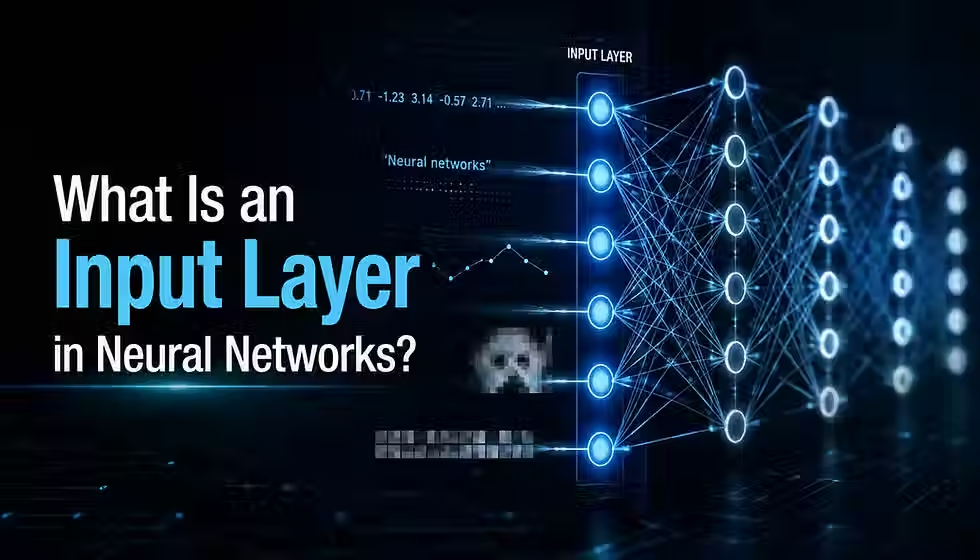
Layer Type | Position | Function |
First | Receives raw data (pixels, tokens, sensor values) | |
Middle | Transforms data into progressively abstract representations | |
Last | Produces the final prediction or classification |
Hidden layers are the "deeper" layers. A network with zero hidden layers is a linear model. A network with one or more hidden layers is a multilayer perceptron (MLP). A network with many hidden layers is a deep neural network—and the field that studies them is deep learning.
Training a network means adjusting the weights in all layers using backpropagation (Rumelhart, Hinton & Williams, Nature, 1986): the algorithm calculates how wrong the output is, then propagates that error backward through each layer to update weights.
3. What Makes a Layer "Deeper"?
Depth = distance from the input layer. The input layer is layer 1 (or layer 0 in some conventions). The layer immediately after is layer 2—already one layer "deeper." The final hidden layer before the output is the deepest.
Depth is measured by counting the number of parameterized layers (layers with trainable weights). Pooling layers, normalization layers, and activation functions are sometimes counted, sometimes not—conventions vary by framework. In PyTorch and TensorFlow documentation, "depth" typically refers to layers with learnable parameters.
Note: The word "deeper" is always relative. In a 3-layer network, layer 3 is the deepest. In a 150-layer ResNet, layer 3 is still shallow.
There's also a distinction between depth and width. Width = number of neurons per layer. You can make a network wide (many neurons, few layers) or deep (many layers, fewer neurons per layer). Research consistently shows that depth is more parameter-efficient for learning hierarchical features—particularly in vision, language, and audio tasks (Bengio et al., PAMI, 2013).
4. The Feature Hierarchy: What Each Layer Learns
The most important insight in all of deep learning is this: deeper layers learn more abstract features. This was demonstrated empirically, not just theorized.
A landmark 2013 study by Zeiler and Fergus (ECCV 2013, "Visualizing and Understanding Convolutional Networks") visualized what individual layers of a deep CNN actually learned from image data:
Layer 1–2: Edges, color gradients, simple textures.
Layer 3: Corners, curves, simple patterns.
Layer 4: Object parts (wheels, eyes, windows).
Layer 5: Full objects (faces, cars, dogs).
This hierarchical structure mirrors how the human visual cortex processes information—from simple signals in V1 (primary visual cortex) to complex object recognition in the inferotemporal cortex.
The same principle applies across domains:
In language models (transformers):
Early layers: Token identity, local syntax.
Middle layers: Phrase structure, grammatical relations.
Deeper layers: Semantic meaning, world knowledge, reasoning.
This was confirmed by Tenney et al. (2019) at Google, who probed BERT's layers and found that syntactic information peaks in middle layers while semantic tasks like coreference resolution and semantic role labeling peak in deeper layers (ACL 2019, "BERT Rediscovers the Classical NLP Pipeline").
In audio models:
Shallow layers: Frequency bands.
Deeper layers: Phonemes → words → meaning.
5. Key Mechanisms That Make Depth Powerful
Non-linear Composition
Each layer applies a non-linear transformation. Stack two non-linear layers, and you can represent functions that neither layer could represent alone. The mathematical result: a deep network with n layers and k neurons per layer can represent exponentially more functions than a shallow network with the same total number of neurons (Montufar et al., NeurIPS 2014, "On the Number of Linear Regions of Deep Neural Networks").
Representation Learning
Deeper layers don't just classify; they learn representations. Instead of hand-engineering features (like traditional machine learning), the network discovers its own. This is why deep learning replaced feature engineering in most computer vision and NLP tasks by 2015.
Weight Sharing (in CNNs)
Convolutional layers apply the same filter across an entire image. Stacking these layers means the same low-level filter in layer 1 contributes to high-level object detection in layer 5. This dramatically reduces the number of parameters needed and generalizes better.
Attention Mechanisms (in Transformers)
In transformer architectures, each deeper layer applies self-attention: every token can attend to every other token in the sequence. Deeper layers refine these relationships, allowing the model to resolve ambiguity and track long-range dependencies. A 2020 study by Clark et al. (ICLR 2020) showed that different attention heads in different layers specialize—some track syntactic dependencies, others track semantic similarity.
6. The Vanishing Gradient Problem (And How It Was Solved)
For decades, going deeper broke networks. Here's why.
Backpropagation computes gradients—signals that tell each weight how to change. As these signals travel backward through many layers, they get multiplied by small numbers (derivatives of the activation function). With sigmoid activations, those derivatives are at most 0.25. Multiply 0.25 by itself 20 times: you get a number close to zero. Gradients in early layers became essentially zero—the network stopped learning.
This was first described formally by Hochreiter (1991) in his thesis and later by Bengio et al. (1994, IEEE Transactions on Neural Networks). It was the primary reason deep networks were considered impractical through most of the 1990s and early 2000s.
Three breakthroughs solved it:
1. ReLU Activation (2010) The Rectified Linear Unit (ReLU)—simply max(0, x)—doesn't saturate like sigmoid. Its gradient is either 0 or 1, preventing exponential shrinkage. Nair and Hinton demonstrated its advantages at ICML 2010.
2. Residual Connections / ResNets (2015) Kaiming He and colleagues at Microsoft Research introduced skip connections (shortcut paths that bypass one or more layers) in their ResNet architecture (CVPR 2015, "Deep Residual Learning for Image Recognition"). This allowed gradients to flow directly to earlier layers without passing through every intermediate layer. Their 152-layer ResNet won the ImageNet Large Scale Visual Recognition Challenge (ILSVRC 2015) with a top-5 error of 3.57%—below human-level performance (estimated at ~5%).
3. Normalization Layers Batch Normalization (Ioffe & Szegedy, ICML 2015) stabilizes the distribution of inputs to each layer during training, allowing much higher learning rates and reducing gradient issues. Layer Normalization, used in transformers, provides similar benefits without dependence on batch size.
7. Case Studies: Depth in Action
Case Study 1: AlexNet (2012) — Depth Defeats Traditional Computer Vision
What happened: Krizhevsky, Sutskever, and Hinton (University of Toronto) entered the 2012 ImageNet competition with AlexNet—an 8-layer deep CNN trained on two GPUs. Their top-5 error rate was 15.3%, versus 26.2% for the second-place entry (which used traditional hand-crafted features).
Why it mattered: This 10.9 percentage point gap shocked the field. It proved empirically that depth + compute + data could outperform decades of hand-engineered features. It triggered the modern deep learning era.
Source: Krizhevsky, A., Sutskever, I., & Hinton, G.E. (2012). "ImageNet Classification with Deep Convolutional Neural Networks." Advances in Neural Information Processing Systems (NeurIPS), 25. Link
Case Study 2: ResNet-152 (2015) — Going 152 Layers Deep
What happened: He et al. at Microsoft Research Asia trained a 152-layer residual network—the deepest competitive network at the time—and achieved a top-5 error of 3.57% on ImageNet ILSVRC 2015. This surpassed estimated human performance. Without residual connections, a 152-layer plain network performed worse than a 56-layer network due to degradation from vanishing gradients. With skip connections, 152 layers worked cleanly.
Why it mattered: ResNets demonstrated that architectural innovations (not just hardware or data) could unlock depth. ResNets became the foundation for hundreds of subsequent architectures and are still widely used in production systems as of 2026.
Source: He, K., Zhang, X., Ren, S., & Sun, J. (2015). "Deep Residual Learning for Image Recognition." CVPR 2016 (arXiv:1512.03385). Link
Case Study 3: BERT and Layer-by-Layer Language Understanding (2018–2019)
What happened: Google released BERT (Bidirectional Encoder Representations from Transformers) in 2018—a 12-layer (BERT-Base) or 24-layer (BERT-Large) transformer model pre-trained on Wikipedia and BookCorpus. Researchers then systematically probed each layer to understand what it had learned.
Tenney et al. (Google Research, ACL 2019) found that BERT's layers rediscover classical NLP pipeline steps in order: part-of-speech tagging resolves in layers 2–3, syntactic parsing in layers 5–6, semantic role labeling in layers 8–9, and coreference resolution in layers 10–12. Deeper layers handle more complex, context-dependent tasks.
Outcome: BERT set new records on 11 NLP benchmarks when released. Its layer-by-layer structure became the template for GPT, T5, RoBERTa, and virtually every major language model that followed.
Source: Tenney, I., Das, D., & Pavlick, E. (2019). "BERT Rediscovers the Classical NLP Pipeline." ACL 2019. Link
8. Types of Deep Layers by Architecture
Different architectures use different layer types. The concept of "deeper" applies across all of them.
Architecture | Deep Layer Type | Primary Use |
MLP (feedforward) | Fully connected (dense) | Tabular data, simple tasks |
CNN | Convolutional + pooling | Images, video, audio |
RNN / LSTM | Recurrent cells | Sequences (time series, legacy NLP) |
Transformer | Self-attention + FFN blocks | Language, vision, multi-modal |
Graph NN | Message-passing layers | Graph-structured data (molecules, social networks) |
Diffusion model | U-Net encoder/decoder layers | Image & audio generation |
Transformer Layers in Detail
Each transformer layer consists of two sub-layers:
Multi-head self-attention: Learns relationships between tokens.
Feed-forward network (FFN): Applies a non-linear transformation to each token independently.
Both sub-layers use residual connections and layer normalization (LayerNorm), which is why transformers can be scaled to hundreds of layers without vanishing gradients. Stacking more transformer layers = a deeper model = finer-grained language understanding, at the cost of compute.
9. Current Landscape: How Deep Are Today's Models?
As of early 2026, the depth of leading AI models has grown dramatically. Public and verified information on layer counts includes:
Model | Organization | Layers (approx.) | Parameters | Source |
BERT-Base | 12 transformer | 110M | Devlin et al., 2018 | |
BERT-Large | 24 transformer | 340M | Devlin et al., 2018 | |
GPT-2 (Large) | OpenAI | 36 transformer | 774M | Radford et al., 2019 |
GPT-3 | OpenAI | 96 transformer | 175B | Brown et al., 2020 |
ResNet-152 | Microsoft/He et al. | 152 conv | 60M | He et al., 2015 |
ViT-Huge | 32 transformer | 632M | Dosovitskiy et al., 2021 |
Note: GPT-4 and Gemini Ultra layer counts have not been officially disclosed by OpenAI or Google as of early 2026. Parameter estimates from independent analysis exist but are unverified.
The trend across all frontier models is toward greater depth combined with architectural innovations (mixture-of-experts routing, sparse attention, grouped-query attention) that let more layers run efficiently. The 2023–2025 period saw many research teams show that depth scales more efficiently than width for most reasoning tasks (Kaplan et al., arXiv 2020, "Scaling Laws for Neural Language Models").
10. Regional & Industry Variations
By Industry
Healthcare: Deep layers in medical imaging CNNs (like those used for radiology) have been validated by the FDA. The FDA's 510(k) database listed over 950 AI/ML-enabled medical devices as of 2024, the majority using deep convolutional networks. Deeper models require more validation data and explainability work to meet regulatory requirements.
Finance: Deeper models for fraud detection improve precision but require careful explainability—EU regulators under the AI Act (2024) require high-risk AI systems to be interpretable. Shallower models are sometimes preferred for compliance over accuracy.
Manufacturing: Industrial inspection CNNs typically use ResNet or EfficientNet backbones. Siemens, Bosch, and Samsung have publicly documented deep CNN deployments for quality control.
NLP/LLMs: Every major language AI product in 2026 (ChatGPT, Gemini, Claude, Copilot) is built on deep transformer architectures. The depth of these models is proprietary but definitively in the dozens to hundreds of layers.
By Region
United States: Leads in frontier model research and deployment. NIST's AI Risk Management Framework (2023) acknowledges layer complexity as a factor in AI risk assessment.
European Union: The EU AI Act (effective August 2024) classifies deep learning systems in high-risk sectors under additional scrutiny. Deeper, less interpretable models face higher compliance burden.
China: Deep learning investment is heavily state-supported. Research output in deep architectures from institutions like Tsinghua and Peking University is globally competitive.
11. Pros & Cons of Adding Depth
Pros
Learns complex patterns: Depth enables hierarchical feature extraction impossible in shallow networks.
More parameter-efficient: Achieves the same function with fewer total parameters than a wide-shallow network (Montufar et al., NeurIPS 2014).
Better generalization: Deeper representations transfer better across tasks (transfer learning works because deep features are broadly useful).
State-of-the-art performance: Every benchmark record in vision and NLP since 2012 has been set by deep networks.
Cons
Harder to train: Requires careful initialization, normalization, and regularization.
Computationally expensive: More layers = more FLOPs per forward/backward pass.
Risk of overfitting: Deeper models have more parameters, requiring more data or stronger regularization.
Reduced interpretability: Deeper layers are harder to explain—a growing legal and regulatory concern in 2026.
Diminishing returns: Beyond a certain depth (dataset-dependent), extra layers stop helping and may hurt.
12. Myths vs. Facts
Myth | Fact |
"Deeper is always better." | False. Depth has diminishing returns and can cause overfitting without sufficient data. ResNet authors showed that beyond certain depth, plain networks degrade (He et al., 2015). |
"Deep learning needs millions of layers." | False. ResNet-50 (50 layers) remains competitive for many vision tasks in 2026. BERT-Base (12 layers) outperforms many larger models on specific tasks. |
"Deeper layers are just doing more of the same thing." | False. Each deeper layer learns qualitatively different, more abstract features (Zeiler & Fergus, 2013). |
"The vanishing gradient problem is solved forever." | Partially true. ResNets, BatchNorm, and ReLU mitigate it substantially, but very deep networks in specific architectures still encounter gradient issues without careful design. |
"Deep neural networks work like the human brain." | Misleading. They share a loose architectural analogy but operate through entirely different mechanisms. The brain uses spike-based, asynchronous processing; ANNs use synchronous floating-point matrix multiplication. |
13. Pitfalls & Risks
Overfitting from depth without data. A 100-layer network trained on 1,000 samples will memorize training data and fail on new data. Rule of thumb: more depth requires more data and stronger regularization (dropout, weight decay, data augmentation).
Gradient explosion. Less common than vanishing gradients, but networks without normalization can produce unboundedly large gradients. Gradient clipping (setting a maximum gradient norm) is the standard fix.
Computational cost at inference. Every layer adds latency. In production AI systems (autonomous vehicles, real-time translation, medical monitoring), deep models must be pruned, quantized, or distilled into shallower models for acceptable latency.
Architectural mismatch. Adding depth to the wrong architecture type fails. Adding transformer layers to a problem better suited to CNNs—or vice versa—wastes compute and reduces accuracy.
Explainability deficit. The deeper a network, the harder it is to trace a specific output back to a specific input feature. In regulated industries, this is not just a technical problem—it's a legal one under the EU AI Act and emerging US federal AI guidance.
14. Future Outlook
Sparse and Conditional Depth (2025–2026)
The latest frontier is not adding more layers uniformly, but routing inputs through different subsets of layers based on content—a concept called Mixture of Experts (MoE). Google's Gemini and various 2024–2025 open-source models use MoE to achieve the effective depth of large models while keeping compute per token manageable. Each "expert" is a small sub-network activated only when relevant.
State Space Models Challenging Transformers
Architectures like Mamba (Gu & Dao, arXiv, December 2023) use state space models (SSMs) rather than attention for deep sequence modeling. As of 2025–2026, these are competitive with transformers on certain tasks at comparable depth while using less memory. This may change what "deep" means in sequence models over the next 2–3 years.
Mechanistic Interpretability
A growing research field focuses on reverse-engineering what specific neurons and layers do in large models. Work from Anthropic's interpretability team (2023–2025) has identified "features" and "circuits" in transformer layers that correspond to human-interpretable concepts. This will shape how depth is designed and audited in high-stakes applications.
Hardware-Aware Depth
Chip architectures in 2025–2026 (NVIDIA Blackwell, Google TPU v5, custom ASICs) are increasingly designed around specific layer operations. This hardware-software co-design loop means optimal depth is increasingly determined by the hardware target, not just the task.
15. FAQ
Q1: What is a layer in a neural network?
A layer is a group of neurons that applies a mathematical transformation to its inputs and passes results to the next layer. Layers are the building blocks of all neural networks.
Q2: What is the difference between a shallow and a deep neural network?
A shallow network has one or two hidden layers. A deep network has many—often dozens to hundreds. Depth enables the network to learn progressively more abstract representations of data.
Q3: How many layers does a "deep" network need?
There's no fixed threshold. Conventionally, any network with more than 2–3 hidden layers is considered "deep." In practice, architectures range from 8 layers (AlexNet) to 96+ (GPT-3) depending on the task.
Q4: What do deeper layers actually learn?
In vision models, shallow layers learn edges and textures; deeper layers learn object parts and full objects. In language models, shallow layers learn syntax; deeper layers learn semantics and reasoning. This was empirically demonstrated by Zeiler & Fergus (2013) and Tenney et al. (2019).
Q5: What is the vanishing gradient problem?
It's a training failure where gradient signals shrink exponentially as they travel backward through many layers, leaving early layers unable to learn. Solved primarily by ReLU activations, residual connections, and normalization layers.
Q6: Can you have too many layers?
Yes. Beyond a task-specific optimal depth, adding layers causes overfitting, gradient instability, and higher compute cost with no performance gain. He et al. (2015) documented this degradation phenomenon in plain networks.
Q7: What are skip connections and why do they help deeper networks?
Skip connections are shortcut paths that let a layer's input bypass one or more layers and connect directly to a deeper layer's output. They let gradients flow backward without passing through every layer, solving the vanishing gradient problem for very deep networks.
Q8: Do all types of neural networks benefit from depth?
Most do—CNNs, transformers, and MLPs all benefit. However, graph neural networks often suffer from over-smoothing with depth (all nodes produce similar representations), limiting useful depth in practice.
Q9: How does depth relate to model size (parameters)?
Depth and size are related but distinct. A deep, narrow network and a shallow, wide network can have similar parameter counts but very different capabilities. Depth is generally more efficient for hierarchical tasks.
Q10: What is representation learning and how does depth enable it?
Representation learning is the ability of a model to discover useful features automatically from raw data. Depth enables this by letting each layer build on the abstractions of the layer below, creating progressively richer representations without human feature engineering.
Q11: Why are transformer layers used in large language models?
Transformers use self-attention, which allows every token to relate to every other token. This captures long-range dependencies in language that recurrent layers struggle with. Stacking many transformer layers builds deep, nuanced understanding of language.
Q12: What is model pruning and why does it relate to depth?
Pruning removes redundant neurons or layers from a trained deep model to reduce size and inference speed, often with minimal accuracy loss. This is critical for deploying deep models on edge devices with limited compute.
Q13: Is depth the same in CNNs and transformers?
Conceptually yes—both benefit from hierarchical processing across layers. Mechanically, the layer operations differ significantly (convolution vs. attention), but the principle of each deeper layer learning more abstract features applies to both.
Q14: How does the EU AI Act affect the use of deep neural networks?
The EU AI Act (in force August 2024) classifies certain AI applications as high-risk and requires explainability, documentation, and human oversight. Deeper, more opaque networks face higher compliance burden in healthcare, law enforcement, and critical infrastructure.
Q15: What is mechanistic interpretability in the context of deep layers?
It's a research field that reverse-engineers what specific neurons, layers, and circuits in a deep network do—translating the black-box into understandable components. It's increasingly important for AI safety and regulatory compliance.
Q16: Are deeper models always more expensive to run?
Yes, generally. More layers = more floating-point operations per input. Optimizations like quantization, pruning, and knowledge distillation reduce this cost by compressing deep models into smaller ones that approximate their behavior.
Q17: What is knowledge distillation?
Knowledge distillation trains a smaller "student" model to mimic a larger "teacher" model. The student learns from the teacher's output probabilities rather than raw labels, often achieving near-teacher performance at a fraction of the depth and cost.
Q18: What is over-smoothing in graph neural networks?
In GNNs, stacking too many layers causes each node's representation to become an average of its entire neighborhood—losing local structure. This limits useful depth to typically 2–5 layers for most graph tasks.
16. Key Takeaways
A deeper layer is any neural network layer further from the input; it processes more abstract, high-level features.
Depth is the core differentiator of deep learning versus shallow machine learning.
Each deeper layer learns qualitatively different information—from edges to objects in vision, from syntax to semantics in language.
The vanishing gradient problem blocked deep networks for decades; it was solved by ReLU, residual connections (ResNets, 2015), and normalization layers.
Modern frontier models stack dozens to hundreds of layers and achieve capabilities impossible with shallow architectures.
Depth has diminishing returns: optimal depth depends on dataset size, task complexity, and compute budget.
Deep layers are increasingly regulated—EU AI Act (2024) demands explainability for high-risk deployments.
The frontier is moving toward conditional depth (Mixture of Experts), where different inputs activate different layer subsets.
Mechanistic interpretability is the emerging field that makes deep layers understandable—critical for safety and compliance.
17. Actionable Next Steps
Start with a baseline shallow model. Before adding depth, benchmark a 2–3 layer network on your data. Establish what performance you get before investing in depth.
Use proven architectures. Don't design your own deep network from scratch. Start with ResNet-50 for vision, BERT-Base for text, or a small transformer for sequences. These have documented depth-performance relationships.
Monitor gradients during training. Use tools like TensorBoard or Weights & Biases to watch gradient norms per layer. Flat or zero gradients in early layers signal the vanishing gradient problem.
Add residual connections if going deep. Any network beyond 10 layers should use skip connections to ensure gradient flow.
Apply layer normalization. Add LayerNorm (for transformers) or BatchNorm (for CNNs) between layers to stabilize training in deep architectures.
Scale data with depth. Adding layers without adding data leads to overfitting. Use data augmentation, or collect more labeled data before increasing depth.
Profile inference latency. Use ONNX, TensorRT, or framework-native profilers to measure per-layer compute cost before deploying deep models in production.
Consider knowledge distillation for production. If your deep model is too slow for real-time use, distill it into a smaller student model using Hinton et al.'s distillation framework.
Read the interpretability literature. If deploying in a regulated domain, review Anthropic's mechanistic interpretability work and Tenney et al. (2019) to understand what your deep layers are actually doing.
Stay current on MoE architectures. As of 2026, Mixture of Experts is reshaping what "deep" means in large-scale models. Follow the Mixtral, Gemini, and related open research for production-ready implementations.
18. Glossary
Activation function: A mathematical function applied after each neuron's weighted sum, introducing non-linearity. Common examples: ReLU, sigmoid, softmax, GELU.
Backpropagation: The algorithm used to train neural networks. Computes the gradient of the loss function with respect to each weight by propagating errors backward through all layers.
Batch normalization: A technique that normalizes layer inputs across a training batch, stabilizing and accelerating training of deep networks (Ioffe & Szegedy, 2015).
BERT: Bidirectional Encoder Representations from Transformers. A 12–24 layer transformer language model from Google (2018) that became a benchmark for NLP tasks.
CNN (Convolutional Neural Network): A deep network architecture using convolutional layers for spatial data—particularly images and video.
Deep learning: A subfield of machine learning using neural networks with many (deep) layers to learn hierarchical representations from data.
Feature hierarchy: The progressive structure of representations across layers—from simple, local features in shallow layers to complex, abstract features in deeper layers.
Gradient: A vector indicating how much a network's loss changes with respect to each weight. Used by backpropagation to update weights during training.
Knowledge distillation: Training a small model (student) to mimic a large model (teacher), transferring the teacher's learned representations at lower computational cost.
Layer normalization: A normalization technique applied per-sample across features within a single layer, used in transformers (Ba et al., 2016).
Mixture of Experts (MoE): An architecture where inputs are routed to different subsets of layers ("experts") based on content, enabling effective depth at lower per-token compute cost.
Overfitting: When a model learns training data too well—including noise—and performs poorly on unseen data. Risk increases with depth and limited training data.
Residual connection (skip connection): A shortcut path in a network that adds a layer's input directly to its output, bypassing intermediate transformations. Core to ResNets and transformers.
ReLU (Rectified Linear Unit): An activation function: max(0, x). Simple, fast, and effective at preventing vanishing gradients in deep networks.
Representation learning: The process by which a deep network automatically discovers useful features from raw data, rather than requiring human feature engineering.
Self-attention: A mechanism in transformers where each token computes a weighted sum of all other tokens' representations, allowing each position to "attend" to the full context. Applied in every transformer layer.
Transformer: A neural network architecture based on self-attention, introduced by Vaswani et al. (2017). The foundation of all major language models as of 2026.
Universal Approximation Theorem: A theoretical result stating that a feedforward network with at least one hidden layer and enough neurons can approximate any continuous function (Hornik et al., 1989).
Vanishing gradient: The problem where gradients shrink exponentially during backpropagation through deep networks, preventing early layers from learning. Solved by ReLU, skip connections, and normalization.
Width (neural network): The number of neurons in a layer. Contrasted with depth (number of layers). Depth scales more efficiently than width for hierarchical tasks.
19. References
Krizhevsky, A., Sutskever, I., & Hinton, G.E. (2012). "ImageNet Classification with Deep Convolutional Neural Networks." NeurIPS 2012. https://proceedings.neurips.cc/paper/2012/hash/c399862d3b9d6b76c8436e924a68c45b-Abstract.html
He, K., Zhang, X., Ren, S., & Sun, J. (2015). "Deep Residual Learning for Image Recognition." arXiv:1512.03385. https://arxiv.org/abs/1512.03385
Zeiler, M.D., & Fergus, R. (2013). "Visualizing and Understanding Convolutional Networks." ECCV 2014. https://arxiv.org/abs/1311.4901
Tenney, I., Das, D., & Pavlick, E. (2019). "BERT Rediscovers the Classical NLP Pipeline." ACL 2019. https://aclanthology.org/P19-1452/
Devlin, J., Chang, M-W., Lee, K., & Toutanova, K. (2018). "BERT: Pre-training of Deep Bidirectional Transformers for Language Understanding." arXiv:1810.04805. https://arxiv.org/abs/1810.04805
Rumelhart, D.E., Hinton, G.E., & Williams, R.J. (1986). "Learning representations by back-propagating errors." Nature, 323, 533–536. https://www.nature.com/articles/323533a0
Bengio, Y., Courville, A., & Vincent, P. (2013). "Representation Learning: A Review and New Perspectives." IEEE Transactions on Pattern Analysis and Machine Intelligence, 35(8), 1798–1828. https://arxiv.org/abs/1206.5538
Montufar, G., Pascanu, R., Cho, K., & Bengio, Y. (2014). "On the Number of Linear Regions of Deep Neural Networks." NeurIPS 2014. https://arxiv.org/abs/1402.1869
Ioffe, S., & Szegedy, C. (2015). "Batch Normalization: Accelerating Deep Network Training by Reducing Internal Covariate Shift." ICML 2015. https://arxiv.org/abs/1502.03167
Vaswani, A., et al. (2017). "Attention Is All You Need." NeurIPS 2017. https://arxiv.org/abs/1706.03762
Brown, T., et al. (2020). "Language Models are Few-Shot Learners." NeurIPS 2020 (GPT-3). https://arxiv.org/abs/2005.14165
Kaplan, J., et al. (2020). "Scaling Laws for Neural Language Models." arXiv:2001.08361. https://arxiv.org/abs/2001.08361
Nair, V., & Hinton, G.E. (2010). "Rectified Linear Units Improve Restricted Boltzmann Machines." ICML 2010. https://icml.cc/Conferences/2010/papers/432.pdf
Hornik, K., Stinchcombe, M., & White, H. (1989). "Multilayer feedforward networks are universal approximators." Neural Networks, 2(5), 359–366. https://doi.org/10.1016/0893-6080(89)90020-8
Gu, A., & Dao, T. (2023). "Mamba: Linear-Time Sequence Modeling with Selective State Spaces." arXiv:2312.00752. https://arxiv.org/abs/2312.00752
Clark, K., Khandelwal, U., Levy, O., & Manning, C.D. (2020). "What Does BERT Look at? An Analysis of BERT's Attention." ICLR 2020. https://arxiv.org/abs/1906.04341
European Parliament. (2024). "Regulation (EU) 2024/1689 — Artificial Intelligence Act." Official Journal of the European Union. https://eur-lex.europa.eu/legal-content/EN/TXT/?uri=CELEX:32024R1689
NIST. (2023). "Artificial Intelligence Risk Management Framework (AI RMF 1.0)." National Institute of Standards and Technology. https://doi.org/10.6028/NIST.AI.100-1
Dosovitskiy, A., et al. (2020). "An Image is Worth 16x16 Words: Transformers for Image Recognition at Scale." arXiv:2010.11929. https://arxiv.org/abs/2010.11929
Radford, A., et al. (2019). "Language Models are Unsupervised Multitask Learners." OpenAI Blog. https://openai.com/research/language-unsupervised