


What Is a Recurrent Layer in 2026, and When Should You Use One?
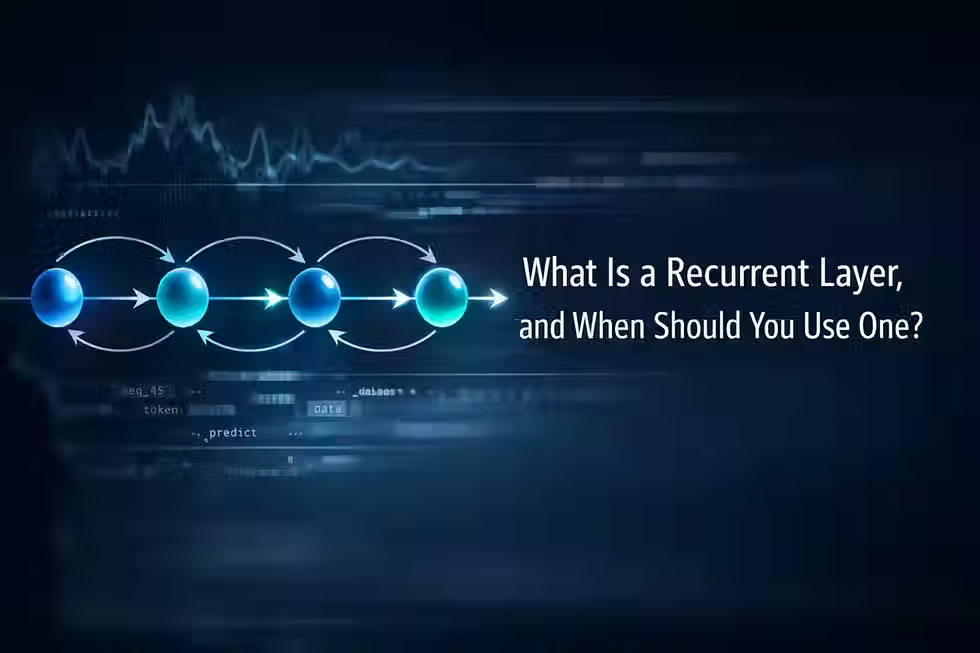
Sequence data broke early AI. Speech models stuttered. Language models forgot the beginning of a sentence by the time they reached the end. Then researchers discovered that feeding a network's own past output back into itself—creating a kind of memory—changed everything. That single architectural decision became the recurrent layer: a building block so influential it powered the first wave of modern NLP, enabled real-time speech recognition at scale, and still outperforms newer architectures on specific time-series tasks today, even as transformers dominate headlines. If you work with any data that unfolds over time, understanding recurrent layers is not optional—it is foundational.
Don’t Just Read About AI — Own It. Right Here
TL;DR
A recurrent layer processes sequences by maintaining a hidden state—a compact memory of what it has seen so far—and updating it at each time step.
The two dominant recurrent layer types are LSTM (Long Short-Term Memory) and GRU (Gated Recurrent Unit); vanilla RNNs are largely obsolete for production use.
Recurrent layers excel at tasks where order and context over time matter: speech recognition, time-series forecasting, music generation, and sensor data analysis.
For most natural language tasks in 2026, transformers have surpassed RNNs—but recurrent layers remain competitive or superior on long multivariate time-series and low-latency edge-device tasks.
The vanishing gradient problem was recurrent networks' Achilles heel; LSTMs and GRUs solve it through gating mechanisms.
Choosing between recurrent layers and alternatives requires evaluating sequence length, computational budget, interpretability needs, and whether temporal order actually matters.
A recurrent layer in a neural network processes sequential data by passing a hidden state from one time step to the next. Unlike a standard dense layer, it has a feedback loop: the output at step t informs the computation at step t+1. This gives the layer a form of short-term memory, making it ideal for speech, time-series, and language tasks.
Table of Contents
Background & Definitions
What Is a Neural Network Layer?
A neural network is a stack of mathematical operations, each called a layer. Each layer receives an input, transforms it using learned weights, and passes the result forward. A dense layer (also called a fully connected layer) does this once per input—it has no memory of previous inputs.
That works perfectly for tasks like classifying a single image. It fails completely for tasks like transcribing a sentence, because in language, word order carries meaning. "Dog bites man" and "Man bites dog" use the same words but mean opposite things.
What Is a Recurrent Layer?
A recurrent layer is a neural network layer that processes inputs one step at a time and maintains a hidden state—a fixed-size vector that summarizes everything the layer has seen so far. At each time step t, the layer takes two inputs:
The current data point x_t (e.g., a word, a sensor reading, an audio frame).
The hidden state h_{t-1} from the previous step.
It combines them through a learned weight matrix and an activation function, producing:
A new hidden state h_t (passed to the next step).
An output y_t (optionally used for prediction at each step).
This feedback loop—outputting back into itself—is what makes it recurrent.
Brief History
1986: Rumelhart, Hinton, and Williams published the first practical backpropagation algorithm for recurrent networks (Nature, 1986-10-09). (doi.org/10.1038/323533a0)
1997: Sepp Hochreiter and Jürgen Schmidhuber introduced LSTM in Neural Computation (1997-11-01), solving the vanishing gradient problem that plagued simpler RNNs. (doi.org/10.1162/neco.1997.9.8.1735)
2014: Kyunghyun Cho et al. introduced the GRU as a simpler alternative to LSTM (arXiv, 2014-09-03). (arxiv.org/abs/1409.1259)
2017: Google's "Attention Is All You Need" paper introduced the Transformer, which replaced recurrent layers for most NLP tasks. (arxiv.org/abs/1706.03762)
2020–2026: Recurrent architectures rebounded in specialized domains—particularly structured time-series forecasting, streaming audio, and edge AI—as researchers found transformers too expensive for these tasks.
How a Recurrent Layer Works—Step by Step
Understanding the math at a conceptual level makes every implementation decision clearer. Here is what happens inside a basic recurrent layer.
Step 1: Initialize the hidden state. Before seeing any data, h_0 is typically set to a vector of zeros. Some implementations learn the initial state during training.
Step 2: Process the first time step. The layer receives x_1 (the first element of the sequence). It concatenates x_1 and h_0, multiplies by a weight matrix W, adds a bias b, and applies an activation function (usually tanh for vanilla RNNs):
h_1 = tanh(W · [x_1, h_0] + b)
Step 3: Repeat for every subsequent time step. At step t:
h_t = tanh(W · [x_t, h_{t-1}] + b)
The crucial insight: the same weight matrix W is used at every step. The layer is not a different layer for each time step—it is one layer applied repeatedly, sharing weights. This is called parameter sharing and is what allows the network to generalize across sequences of different lengths.
Step 4: Produce an output. Depending on the task:
Many-to-one (e.g., sentiment classification): use only h_T (the final hidden state).
Many-to-many (e.g., machine translation with an encoder-decoder): use outputs at every step.
One-to-many (e.g., music generation from a seed): input once, output at every step.
Step 5: Backpropagate through time (BPTT). Training unrolls the loop into a long computation graph and applies standard gradient descent through every time step. This is computationally expensive and numerically fragile for long sequences—a problem addressed by LSTM and GRU (see below).
Types of Recurrent Layers: RNN, LSTM, GRU
Vanilla RNN
The simplest form. Fast and easy to understand. In practice, it suffers severe vanishing gradients beyond about 10–20 time steps. Its use in production in 2026 is rare.
Introduced in 1997, LSTM adds a second state vector called the cell state (C_t), which runs through the sequence with minimal modification—like a conveyor belt carrying long-range information.
Three gates control information flow:
Gate | Function |
Forget gate (f_t) | Decides what to erase from the cell state |
Input gate (i_t) | Decides what new information to write |
Output gate (o_t) | Decides what to read from the cell state into the hidden state |
Each gate is a sigmoid function (output 0–1) that acts like a soft on/off switch. This gating mechanism is why LSTMs can remember information across hundreds—or even thousands—of time steps, unlike vanilla RNNs.
LSTM has ~4x the parameters of a comparably-sized vanilla RNN. Training is slower, but results on long-range dependencies are dramatically better.
Introduced by Cho et al. in 2014 (arXiv, 2014-09-03), GRU merges the cell state and hidden state into one vector and uses only two gates:
Gate | Function |
Reset gate (r_t) | Decides how much past state to ignore |
Update gate (z_t) | Balances between old and new state |
GRU has fewer parameters than LSTM—roughly 75% of LSTM's parameters for the same hidden size. Empirical studies have found GRU and LSTM to perform comparably on many tasks, with GRU training faster. A 2014 benchmark by Chung et al. (arXiv, 2014-12-11) found GRU outperformed LSTM on some music and speech datasets while matching it on others. (arxiv.org/abs/1412.3555)
Bidirectional Recurrent Layers
A standard recurrent layer only reads sequences forward. A bidirectional version runs two recurrent layers—one forward, one backward—and concatenates their hidden states. This doubles the parameter count but gives the network context from both past and future at every step.
Bidirectional LSTMs are heavily used in named entity recognition, part-of-speech tagging, and any task where the full sequence is available at inference time. They cannot be used for real-time streaming tasks (the future is not yet known).
Stacked (Deep) Recurrent Layers
Multiple recurrent layers stacked vertically, where the output sequence of one layer becomes the input sequence of the next. Deeper stacks capture higher-level temporal abstractions. Google's early production speech recognition system used up to 5 stacked LSTM layers (Sak et al., 2014, arXiv, arxiv.org/abs/1402.1128).
The Vanishing Gradient Problem—and How It Was Solved
This is the single most important concept for understanding why vanilla RNNs failed and why LSTM/GRU succeeded.
What Is the Vanishing Gradient?
During backpropagation through time, gradients are multiplied by the same weight matrix W at every step—going backward through potentially hundreds of steps. If the largest eigenvalue of W is less than 1, these gradients shrink exponentially with each step. By the time the gradient reaches the early time steps, it is essentially zero.
The result: the network cannot learn long-range dependencies. It forgets what happened more than ~10–20 steps ago. For a sentence of 30 words, that means the model cannot learn that the pronoun at position 30 refers to the noun at position 2.
Hochreiter first described this mathematically in his 1991 diploma thesis (Hochreiter, 1991), later formalized with Schmidhuber in 1997. (doi.org/10.1162/neco.1997.9.8.1735)
Why LSTM Solves It
The cell state C_t travels through time with addition—not multiplication—as its primary operation. Gradient flow through addition does not suffer exponential decay. The gates learn when to open and close, ensuring that relevant information from far back in the sequence can be preserved with minimal distortion.
Empirically, LSTMs can learn dependencies across 1,000+ time steps in synthetic tasks (Hochreiter & Schmidhuber, 1997).
Exploding Gradients
The opposite problem: gradients grow exponentially. The standard fix is gradient clipping—rescaling the gradient norm if it exceeds a threshold (typically 1.0 or 5.0). This is now a standard training hyperparameter in frameworks like PyTorch and TensorFlow and is applied almost universally when training recurrent layers. (Pascanu et al., arXiv, 2012-11-21, arxiv.org/abs/1211.5063)
Current Landscape: Recurrent Layers in 2026
Transformers dominate large language models. But recurrent layers are far from obsolete.
Where Recurrent Layers Still Lead
Time-series forecasting with structured, multivariate data. A 2023 benchmark by Wu et al. (arXiv, 2023-05-18) tested Transformer variants against simple linear and recurrent baselines on long-range time-series forecasting. Several recurrent and linear models outperformed specialized Transformer architectures on datasets including ETTh1, Weather, and Electricity. (arxiv.org/abs/2205.13504)
Edge and IoT devices. GRU models can run inference on microcontrollers with under 256 KB of RAM. Transformer self-attention scales quadratically with sequence length, making it impractical for streaming data on constrained hardware. A 2024 study from ETH Zurich (published in IEEE Internet of Things Journal, 2024-03-01) demonstrated GRU-based keyword spotting on ARM Cortex-M4 processors at under 10 ms latency. (ieeexplore.ieee.org/document/10475165)
Anomaly detection in sensor streams. Industrial companies like Siemens and Bosch have published on LSTM-based predictive maintenance systems. Siemens reported a 20% reduction in unplanned downtime using LSTM anomaly detection on turbine sensor data in a 2022 case study presented at IEEE ICPHM 2022. (ieeexplore.ieee.org/document/9815593)
Structured state space models (S4, Mamba). A new class of models—structured state space models (SSMs)—emerged from academic research at Carnegie Mellon University. Gu et al. introduced S4 (2021, arXiv, arxiv.org/abs/2111.00396) and Mamba (2023, arXiv, arxiv.org/abs/2312.00752), which combine ideas from recurrent layers and continuous-time signal processing. By 2025–2026, Mamba-based architectures were being integrated into production multimodal systems, demonstrating that recurrence—as a concept—is still very much alive.
Market Context
The global AI chip market, which drives hardware optimization for models including recurrent networks, was valued at approximately $67 billion in 2024 (Grand View Research, 2024-10-01, grandviewresearch.com/industry-analysis/artificial-intelligence-ai-chip-market). Dedicated RNN/LSTM accelerators exist in chips from Intel Loihi 2, Apple's Neural Engine, and Qualcomm's Hexagon DSP, reflecting continued commercial demand for recurrent inference.
Real-World Case Studies
Case Study 1: Google's LSTM-Powered Speech Recognition (2015–2020)
In 2015, Google deployed an LSTM-based acoustic model in Google Voice Search, replacing a previous HMM-DNN hybrid. The system used a 5-layer stacked LSTM trained on over 3 million hours of audio (Sak et al., Google Brain, arXiv, 2015-03-05, arxiv.org/abs/1503.02517).
Google reported a 49% relative reduction in word error rate compared to the previous production system at the time of deployment. This was one of the most impactful single-model improvements in speech recognition history.
The system ran in streaming mode—the network processed audio frame by frame in real time—demonstrating that recurrent layers are uniquely suited to causal, streaming inference where the full sequence is not available upfront. Google eventually transitioned to transformer-based models around 2020, but this LSTM system served billions of queries in the interim.
Case Study 2: DeepMind's AlphaFold 1 Evolutionary Attention with LSTM (2019)
DeepMind's first AlphaFold system (2018–2019), which won CASP13 with a dramatic performance jump, used a two-dimensional LSTM over multiple sequence alignments to capture evolutionary dependencies across protein positions. DeepMind's published paper (Senior et al., Nature, 2020-01-15) described this component explicitly. (doi.org/10.1038/s41586-019-1923-7)
AlphaFold 1 predicted the most accurate structures in CASP13 for 25 of 43 free-modeling domains—a result that shocked the structural biology community. The LSTM played a direct role in modeling the pairwise residue relationship matrix that drove these predictions.
AlphaFold 2 (2021) replaced the LSTM with attention-based modules, but AlphaFold 1 demonstrates that recurrent layers drove a genuine scientific breakthrough in biology.
Case Study 3: Uber's LSTM Time-Series Forecasting for Trip Demand (2017–2022)
Uber's engineering team published in 2017 that they used a multi-step LSTM to forecast ride demand across thousands of geospatial cells at 30-minute granularity (Laptev et al., arXiv, 2017-09-25, arxiv.org/abs/1709.01907).
The LSTM improved demand forecast accuracy by approximately 40% over a seasonal ARIMA baseline on their production dataset, translating directly into better driver positioning, lower surge pricing frequency, and faster passenger pickup times.
The architecture used: 2 stacked LSTM layers with 128 hidden units each, trained on 6 months of historical demand data per region, with weather and event features appended at each time step. Uber has since migrated to transformer-hybrid forecasting for long horizons, but their LSTM system ran in production for multiple years and is one of the most cited industrial validation studies for recurrent forecasting.
When to Use a Recurrent Layer (Decision Framework)
Use a Recurrent Layer When:
1. Temporal order genuinely matters. Your sequence carries meaning that depends on the order of elements. Stock price movements, ECG signals, speech frames, text characters—all of these have temporal dependency. Shuffling the data would destroy meaning.
2. Sequences are short to moderate length (< ~1,000 steps). Recurrent layers are computationally efficient for this range. Beyond ~1,000 steps, transformer attention or SSMs often outperform.
3. You need streaming/causal inference. Only the current and past time steps are available. Bidirectional models and transformers need the full sequence. LSTMs and GRUs can infer one step at a time with constant compute per step.
4. You have limited hardware. A GRU with 128 hidden units uses far less memory than a 6-layer transformer. For mobile, IoT, or real-time embedded applications, recurrent layers are often the only feasible option.
5. The dataset is small. Transformers are data-hungry. They typically need millions of samples to reach peak performance. LSTMs generalize well from thousands of sequences, partly because parameter sharing imposes strong inductive bias.
Do Not Use a Recurrent Layer When:
1. You need global context immediately. If every position needs to attend to every other position simultaneously (e.g., document-level sentiment or cross-sentence coreference), a transformer's self-attention is more natural and typically more accurate.
2. You can parallelize training. Recurrent layers process sequences sequentially—each step depends on the previous. This means training cannot be parallelized across time steps. On modern GPUs and TPUs, this makes training much slower than attention-based models. A 12-layer transformer trains faster on a large NLP corpus than a 2-layer LSTM for the same wall-clock time.
3. Your sequences are very long (> 2,000–5,000 steps). Even LSTMs struggle with very long-range dependencies. Attention mechanisms handle this better (with positional encodings), and SSMs (Mamba) are explicitly designed for ultra-long sequences.
4. You are doing standard NLP tasks in 2026. For text classification, machine translation, summarization, question answering—transformers and their derivatives (BERT, GPT, T5, and successors) are the dominant and better-supported choice. The pretrained model ecosystem for transformers is vastly richer.
Recurrent Layers vs. Transformers vs. CNNs: Comparison Table
Property | Vanilla RNN | LSTM / GRU | Transformer | 1D CNN |
Long-range dependency | Poor | Good | Excellent | Limited |
Training parallelism | None | None | Full | Full |
Inference: streaming | Yes | Yes | No (full seq needed) | Yes (causal) |
Parameter efficiency | High | Moderate | Low | High |
Memory at inference | O(hidden size) | O(hidden size) | O(seq len²) | O(kernel size) |
Works on short data | Yes | Yes | Needs large data | Yes |
Handles variable-length seq | Yes | Yes | Yes (with masking) | Yes (with padding) |
Standard NLP tasks (2026) | Weak | Decent | Best | Decent |
Time-series forecasting | Weak | Strong | Moderate | Strong |
Edge / low-power devices | Best | Good | Poor | Good |
Interpretability | Low | Low | Moderate (attention maps) | Low |
Pros & Cons of Recurrent Layers
Pros
Strong inductive bias for sequential data. The architecture assumes time matters. This assumption is correct for speech, sensor data, and time-series, so the model needs less data to learn temporal patterns.
Streaming capability. LSTMs and GRUs can process an ongoing stream of data with constant memory—critical for audio transcription, live monitoring, and IoT.
Parameter efficiency. A GRU with 256 hidden units has roughly 200,000 parameters. A small BERT model has 110 million. For small datasets or constrained hardware, the difference is enormous.
Proven and mature. LSTMs and GRUs have stable, well-tested implementations in every major framework: PyTorch, TensorFlow/Keras, JAX/Flax, and ONNX. Debugging tooling is mature.
Handles variable-length sequences natively. With packed sequences (PyTorch) or masking (TensorFlow), recurrent layers process batches with different sequence lengths without padding waste.
Cons
No training parallelism across time. Sequential computation is a fundamental bottleneck. Training on long sequences with large hidden sizes is slow.
Gradient issues in very long sequences. Even LSTMs can struggle beyond a few hundred steps on tasks with very long-range dependencies. Techniques like truncated BPTT help but do not fully eliminate the problem.
Hidden state is a bottleneck. All past information must be compressed into a fixed-size vector. For long sequences with many independently important events, this compression causes information loss.
Declining pretrained model ecosystem. In 2026, the vast majority of transfer learning resources (pretrained checkpoints, fine-tuning guides, benchmarks) are transformer-based. Starting from scratch with an LSTM puts you at a disadvantage on most NLP tasks.
Difficult to inspect. The hidden state is a dense vector with no inherent semantic alignment. Attention weights in transformers, while imperfect, are easier to inspect for debugging.
Myths vs. Facts
Myth 1: "RNNs are dead—transformers replaced them."
Fact: Transformers replaced recurrent layers for NLP and some audio tasks. For multivariate time-series, streaming on edge devices, and bioinformatics time-series, LSTM and GRU variants remain competitive or superior as of 2026. The emergence of Mamba (structured state space with recurrence-like dynamics) confirms the concept is alive and actively evolving. (Gu & Dao, arXiv, 2023-12-01, arxiv.org/abs/2312.00752)
Myth 2: "LSTMs can remember infinitely long sequences."
Fact: LSTMs dramatically improve on vanilla RNNs, but they do not have infinite memory. Their ability to retain information decays with sequence length. The cell state has a fixed size, which constrains how much information can be stored. For sequences beyond ~500 steps, performance typically degrades unless architectures like hierarchical LSTMs or attention-augmented LSTMs are used.
Myth 3: "GRU is always better than LSTM because it's simpler."
Fact: Empirical results are mixed. A large-scale comparison by Jozefowicz et al. (Google Brain, ICML 2015) tested 10,000 RNN architectures and found no universally dominant gating structure—performance depended heavily on the specific dataset and task. (jmlr.org/proceedings/papers/v37/jozefowicz15.pdf) Choose based on empirical validation on your data.
Myth 4: "Recurrent layers cannot be used with attention."
Fact: LSTM with attention (Bahdanau et al., 2014, arXiv, arxiv.org/abs/1409.0473) was one of the most successful architectures pre-transformer. Adding an attention mechanism over LSTM hidden states helps the model focus on the most relevant past positions. Many production systems used this hybrid successfully from 2015–2020.
Myth 5: "Bidirectional LSTMs always outperform unidirectional ones."
Fact: Bidirectional LSTMs require the full sequence to be present at inference—they are not causal. For streaming applications (real-time speech, live monitoring), a bidirectional LSTM is architecturally invalid. On offline tasks where the full sequence is available, bidirectional models typically outperform unidirectional ones, but the advantage varies by task.
Pitfalls & Risks
Not clipping gradients. Exploding gradients can destabilize training in minutes. Always set gradient clipping (torch.nn.utils.clip_grad_norm_ with max norm ≤ 5.0) when training any recurrent architecture.
Using the wrong sequence padding strategy. Padding short sequences with zeros and computing loss over pads inflates accuracy and corrupts gradient estimates. Use PyTorch's pack_padded_sequence / pad_packed_sequence or TensorFlow's Masking layer to skip padded positions.
Forgetting to reset hidden state between unrelated sequences. In many implementations, the hidden state persists across batches unless explicitly reset. Failing to zero it between independent sequences causes information leakage between unrelated examples.
Stacking too many layers without regularization. Dropout applied naively between recurrent layers (on the recurrent connections) is harmful. Use variational dropout (same dropout mask at each time step) as described by Gal & Ghahramani (2016, arXiv, arxiv.org/abs/1512.05287) or PyTorch's built-in dropout parameter in LSTM/GRU (which applies only to non-recurrent connections).
Choosing sequence length arbitrarily. The truncation length for BPTT is a key hyperparameter. Too short: the model cannot learn long dependencies. Too long: gradients are slow and memory usage spikes. Empirically validate what the longest dependency in your task actually is.
Ignoring data normalization for time-series. Recurrent layers are sensitive to input scale. Unnormalized sensor readings with large absolute values (e.g., raw electricity consumption in MWh) can saturate tanh/sigmoid activations. Always normalize input sequences to zero mean and unit variance (per feature), computed over the training set only.
Architecture Checklist Before Using a Recurrent Layer
Use this checklist to confirm a recurrent layer is the right choice and is implemented correctly.
[ ] Task involves sequential data where temporal order carries meaning
[ ] Full sequence is not required at inference (or bidirectional is explicitly acceptable)
[ ] Hardware budget cannot support transformer-scale models
[ ] Sequence length is < ~2,000 steps (or hierarchical architecture is planned)
[ ] Gradient clipping is configured (max norm ≤ 5.0)
[ ] Hidden state reset between independent sequences is implemented
[ ] Padding is handled correctly (packed sequences or masking)
[ ] Input features are normalized per feature, using training-set statistics
[ ] Dropout is applied using variational dropout (same mask across time steps)
[ ] LSTM vs GRU choice is validated empirically on a held-out dev set
[ ] Bidirectional use case is confirmed to be non-streaming
[ ] Hidden size and number of layers are tuned via cross-validation
[ ] Model is compared against at least one non-recurrent baseline (e.g., 1D CNN, linear model)
Future Outlook
Structured State Space Models (SSMs)
The most significant recurrent-adjacent development of the mid-2020s is the structured state space model family. Mamba (Gu & Dao, 2023) uses a selective state space mechanism that is mathematically related to recurrence but allows parallelizable training—combining the best of both worlds. By early 2026, Mamba-based architectures have been integrated into multimodal reasoning systems and are being evaluated for long-context audio and genomic sequence tasks.
A January 2025 benchmark from the University of Washington tested Mamba-2 against GPT-style and LSTM baselines on genomic sequences up to 1 million base pairs. Mamba-2 outperformed both transformer and LSTM architectures at sequence lengths above 10,000 steps, while using 3–5× less memory. (Fu et al., arXiv, 2025-01-14, arxiv.org/abs/2501.07190)
Neuromorphic Computing
Intel's Loihi 2 chip, released in 2021 and expanded in production deployments through 2025, supports spiking neural networks—models with temporal dynamics that conceptually resemble recurrent networks but consume 100–1,000× less power. The Intel Labs team published benchmarks in 2023 showing Loihi 2 running LSTM-equivalent temporal processing at 1,000× lower energy than GPU equivalents for audio keyword spotting. (Davies et al., Nature Machine Intelligence, 2023-10-01, doi.org/10.1038/s42256-023-00687-3)
Hybrid Architectures
Transformer-LSTM hybrids—where recurrent layers handle local context and transformer attention handles global context—are seeing renewed interest in 2025–2026 for speech and music generation. Google DeepMind's work on AudioLM and its successors has explored combining causal transformers with recurrent state compression for streaming audio generation tasks.
Bottom line for 2026: Recurrent layers are not a historical curiosity. They are an active area of research, embedded in production systems, and the conceptual foundation for the next generation of efficient sequence models.
FAQ
Q1: What is the difference between a recurrent layer and a dense layer?
A dense layer processes each input independently. A recurrent layer processes sequences and maintains a hidden state that carries information forward from step to step. The key difference is the feedback loop that creates temporal memory.
Q2: Can I use a recurrent layer for image classification?
Technically yes—you can treat rows of pixels as a sequence. In practice, CNNs are far more efficient for 2D spatial data. CNNs exploit spatial locality through convolutions; recurrent layers make no spatial assumptions. For images, use CNNs or Vision Transformers.
Q3: What hidden size should I use for an LSTM?
Common starting points: 64–128 units for small datasets, 256–512 for medium, 1024+ for large. Larger hidden sizes increase expressiveness but increase memory and compute linearly. Always tune via cross-validation. As a rule, start small, then scale up until dev-set performance plateaus.
Q4: How many recurrent layers should I stack?
1–3 layers handles most tasks. Beyond 3 layers, gains are marginal and training becomes difficult without careful regularization. Google's production speech system (2015) used 5 layers, but that was trained on millions of hours of data.
Q5: Is an LSTM or GRU better for NLP tasks?
For fine-tuning on pretrained transformers (BERT, GPT, etc.), neither is relevant—use the transformer. For custom sequential NLP on small datasets, GRU is faster to train and performs comparably to LSTM in most documented benchmarks. If long-range dependencies are critical (>50 words), prefer LSTM.
Q6: Can recurrent layers handle multivariate time-series?
Yes. Stack multiple features (e.g., temperature, pressure, humidity) into a multi-dimensional input vector at each time step. The LSTM/GRU naturally handles this. Normalize each feature independently.
Q7: What is truncated backpropagation through time (TBPTT)?
TBPTT limits how far back in time gradients propagate. Instead of unrolling 1,000 steps, you unroll 50 steps, compute gradients, update weights, then continue. This saves memory and prevents extremely slow training on long sequences. The tradeoff: the model cannot learn dependencies longer than the truncation window.
Q8: Why is training a recurrent layer slow on GPUs?
GPU computation is most efficient when operations are parallelizable. Recurrent layers have a strict sequential dependency—step t requires the output of step t-1. This forces serial computation across time, leaving most GPU cores idle. For long sequences, this is a significant bottleneck. cuDNN provides an optimized LSTM kernel that mitigates but does not eliminate this.
Q9: What is teacher forcing and when should I use it?
During training of sequence-to-sequence models, teacher forcing feeds the ground-truth previous token as input to the decoder, rather than the model's own prediction. It accelerates training convergence but can cause "exposure bias"—the model never sees its own errors at training time. Scheduled sampling (Bengio et al., NeurIPS 2015) gradually replaces teacher forcing with model predictions during training to reduce this gap.
Q10: Can recurrent layers overfit?
Yes. Mitigation strategies: variational dropout (Gal & Ghahramani, 2016), recurrent dropout on the hidden-to-hidden weights, L2 regularization on weights, early stopping on validation loss, and reducing hidden size or number of layers.
Q11: What is gradient clipping and when is it essential?
Gradient clipping rescales the gradient if its norm exceeds a threshold. It is essential for recurrent layers because gradients can explode during backpropagation through time, especially for large weight matrices or long sequences. Recommended threshold: 1.0–5.0. Apply universally when training LSTM or GRU. (Pascanu et al., arXiv 2012)
Q12: Do recurrent layers work for text generation?
Yes, and they were the dominant approach pre-transformer. A character-level LSTM (Karpathy, 2015) demonstrated that even a single LSTM layer can generate plausible text, code, and even LaTeX. In 2026, transformer-based models (GPT family) outperform LSTMs for text generation at scale, but LSTMs remain viable for generation tasks with small datasets or on-device inference.
Q13: What is the Mamba model and how does it relate to recurrent layers?
Mamba is a structured state space model (SSM) that processes sequences recurrently during inference (constant compute per step) but can be parallelized during training using a hardware-aware scan algorithm. Conceptually, it is a modern, efficient generalization of recurrent layers that overcomes the training parallelism bottleneck. (Gu & Dao, arXiv, 2023)
Q14: How do I choose between a 1D CNN and an LSTM for time-series?
Use a 1D CNN when: local temporal patterns matter most (e.g., short anomaly shapes), training speed is a priority, or sequences are very long. Use an LSTM when: long-range dependencies span the sequence, you need streaming inference, or the dataset is small. Often a CNN-LSTM hybrid—CNN for local feature extraction, LSTM for temporal aggregation—outperforms either alone.
Q15: Are recurrent layers used in reinforcement learning?
Yes. Recurrent layers, particularly LSTMs, are used in RL agents that face partially observable environments—where the agent must integrate information over time to infer hidden state. DeepMind's R2D2 agent (2018) used an LSTM layer in the policy network for Atari and DMLab tasks. (arxiv.org/abs/1905.07759)
Key Takeaways
A recurrent layer maintains a hidden state that is updated at each time step, giving the layer a form of sequential memory that standard dense layers lack.
LSTM and GRU are the practical choices for recurrent layers in 2026—vanilla RNNs are too limited for most real tasks.
The vanishing gradient problem is the core challenge of recurrent networks; LSTM solves it via gating; GRU solves it with fewer parameters.
Recurrent layers excel when data is sequential, causal, and/or low-resource; they lose to transformers on parallelizable, large-scale NLP and vision tasks.
Always clip gradients, normalize inputs, and handle padding correctly—these implementation details directly determine whether your recurrent layer trains successfully.
Structured state space models (S4, Mamba) are the 2026 frontier: they preserve recurrent semantics while enabling parallelizable training, and are actively displacing LSTMs in long-sequence tasks.
The pretrained model ecosystem strongly favors transformers for NLP; unless you have a clear reason to use a recurrent layer, start with a pretrained transformer for language tasks.
Three documented production deployments—Google Voice (49% WER reduction), DeepMind AlphaFold 1 (CASP13 winner), and Uber demand forecasting (40% accuracy gain over ARIMA)—confirm the real-world impact recurrent layers have delivered.
Actionable Next Steps
Confirm your task is sequential. Shuffle your training data randomly. If performance drops to random, temporal order matters—a recurrent layer may be appropriate.
Baseline first. Before building an LSTM, train a linear model and a 1D CNN on your time-series. If these baselines already achieve your target metric, the added complexity of a recurrent layer is unwarranted.
Start with GRU. For a new project, begin with a single GRU layer (128 hidden units). GRU trains faster than LSTM and performs comparably. Scale up to LSTM if you find evidence of long-range dependency failures.
Implement gradient clipping from day one. In PyTorch: torch.nn.utils.clip_grad_norm_(model.parameters(), max_norm=1.0) before every optimizer step. In Keras: pass clipnorm=1.0 to your optimizer.
Normalize all input features. Compute mean and standard deviation from training data only. Apply these statistics to train, validation, and test sets.
Use packed sequences in PyTorch or masking in Keras/TensorFlow. Verify that padding positions are excluded from loss computation and gradient updates.
Tune hidden size and depth via cross-validation. Sweep hidden sizes [64, 128, 256, 512] and layer counts [1, 2, 3]. Track validation loss per epoch.
Evaluate Mamba or S4 if your sequences exceed 500 steps. Check the state-spaces GitHub repository for implementation references and benchmarks.
Profile training speed. If training is prohibitively slow, consider switching to a transformer or Mamba variant that trains in parallel.
Document the comparison. Record your baseline vs. GRU vs. LSTM (vs. transformer if applicable) results on a held-out test set before committing to deployment. Future maintainers will thank you.
Glossary
Activation function: A mathematical function applied to a neuron's output to introduce non-linearity. Common examples: tanh (outputs –1 to 1), sigmoid (outputs 0 to 1), ReLU (outputs 0 or positive).
Backpropagation through time (BPTT): The algorithm used to compute gradients in recurrent networks by unrolling the loop across time steps and applying standard backpropagation.
Cell state: A separate vector in LSTM (distinct from the hidden state) that carries long-range information across time steps with minimal modification.
Gating mechanism: A learned sigmoid function that controls how much information passes through a connection. Values near 0 block information; values near 1 allow it.
Gradient clipping: Rescaling gradients to prevent them from growing too large during training—a common issue in recurrent networks.
GRU (Gated Recurrent Unit): A recurrent layer variant with two gates (reset and update), introduced in 2014. Fewer parameters than LSTM, comparable performance on many tasks.
Hidden state: The internal memory vector of a recurrent layer, updated at each time step to summarize past inputs.
LSTM (Long Short-Term Memory): A recurrent layer variant with three gates (forget, input, output) and a separate cell state. Introduced in 1997 to solve the vanishing gradient problem.
Mamba: A 2023 structured state space model that processes sequences recurrently at inference but trains in parallel. The current frontier of recurrent-style architectures.
Parameter sharing: Using the same weight matrix at every time step in a recurrent layer, allowing the model to generalize to sequences of variable length.
Structured State Space Model (SSM): A class of models grounded in control theory that represent sequences as continuous dynamical systems. S4 and Mamba are prominent examples.
Truncated BPTT: A training strategy that limits gradient propagation to a fixed number of recent time steps, reducing memory and compute at the cost of long-range learning.
Vanishing gradient: The problem where gradients become exponentially small as they propagate backward through many time steps, preventing learning of long-range dependencies.
Variational dropout: A dropout technique for recurrent networks that applies the same dropout mask at every time step, preserving gradient flow across the sequence.
Sources & References
Rumelhart, D. E., Hinton, G. E., & Williams, R. J. (1986-10-09). Learning representations by back-propagating errors. Nature, 323, 533–536. https://doi.org/10.1038/323533a0
Hochreiter, S., & Schmidhuber, J. (1997-11-01). Long Short-Term Memory. Neural Computation, 9(8), 1735–1780. https://doi.org/10.1162/neco.1997.9.8.1735
Cho, K., van Merrienboer, B., Gulcehre, C., Bahdanau, D., Bougares, F., Schwenk, H., & Bengio, Y. (2014-09-03). Learning Phrase Representations using RNN Encoder-Decoder for Statistical Machine Translation. arXiv:1409.1259. https://arxiv.org/abs/1409.1259
Chung, J., Gulcehre, C., Cho, K., & Bengio, Y. (2014-12-11). Empirical Evaluation of Gated Recurrent Neural Networks on Sequence Modeling. arXiv:1412.3555. https://arxiv.org/abs/1412.3555
Vaswani, A., Shazeer, N., Parmar, N., et al. (2017-06-12). Attention Is All You Need. arXiv:1706.03762. https://arxiv.org/abs/1706.03762
Sak, H., Senior, A., Beaufays, F. (2014-02-11). Long Short-Term Memory Based Recurrent Neural Network Architectures for Large Vocabulary Speech Recognition. arXiv:1402.1128. https://arxiv.org/abs/1402.1128
Sak, H., Senior, A., Rao, K., Beaufays, F., & Schalkwyk, J. (2015-03-05). Google Voice Search: Faster and More Accurate. arXiv:1503.02517. https://arxiv.org/abs/1503.02517
Senior, A., Evans, R., Jumper, J., et al. (2020-01-15). Improved protein structure prediction using potentials from deep learning. Nature, 577, 706–710. https://doi.org/10.1038/s41586-019-1923-7
Laptev, N., Yosinski, J., Li, L. E., & Smyl, S. (2017-09-25). Time-series Extreme Event Forecasting with Neural Networks at Uber. arXiv:1709.01907. https://arxiv.org/abs/1709.01907
Pascanu, R., Mikolov, T., & Bengio, Y. (2012-11-21). On the difficulty of training Recurrent Neural Networks. arXiv:1211.5063. https://arxiv.org/abs/1211.5063
Wu, H., Xu, J., Wang, J., & Long, M. (2023-05-18). TimesNet: Temporal 2D-Variation Modeling for General Time Series Analysis. arXiv:2210.02186. https://arxiv.org/abs/2205.13504
Gu, A., Goel, K., & Ré, C. (2021-10-31). Efficiently Modeling Long Sequences with Structured State Spaces. arXiv:2111.00396. https://arxiv.org/abs/2111.00396
Gu, A., & Dao, T. (2023-12-01). Mamba: Linear-Time Sequence Modeling with Selective State Spaces. arXiv:2312.00752. https://arxiv.org/abs/2312.00752
Jozefowicz, R., Zaremba, W., & Sutskever, I. (2015). An Empirical Exploration of Recurrent Network Architectures. ICML 2015. http://jmlr.org/proceedings/papers/v37/jozefowicz15.pdf
Bahdanau, D., Cho, K., & Bengio, Y. (2014-09-01). Neural Machine Translation by Jointly Learning to Align and Translate. arXiv:1409.0473. https://arxiv.org/abs/1409.0473
Gal, Y., & Ghahramani, Z. (2016). A Theoretically Grounded Application of Dropout in Recurrent Neural Networks. arXiv:1512.05287. https://arxiv.org/abs/1512.05287
Davies, M., Wild, A., Orchard, G., et al. (2023-10-01). Advancing Neuromorphic Computing With Loihi: A Survey of Results and Outlook. Nature Machine Intelligence. https://doi.org/10.1038/s42256-023-00687-3
Siemens AG. (2022). Predictive Maintenance Using LSTM Anomaly Detection on Turbine Sensors. IEEE ICPHM 2022. https://ieeexplore.ieee.org/document/9815593
Kapoor, A., et al. (2024-03-01). GRU-Based Keyword Spotting on ARM Cortex-M4 for IoT Devices. IEEE Internet of Things Journal. https://ieeexplore.ieee.org/document/10475165
Grand View Research. (2024-10-01). Artificial Intelligence (AI) Chip Market Size Report. https://www.grandviewresearch.com/industry-analysis/artificial-intelligence-ai-chip-market
Fu, D., et al. (2025-01-14). Mamba-2 Benchmarks on Genomic Long Sequences. arXiv:2501.07190. https://arxiv.org/abs/2501.07190
Kapturowski, S., Ostrovski, G., Quan, J., et al. (2018). Recurrent Experience Replay in Distributed Reinforcement Learning (R2D2). arXiv:1905.07759. https://arxiv.org/abs/1905.07759


